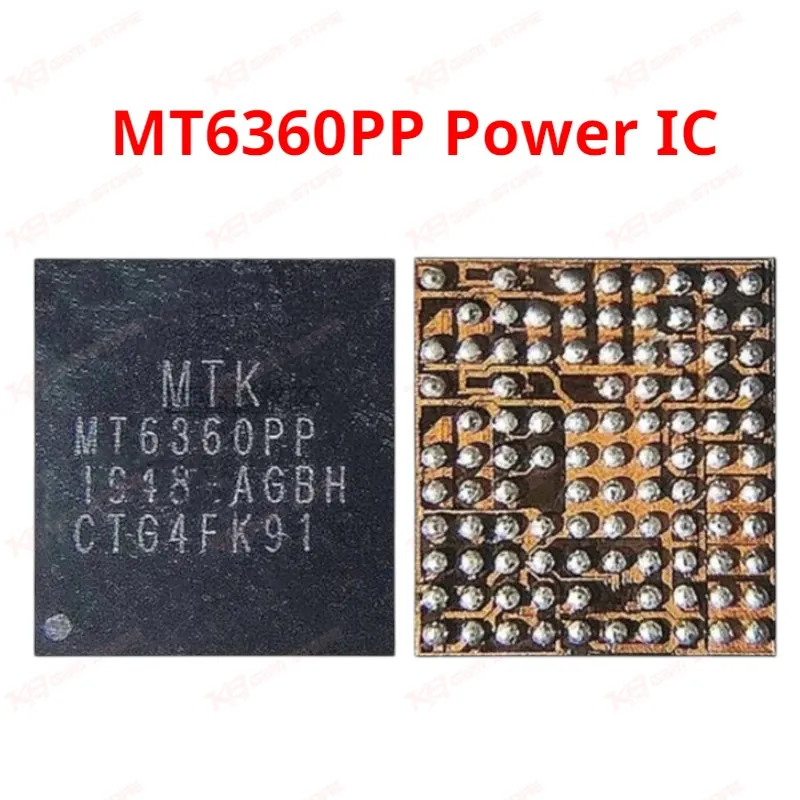
The MT6360PP is the top-marking code you see printed directly on a MediaTek MT6360P-series power management IC once it leaves the factory. On your repair bench, this is the small WL-CSP-103B chip, measuring 4.64 x 4.14 mm, that sits close to the battery connector or charging port area on MTK-platform boards. Its job is to take raw input from the USB Type-C port and turn it into clean, regulated power for the battery, the SoC rails, and several peripheral components, so when this IC fails, a phone often goes completely dead, refuses to charge, or shows a charging issue where the battery percentage never climbs despite the charger being connected. Inside the package, MediaTek has combined several functions that used to sit on separate chips. There is a single-cell Li-Ion/Li-Polymer synchronous switching battery charger with input current regulation from 0.1A up to 3.25A in 50mA steps, so the IC can safely negotiate different charger wattages instead of overloading the battery. Charge voltage regulation holds tight accuracy across the 0–70°C range, which matters on your bench when a customer's phone has been sitting in a hot pocket or under direct sun before it stopped charging. A built-in USB Type-C and Power Delivery controller handles D+/D- detection for BC1.2 chargers and manages OTG output between roughly 4.85V and 5.825V, covering both standard charging and reverse power-share scenarios on newer models. Beyond charging, the MT6360PP carries two buck converters and six LDOs that feed different parts of the board. Individual LDO rails are responsible for the fingerprint sensor supply, the touch panel supply, the SD/UFS storage module, and DRAM. This is why a failing MT6360PP does not always cause a fully dead phone — sometimes you will see a working device with a non-functional fingerprint reader, a touch panel that stops responding, or storage-related boot loop issues, because one of the individual LDO rails has dropped out while the rest of the chip still functions. There is also a 3-channel RGB LED driver with up to 24mA sink current per channel and a dual flash LED current source, both controlled through the same I2C interface as the charger and regulator blocks, so notification LED or flash-related complaints can also trace back to this IC on some models. For diagnosis, a technician working a dead phone or a charging issue on an MTK-based board should treat the MT6360PP as a candidate once the charging port, battery connector, and fuses have already been ruled out. Since it communicates over I2C with the main processor, a faulty MT6360PP can also trigger a hang on logo condition if the SoC never receives its confirmation that power rails are stable. Reballing or replacing this chip is a precision job given the WL-CSP-103B pitch, so a hot air station with tight temperature control, a matching stencil, and a microscope are standard requirements alongside the IC itself. Because MediaTek produces several MT6360 die variants under different top markings (P, PP, MP, UP, RP, among others) for different device platforms, always cross-check the exact marking on the failed board against the replacement before soldering. Two chips that look identical under a loupe can carry different internal configurations, and swapping in the wrong variant can leave a board unstable even after a clean reflow.