Skip to product information
1 of 4

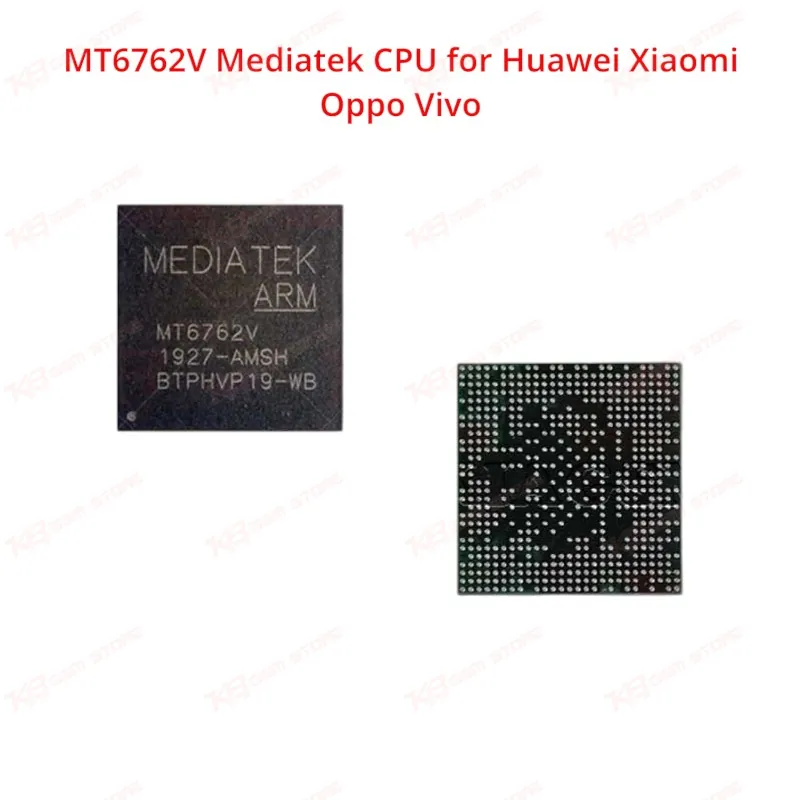
MT6762V Mediatek CPU for Huawei Xiaomi Oppo Vivo

MT6762V Mediatek CPU for Huawei Xiaomi Oppo Vivo

Regular price Rs.1.00 PKR
Regular price Sale price Rs.1.00 PKR
Sale Sold out
Shipping calculated at checkout.
Quantity

The MT6762V is a genuine MediaTek Helio P22 chipset built on 12nm process technology, commonly found in Huawei, Xiaomi, Oppo, and Vivo mid-range phones. This octa-core CPU combines four Cortex-A53 cores at 2.0GHz with four Cortex-A53 cores at 1.5GHz, paired with a PowerVR GE8320 GPU. Technicians use this IC to replace dead CPU chips after board-level faults, short circuits, or failed reflow attempts. You get a reliable replacement part for CPU jumper work, IC reballing, and dead board repair on your bench.

⚖️ Weight: 0.01 kg

SKU:MST-IC-180

  • Safe & Secure Payment
  • Fast Delivery
  • WhatsApp Support
View full details

Description

The MT6762V carries the Helio P22 architecture that MediaTek designed for budget and mid-range Android devices. On your repair bench, this chip shows up in dead phone cases where the board takes no charging, shows no display, or hangs on logo after a failed update or moisture damage. Before you order a replacement IC, check the board under a microscope for burnt tracks, lifted pads, or shorted power rails around the CPU seating area, since a dead CPU is often a symptom of a deeper hardware fault rather than the root cause.This chip runs eight Cortex-A53 cores split into two clusters: four cores clock up to 2.0GHz for handling apps and multitasking, while four cores run at 1.5GHz for background tasks and standby power saving. The PowerVR GE8320 GPU handles display output and light gaming loads, which matters when you diagnose a phone with graphics glitches or screen artifacts tied to GPU failure rather than a cracked panel. Built on 12nm FinFET process technology, the MT6762V runs cooler than older 22nm MediaTek chips, so board-level heat damage around this IC usually points to a shorted component nearby rather than the chip overheating on its own.Memory support covers LPDDR3 and LPDDR4X RAM up to 4GB, paired with eMMC 5.1 storage. When you get a board with a dead-after-flash condition or a phone stuck in boot loop after a software update, cross-check whether the RAM or eMMC IC sits at fault before condemning the CPU. Many "dead after flash" cases trace back to a corrupted EFS partition or eMMC wear rather than CPU failure, so run a full diagnostic in your flash box before pulling the chip.Connectivity on this SoC includes 4G LTE with Cat-7 download and Cat-13 upload speeds, Wi-Fi 802.11 a/b/g/n/ac, Bluetooth 5.0, and GPS with GLONASS and BeiDou support. If a customer brings in a network issue complaint alongside a dead phone, this integrated modem means both problems can trace back to the same chip, so test signal reception after your reballing job before returning the unit.Reballing this chip requires a proper stencil matched to the MT6762V ball layout, a hot air station with stable temperature control, and flux suited for lead-free solder. Rushing the reflow process or using incorrect heat profiles causes cold joints, which shows up later as an intermittent dead phone or random restart issue. Clean the board pads thoroughly with isopropyl alcohol before reballing, and verify continuity with a multimeter on the power rails before you power on the board for the first time.This IC fits into your CPU repair workflow for Huawei Y-series, Xiaomi Redmi entry models, Oppo A-series, and Vivo Y-series boards built on this chipset generation. Keep it in stock if your shop regularly handles dead board cases, CPU jumper work, or IC change jobs on budget Android devices, since sourcing a matched replacement mid-repair slows down your turnaround time.

Key Features

Genuine MediaTek Helio P22 chipset for verified board-level repair work

Octa-core Cortex-A53 configuration for accurate replacement matching

12nm FinFET build for lower heat output during reballing and testing

Integrated PowerVR GE8320 GPU for display and graphics fault isolation

LPDDR3/LPDDR4X memory controller support for RAM-related diagnostics

eMMC 5.1 storage interface compatible with common flash tools

Integrated 4G LTE modem covering Cat-7 download and Cat-13 upload

Built-in GPS, Wi-Fi, and Bluetooth 5.0 for full connectivity restoration

Specifications

Brand Entity MediaTek
Product Entity MT6762V Helio P22 CPU IC
Technology Entity 12nm FinFET, Cortex-A53 architecture
Compatible Device Entities Huawei Y-series, Xiaomi Redmi series, Oppo A-series, Vivo Y-series

Compatible Devices

Chipset family used across Huawei Y-series, Xiaomi Redmi entry-level series, Oppo A-series, and Vivo Y-series boards built on the Helio P22 platform. Confirm exact board model number against your device before ordering, since IC placement varies by PCB revision.

Common Repair Uses

CPU IC replacement on dead boards, dead-after-flash recovery, board-level jumper and reballing work, GPU-related display fault diagnosis, and network/modem fault isolation tied to CPU failure.

FAQ

What is the product name?
The product name is MT6762V Mediatek Helio P22 CPU IC.
What is the brand of this product?
The brand of this product is MediaTek.
What is the model of this product?
The model of this product is MT6762V (Helio P22).
What is this product used for?
This product is used for replacing a faulty CPU IC on dead boards, dead-after-flash boards, and boards with display or connectivity faults tied to the SoC.
Which devices are compatible with this product?
This IC matches the Helio P22 chipset family used in Huawei Y-series, Xiaomi Redmi entry-level models, Oppo A-series, and Vivo Y-series boards.
Who should use this product?
This product is suitable for mobile repair technicians, repair shops, service centers, and professional users.
Does this IC support both RAM types used in Helio P22 boards?
Yes, the MT6762V supports both LPDDR3 and LPDDR4X memory, so check your board's RAM type before reballing to confirm a matching replacement.
Can a dead-after-flash phone be fixed by replacing this CPU IC?
Not always. Dead-after-flash issues often trace back to eMMC or EFS corruption, so run a full diagnostic in your flash box before condemning the CPU IC.

Ask any Query