Skip to product information
1 of 3

MY-4006 No-Disassembly Charging IC EEPROM Programmer for iPhone 15/16 Series

MY-4006 No-Disassembly Charging IC EEPROM Programmer for iPhone 15/16 Series

Regular price Rs.6,000.00 PKR
Regular price Sale price Rs.6,000.00 PKR
Sale Sold out
Shipping calculated at checkout.
Quantity

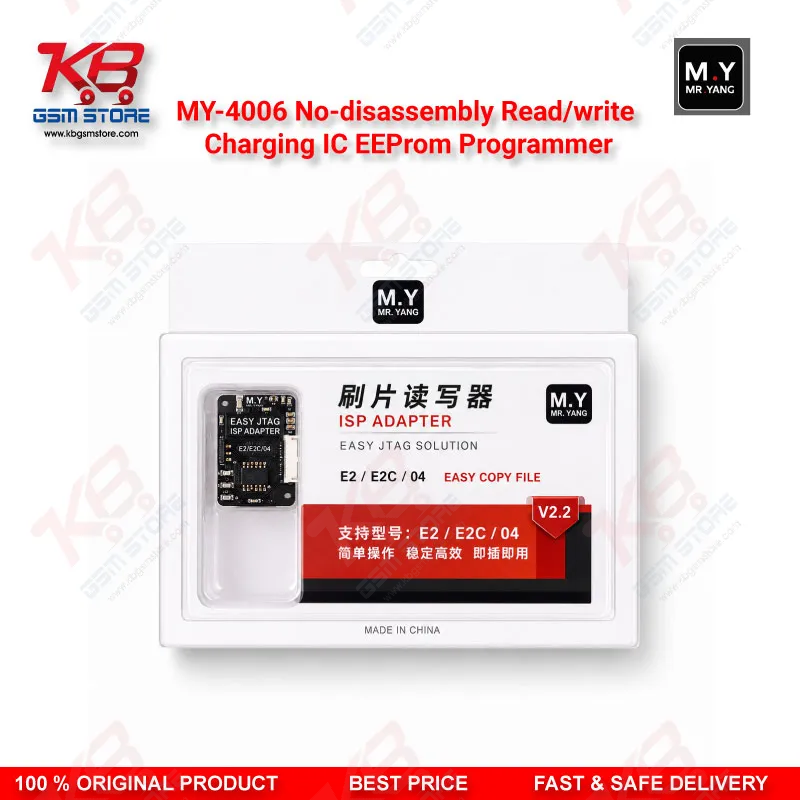
The MY-4006 No-Disassembly Charging IC EEPROM Programmer lets you read, write, and back up the charging IC EEPROM data on iPhone 15 and iPhone 16 series motherboards without removing the chip from the board. Built around a pogo-pin contact socket paired with a USB programmer, it presses directly onto the board pads to access the EEPROM instantly, cutting out the jumper wire layering process that traditional charging IC repairs demand. Technicians use it to restore lost EEPROM data after a charging IC swap, recover a board that stopped charging after a repair, or clone original chip data before replacement. It connects to a PC over USB and pairs with dedicated read/write software for fast, repeatable EEPROM operations right on the repair bench.

SKU:MST-FLASHING-DEVICE-26

⚖️ Weight: 0.05 kg

  • Safe & Secure Payment
  • Fast Delivery
  • WhatsApp Support
View full details

The charging IC on iPhone 15 and iPhone 16 series boards, commonly called the U2 chip by technicians, carries a small EEPROM alongside it that stores calibration and identity data the phone needs to charge normally. When that chip fails and gets replaced, or when a board goes dead after flash or dead after a repair attempt, the EEPROM data often needs to be read out, backed up, or rewritten to bring charging back to life. The old way to do this meant lifting the chip, running jumper wires, and layering connections onto tiny pads under a microscope, a process that eats time and risks lifting a pad on boards that already have zero margin for error. The MY-4006 removes that step entirely. It uses a pogo-pin test fixture that clamps directly onto the motherboard and makes contact with the EEPROM pads through spring-loaded pins, so the chip stays exactly where it is while the programmer talks to it over a USB connection to a PC. You get a one-press connection instead of a soldering job, which means less time on the bench per board and far less risk of damaging pads that are already fragile from prior rework. On the workflow side, the MY-4006 fits into the standard charging-fault diagnostic path: once you have identified that the fault sits at the charging IC and not upstream at the battery connector, PMIC, or Tristar-style USB controller stage, the tool reads the current EEPROM contents first so you always have a backup before touching anything. If the chip itself needs replacing because of a hardware fault, you reball or swap the charging IC using your usual soldering station, then use the MY-4006 to write the saved EEPROM data back onto the new chip so the board recognizes it as original rather than throwing a charging error or refusing to charge at all. This read-then-write sequence is the core reason boards come back dead after a charging IC replacement in the first place, since a mismatched or missing EEPROM value is a common cause of that failure, and having a dedicated tool for it turns a guessing exercise into a repeatable procedure. The software side runs on a PC and displays the EEPROM contents in a readable format, letting you save multiple backups per device so you are never working from a single point of failure if a write attempt does not take the first time. Because the fixture presses onto the board rather than bonding to it, you can also use the MY-4006 purely for verification, pulling a quick read to confirm whether a board's EEPROM data is intact before deciding whether the fault is even chip-related, which saves you from replacing a charging IC that never needed to move. For a repair shop running through a steady queue of iPhone 15 and 16 series boards, this shifts charging IC work from a high-risk, high-skill soldering task into a process a trained technician can run consistently, which matters when volume and turnaround time affect the bottom line as much as repair quality does. It also reduces the failure points that come from manual jumper work: no lifted pads, no cold joints on ultra-fine pitch connections, and no rework of rework when a jumper fails after a few weeks in the field. Pair this with a hot air station for the actual chip removal and placement, a fine-tip soldering iron for any surrounding component work, and a PCB holder to keep the board steady during the pogo-pin connection, and you have a complete charging IC repair workflow that covers diagnosis, chip replacement, and EEPROM recovery in one bench setup. Technicians handling iPhone 15 Pro Max or 16 Pro Max boards, where charging faults tend to cluster around this exact chip pairing, will find this the difference between a same-day fix and a board that sits waiting for a safer method. Data retention across write cycles matters here too, since a board that comes back a second time for the same fault usually means the EEPROM write did not fully take or the wrong dataset was written, so keeping clean, verified backups before every write is worth building into your standard process rather than treating it as optional.

Key Features

  • Reads, writes, and backs up charging IC EEPROM data without removing the chip from the board
  • Pogo-pin fixture presses onto motherboard pads for instant contact, replacing jumper wire layering
  • Connects to a PC over USB with dedicated read/write software
  • Built for iPhone 15 and iPhone 16 series charging IC (U2) EEPROM chips
  • Lets you save multiple EEPROM backups per board before any write operation
  • Cuts charging IC repair time by removing microscope-based jumper soldering from the process
  • Reduces pad damage risk on ultra-fine pitch charging IC connections
  • Doubles as a verification tool to confirm EEPROM integrity before deciding on a chip replacement

Specifications

Brand Entity MY-4006 (No-Disassembly Series)
Product Entity No-Disassembly Charging IC EEPROM Programmer
Technology Entity Pogo-pin in-circuit EEPROM read/write
Compatible Device Entities iPhone 15 series, iPhone 16 series
Repair Process Entity Charging IC (U2) EEPROM backup and restoration
Industry Entity Mobile phone board-level repair

Compatible Devices


iPhone 15, iPhone 15 Plus, iPhone 15 Pro, iPhone 15 Pro Max, iPhone 16, iPhone 16 Plus, iPhone 16 Pro, iPhone 16 Pro Max — charging IC (U2) EEPROM chip family used on these boards

Common Repair Uses


Backing up charging IC EEPROM data before board-level repair, restoring EEPROM data after a charging IC replacement, fixing charging failure or dead-after-repair faults caused by lost or mismatched EEPROM data, and verifying EEPROM integrity during charging fault diagnosis without desoldering the chip

FAQ

What is the product name?
The product name is MY-4006 No-Disassembly Charging IC EEPROM Programmer.
What is this product used for?
This product is used for reading, writing, and backing up charging IC EEPROM data on iPhone motherboards without removing the chip.
Which devices are compatible with this product?
This product is compatible with the charging IC (U2) EEPROM chip on iPhone 15 series and iPhone 16 series boards.
Who should use this product?
This product is suitable for mobile repair technicians, repair shops, service centers, and professional users.
Does this tool require desoldering the charging IC before reading or writing EEPROM data?
No, it connects through a pogo-pin fixture that presses onto the board pads, so the chip stays in place with no desoldering or removal needed.
Can this programmer restore EEPROM data after a charging IC replacement on iPhone 15 or 16 boards?
Yes, that is its core use — it lets you back up the original EEPROM data and write it onto a replacement chip to prevent dead-after-repair charging faults.