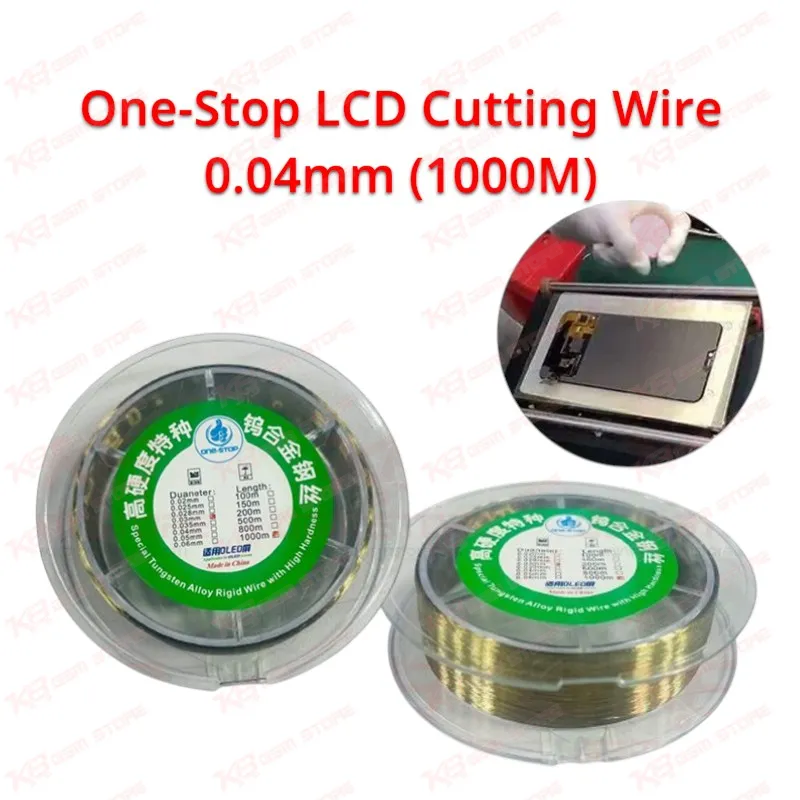
When you're pulling broken outer glass off a phone that still has a good LCD underneath, the thickness of your cutting wire decides whether that panel survives the job or ends up in the scrap pile. This 0.04mm tungsten alloy steel wire is built for exactly that kind of precision separation. The ultra-thin gauge cuts through the OCA adhesive layer between the glass and the LCD/digitizer stack without dragging or catching, which keeps your success rate high on screens where the customer only wants the glass changed and not a full panel swap. You get a wire that holds its shape under tension instead of kinking after a few pulls, which matters when you're separating multiple units back to back during a busy repair day. Tungsten alloy construction gives the wire high hardness and wear resistance, so it keeps a sharp cutting edge through repeated use instead of dulling and tearing the adhesive layer unevenly. Where a thicker generic wire tends to leave visible drag marks or press through weak spots on the LCD, this 0.04mm profile stays fine enough to follow the adhesive line cleanly on curved edge screens and flat panels alike. On your repair bench this wire fits into the same workflow as your hot plate or separator machine: you heat the glass to soften the OCA glue, then draw the wire through the softened layer to lift the glass away in one clean motion. It's a tool you'll reach for on cracked glass jobs, LCD refurbishing before resale, digitizer replacement where the LCD is being reused, and general screen rework where cutting through adhesive without electrical or mechanical damage is the goal. Because it's a mechanical cutting tool and not a chipset-bound accessory, compatibility isn't tied to brand or model — it works across smartphone and tablet screens with glued glass-LCD construction, which covers the bulk of devices coming through a general repair shop, including Samsung, Oppo, Vivo, Infinix, Tecno, and iPhone units with fused display assemblies. At 1000 meters per spool, you're not restocking every week the way you would with a 100m roll, which keeps this item practical for shops doing glass repairs daily rather than occasionally. The wire ships wound on a storage reel, so it stays organized and doesn't tangle in your toolbox next to your other separator accessories. For a technician dealing with a dead phone glass crack or an LCD that's hang on logo but the glass itself is shattered, this wire lets you isolate the actual fault before deciding whether it's a hardware fault needing a full screen or just a charging issue or display problem on an otherwise fine board. It's a low-cost, high-repeat-use consumable that belongs next to your hot air station and separator machine on any bench doing regular screen work, and it pairs naturally with your existing reballing kit and PCB holder setup for full display and board-level repair coverage.