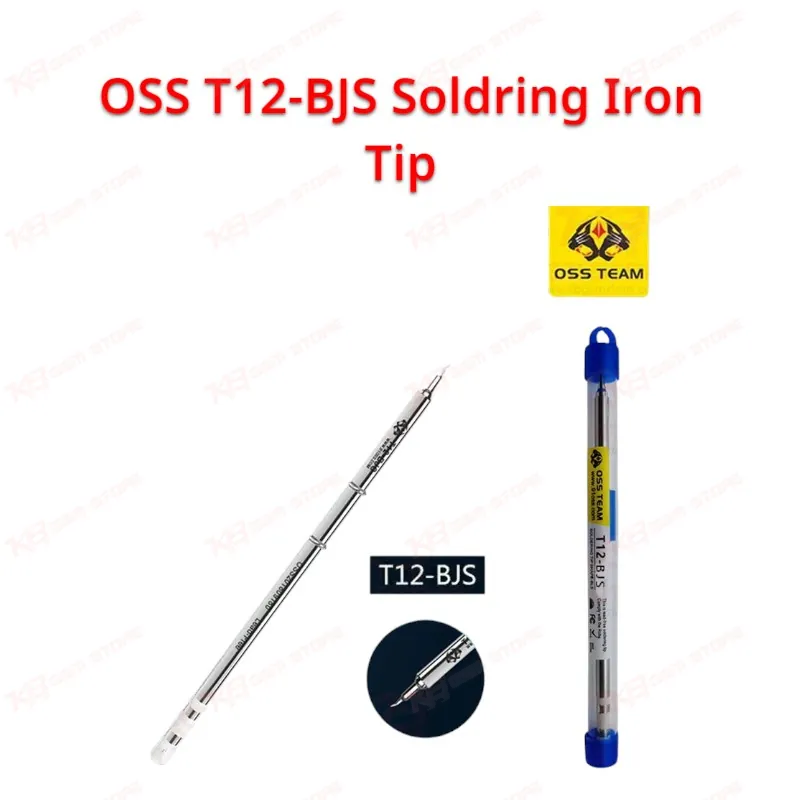
When you're running a T12 soldering station all day on a repair bench, the tip is the one part that decides whether your joints come out clean or whether you're fighting cold solder and oxidized copper by lunchtime. The OSS T12-BJS is built specifically to solve that problem for technicians who solder IC legs, connector pins, and board-level components repeatedly through the day. OSS Team manufactures this tip from imported copper oxide raw material and runs it through a dedicated molding process rather than a generic stamping method, which gives the tip a denser, more heat-stable core. That density matters on a repair bench because it means faster thermal recovery between joints — you touch down on a pad, the tip transfers heat quickly, and you're moving to the next joint without waiting for the temperature to climb back up. The surface receives a specialized coating treatment on top of that copper core, and this is what keeps the working tip from turning black under sustained high heat, a problem that shortens the life of cheaper unbranded tips within days of heavy use. OSS rates the T12-BJS for 40,000 to 50,000 soldering joints under normal working conditions, with some tip sizes in the same series reaching up to 70,000 joints before performance drops off, so you're not restocking tips every week on a busy bench. Tin pickup and melting behavior stay uniform across the tip face, which reduces the chance of empty or incomplete solder joints — a real issue when you're reflowing small SMD components or reworking a charging IC where a missed joint means a dead phone comes back to you a second time. The anti-oxidation coating also helps the tip hold moisture and tin better between uses, so you're not constantly re-tinning before every joint just to keep the surface wetting properly. Physically, the T12-BJS measures approximately 15cm and drops straight into any handle built around the T12 cartridge-style heating element, which covers the majority of digital soldering stations technicians run in Pakistan's repair market — whether that's a dedicated T12 station or a T12-compatible handle fitted to another base unit. Because the heating element sits inside the tip itself rather than requiring a separate heater cartridge, swapping the T12-BJS in and out takes seconds, which matters when you're mid-repair and need to switch between a fine point for IC-level work and a different profile for general board soldering. This BJS profile in particular suits precision work: small pad soldering, jumper wire attachment after an IC change, connector pin repair, and touch-up work on boards where you can't afford excess heat spreading to nearby components. Technicians doing daily hardware fault diagnosis — reattaching a charging port, running a jumper after a short circuit repair, or resoldering a dislodged component after a hardware fault — get more consistent results from a tip that doesn't oxidize mid-session. The lead-free construction also keeps the tip aligned with modern soldering practice, so you're not introducing lead contamination into your workflow or your consumables. For a repair shop running multiple technicians and multiple stations, keeping a stock of T12-BJS tips on hand means less downtime waiting on a single tip to be shared across the bench, and more predictable soldering quality across every repair that leaves the shop. Whether you're doing PCB-level rework, IC reballing prep, or straightforward board cleaning and resoldering, this tip is built to hold its edge and its heat consistency through extended daily use rather than degrading after a short burn-in period.