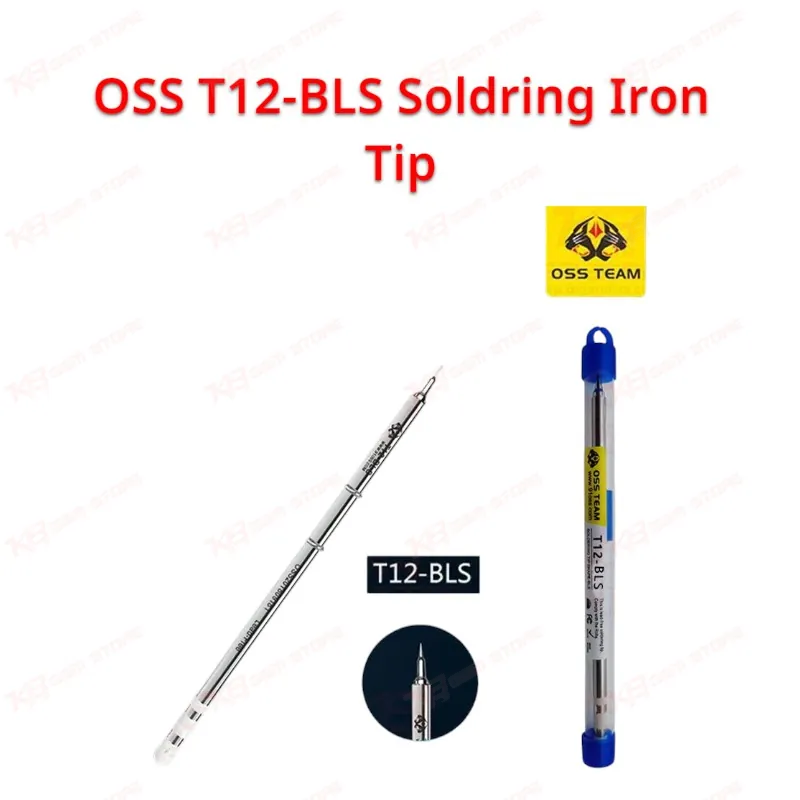
When you spend your day doing IC change karna on tightly packed mobile boards, the shape and durability of your soldering tip decide how clean your joints turn out. The OSS T12-BLS is a B-shape conical replacement tip built specifically for T12-style digital soldering stations, and it targets the kind of point soldering work that dominates GSM repair benches — fine-pitch component legs, small jumpers, connector pins, and board-level micro soldering where a bulkier tip simply cannot reach. The tip body uses a copper core processed through a dedicated molding technique, which keeps heat transfer consistent from the moment you power up your station to the last joint of a long repair session. A special coating on the tip end stops it from turning black under continuous high temperature, a problem that shortens the life of cheaper uncoated tips within weeks of daily use on a busy repair bench. You get uniform, fluent solder flow with the T12-BLS, and the anti-oxidation surface treatment means the tin sits evenly on the tip instead of beading or resisting contact, which cuts down on empty soldering and rework on the same joint. Technicians running high-volume repair shops rate T12 tips by working life, and the T12-BLS holds up for roughly 40,000 to 50,000 solder joints under normal use, with some production batches extending to 70,000 joints before the tip needs replacing — a meaningful stretch when you are running a station through multiple boards a day. At approximately 15cm in length, the tip slots directly into standard T12 handle assemblies, so it works with Hakko T12, Quicko T12, and OSS Team T12-X/T12-D stations, along with ST91 and ST92 handles, without any adapter or handle swap. This makes it a practical drop-in upgrade if you already run a T12-based station and just need a tip that holds shape under repeated point soldering rather than a full handle or station replacement. The B-shape conical geometry sits in contrast to K-shape tips like the T12-SKUS or T12-KU, which are built for drag soldering across wider pads; the T12-BLS instead gives you a narrow, controlled contact point that suits precision work like reattaching a lifted pad, running a jumper wire between two test points, or soldering a small IC back onto a board after a dead-after-flash repair. For diagnostics and board-level rework, that kind of control matters more than raw tip size, since a wrong touch on a densely populated PCB can damage neighboring components. The copper-based construction also means the tip tins easily at the start of each session, so you are not fighting oxidation buildup before you can even start work on a hardware fault. Repair shops handling charging port work, display connector repair, or general PCB cleaning after liquid damage tend to keep a few of these on hand since the point-soldering geometry covers a wide range of daily bench tasks without needing a separate tip for each job. Because it is a direct T12-style fitment, swapping it onto your existing handle takes seconds, and you lose no time recalibrating your station's temperature profile the way you might with a mismatched third-party tip. For a repair business running multiple stations across a workshop or service center, standardizing on a known, verified tip shape like the T12-BLS also keeps training simple for junior technicians, since the same tip behaves the same way across every station it goes into.