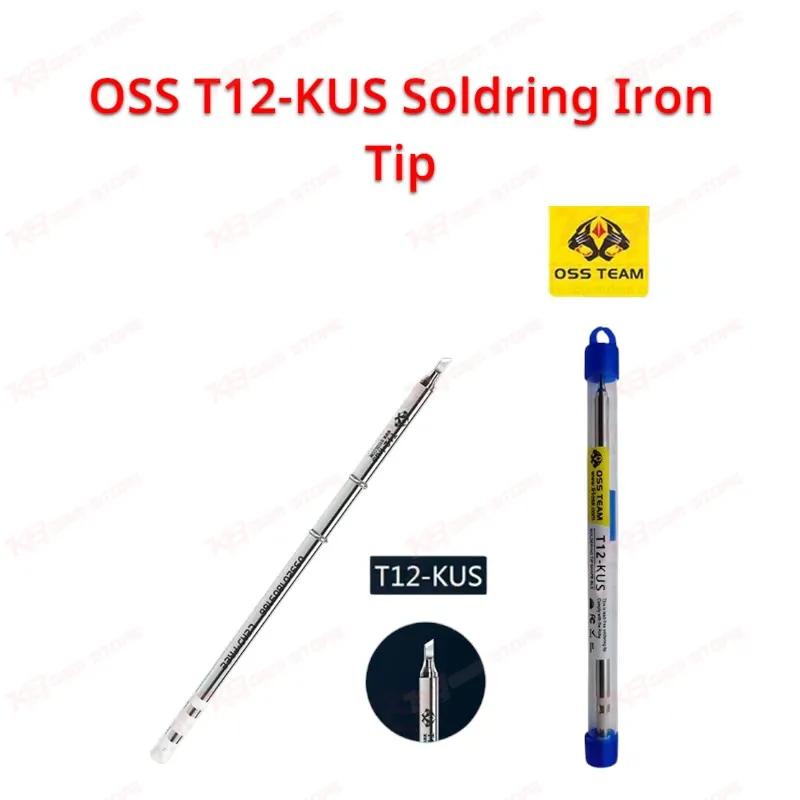
When you're running a busy repair bench, tip quality decides how fast and how clean your soldering work actually turns out, and the OSS T12-KUS addresses that directly by giving you a bit built specifically for the T12 handle ecosystem that dominates GSM and PCB repair stations today. You insert it straight into your existing T12 handle, no adapters or modifications needed, and it heats up quickly because the core is made from imported oxide-free copper rather than lower-grade alloys that lag on thermal response. That fast heat-up matters when you're moving between multiple boards in a shift, since you don't want to wait on your iron every time you switch tasks. The tip surface goes through a special coating process at the working end, which keeps it from turning black even after hours of continuous use at soldering temperature, a problem that cheaper unbranded tips run into within days. Multilayer electroplating on the shaft protects against oxidation and corrosion, so the tip stays functional through repeated tinning cycles instead of degrading after light use. In practical terms, this means smoother tin-on performance, more even melting, and none of the empty-solder joints that come from a tip losing its wetting ability. For technicians handling IC change work, jumper wire soldering, connector re-flow, or general board cleaning, that consistency directly affects how many boards you can get through without stopping to re-tin or file the tip. The KUS profile gives you a shape suited to general-purpose soldering and desoldering across small and mid-sized components, so you're not limited to one narrow use case on the bench. Length runs at approximately 15cm, matching the standard T12 bit spec, and each unit ships as a single piece so you can stock spares by size without overbuying. Manufacturer testing puts working life at 40,000 to 50,000 soldering joints, with some tip variants in the T12 series rated up to 70,000, giving you a genuine cost-per-joint advantage over generic replacement tips that need swapping every few weeks. Moisture resistance on the coating also means the tip holds its wetting properties in Pakistan's humid coastal cities as well as it does in drier inland workshops, so performance doesn't shift with your location. This bit fits into the broader T12 workflow alongside your existing soldering station, hot air rework tools, and PCB holders, letting you standardize your tip inventory around one handle system instead of juggling multiple incompatible bit types across different brands. Whether you're doing routine board cleaning, correcting thin bridges, reworking connector pads, or handling fine IC leg soldering on a dead phone brought in for hardware fault diagnosis, the T12-KUS gives you the tip-end reliability that keeps rework quality consistent from the first joint to the fifty-thousandth. For repair shops running multiple technicians on shared stations, that consistency reduces the rework and touch-up soldering that comes from an underperforming tip, which translates into fewer callbacks and faster turnaround per board.