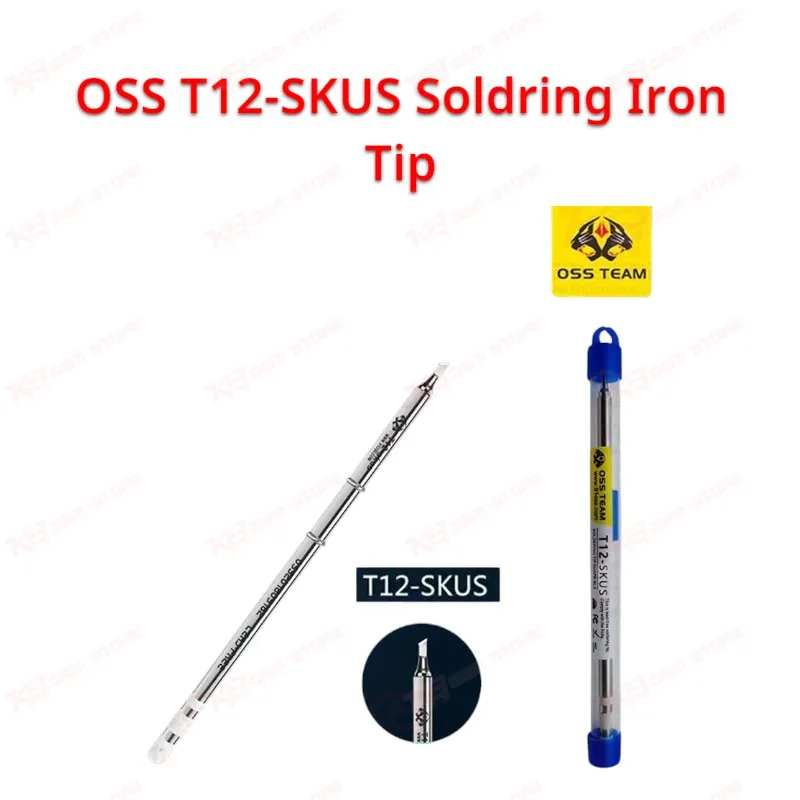
Every repair bench eventually comes down to the tip doing the actual work, and the OSS Team T12-SKUS earns its place there by combining a fine, precise point with the thermal consistency technicians expect from the T12 platform. Built from imported oxide-grade copper and shaped on a dedicated forming machine, the tip carries heat from the core to the working surface fast enough to keep pace with production-line repair volume, whether you're reflowing a charging IC, tacking down a jumper wire after a board trace lifts, or touching up a cold joint on a power management chip. The surface receives a dedicated coating treatment after shaping, and that coating is what keeps the tip from turning black the way uncoated copper does after repeated exposure to flux and high heat — a detail that matters when you're running the same tip across dozens of boards in a single shift without swapping it out. You get clean, uniform tin flow instead of the dragging, uneven melt that comes from an oxidized or pitted tip, and that translates directly into fewer cold joints, less rework, and faster turnaround on boards that already have a customer waiting on them. The T12-SKUS slots into the wider T12 tip family, so it works with Hakko T12, Quicko T12, and OSS Team's own T12-X and T12-D handles, along with ST91 and ST92 soldering stations — if your bench already runs a T12-compatible handle, this tip installs without any adapter or modification. Durability is where this tip separates itself from cheaper alternatives: rated for roughly 40,000 to 50,000 solder joints under normal shop use, with some tip sizes in the series pushing past 70,000 joints before wear becomes noticeable. For a shop doing volume repair work — dead phone diagnostics, board-level rework, IC reflow, and connector replacement — that lifespan means fewer tip changes per month and less downtime spent hunting for a spare when a job is already on the bench. The lead-free, eco-friendly composition also means you're not introducing extra handling concerns into a workspace that already deals with flux fumes and solder residue daily. Anti-oxidation performance holds up well across repeated heating and cooling cycles, which is exactly the stress pattern a busy repair bench puts on a tip — power on, solder a few joints, let it idle, power back up for the next board. A fine point like this earns its keep on tasks where a standard chisel tip is overkill: reattaching a lifted pad, soldering a bridge wire between test points, tacking a replacement IC into place after a hardware fault diagnosis, or cleaning up a network or charging issue traced back to a cracked joint near the connector. It's not a tip built for bulk desoldering or high-mass ground plane work — for that, a wider chisel or bevel tip on the same handle does the job better — but for the fine, deliberate work that makes up most day-to-day mobile board repair, the SKUS profile gives you the control you need without fighting the tool. Silver-white in finish and roughly 15cm in length, it matches the standard T12 tip footprint, so there's no adjustment to your existing handle grip or working angle when you switch it in. For a shop running multiple T12 handles across different technicians, stocking a few of these as standard rotation tips keeps everyone working with consistent heat transfer instead of compensating for a worn or oxidized point.