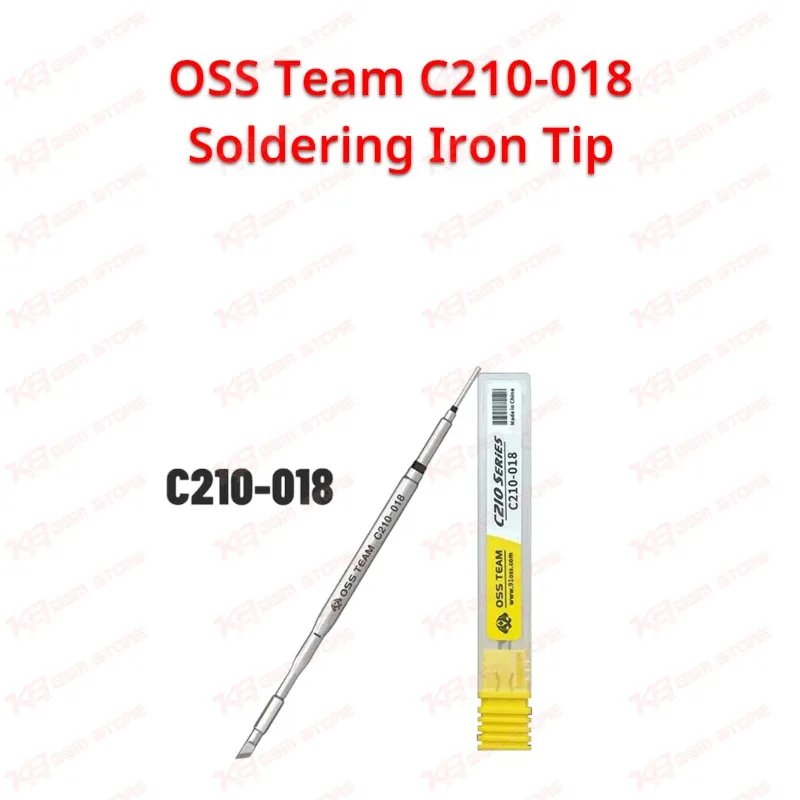
When a board comes in with a ground plane that will not take tin evenly, or a row of connector pads that need a flat, controlled pass of solder, a conical tip only gets in the way — this is exactly the gap the OSS Team C210-018 knife tip fills. Built for the C210/T210/T26 handle family, this tip trades the pointed profile of standard cartridges for a flat, blade-like working face designed for horizontal and angled soldering rather than fine-point work. On a Pakistani repair bench where technicians move between charging port jobs, ground shielding, and connector rework in the same session, that flat edge means less time chasing solder flow and more consistent coverage across wider pads. The stainless steel housing sits at the core of the build, chosen because it reduces heat loss between the internal heating element and the working tip, so the iron reaches soldering temperature quickly after you power on the station and holds that temperature steadily as you work through a stack of boards. Underneath the housing, a multilayer electroplating process — including a soldering layer to stop tin from climbing up the shaft, a nickel coating for rust and corrosion resistance, and an iron plating layer for overall build quality — protects the tip from the oxidation that normally shortens the life of cheaper cartridges. The result is a tip that keeps its tin-loading properties even after repeated heating and cooling cycles, instead of blackening and losing efficiency within a few weeks of daily use. Pre-tinning at the factory means the working face is ready to accept solder from the first use, which cuts down the seasoning time technicians usually spend prepping a new tip before it behaves properly, and it lowers the chance of cold solder joints forming during that break-in period. In practical repair scenarios, the C210-018 knife shape is suited to SOJ, PLCC, SOP, and QFP package soldering, ground point connections, correcting tin bridges that form when reworking closely spaced pins, and general connector soldering where a broad, flat contact area speeds up the job compared to a narrow point. Technicians handling dead board diagnostics, IC change karna on components with wide ground pads, or jumper lagana across shorted tracks will find the flat edge easier to control than a fine tip, since it spreads heat across a larger contact surface without needing to drag the iron back and forth as much. The tip installs directly into T210 and T26 handles without requiring any adapter or modification, so it slots into an existing C210-series soldering station as either a replacement for a worn cartridge or an additional tip shape alongside the pointed and curved variants already in a technician's kit. Because the C210 series shares a common handle interface across several soldering station brands, this tip is also a practical option for workshops running compatible GSM and Sugon T26-based stations rather than being locked to a single station brand. For a shop doing repeated board-level repair — ground shielding rework, connector resoldering, tin bridge cleanup on flash and charging ICs — having a dedicated knife tip on hand alongside a standard pointed tip reduces the number of times a technician has to compromise on tip shape for a job that really calls for a flat edge, which in turn cuts rework time and improves the consistency of the solder joints going back onto the board.