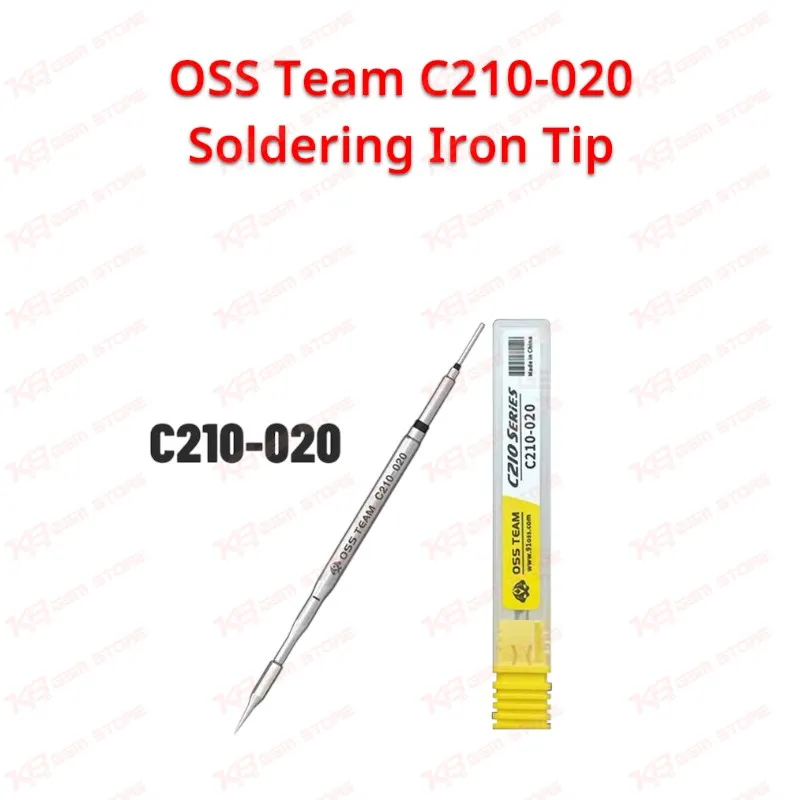
When you're working on a dead phone board under magnification, the tip you're using decides whether you get clean joints or a mess of bridged pads, and the OSS Team C210-020 exists for exactly that kind of close work. Built on the C210 cartridge platform, this tip integrates with the same heating element style used across the T210 and T26 lineup, so you pull the old cartridge, seat this one, and get back to the bench without hunting for a compatible handle. The body runs about 80mm in length with stainless steel construction from base to point, and that steel housing does more than protect the tip physically — it reduces heat bleed along the shaft so your set temperature actually reaches the working surface instead of dissipating before it gets there. Multilayer electroplating on the tip surface fights oxidation, which matters a lot in humid Karachi or Lahore workshop conditions where tips corrode faster if left idle between jobs. You'll notice the fine geometry immediately: at around 6mm on the working section and a tip diameter near 0.1mm, this isn't a general-purpose tip for cable splicing or thick joint work — it's built for IC change karna on tightly packed boards, reworking charging ICs, PMICs, and small RF components where a fatter tip would bridge adjacent pads. That fine profile is also what makes it the go-to choice for correcting tin bridges after a chip reflow, since you can drag excess solder off individual legs without disturbing neighboring pins. The stainless steel core keeps thermal recovery quick between touches, so when you're moving fast across a dozen pads on a fine-pitch chip, the tip doesn't lag behind your pace and cool down mid-joint. Lead-free soldering compatibility is built into the design, which is standard now across most repair shops given the availability and pricing of lead-free solder wire in the local market. At roughly 15g, the tip adds almost no weight to your iron handle, so hand fatigue stays low during long repair sessions — something technicians doing volume board work will notice over an eight-hour shift far more than someone doing occasional repairs. Installation is straightforward: power down the station, let the handle cool, remove the existing cartridge, and insert the C210-020 fully into the heating element housing until it seats. There's no soldering or crimping involved since the cartridge design carries both the heating element and tip in one unit, which also means tip replacement doesn't require any recalibration on stations that auto-detect cartridge type. For a repair shop running multiple technicians on shared stations, having a stock of C210-020 tips on hand means less downtime waiting for a tip to arrive when one wears out or gets damaged from dry soldering. This tip earns its place in a mobile repair workflow anywhere fine, controlled heat transfer decides the outcome — board-level component swaps, jumper lagana on damaged traces, dead-after-flash board rework, and general PCB repair where precision beats raw power. Pair it with a T210 or T26 station running lead-free solder and flux paste, and you get consistent joint quality across repeated repairs without the tip degrading faster than expected under normal shop use.