


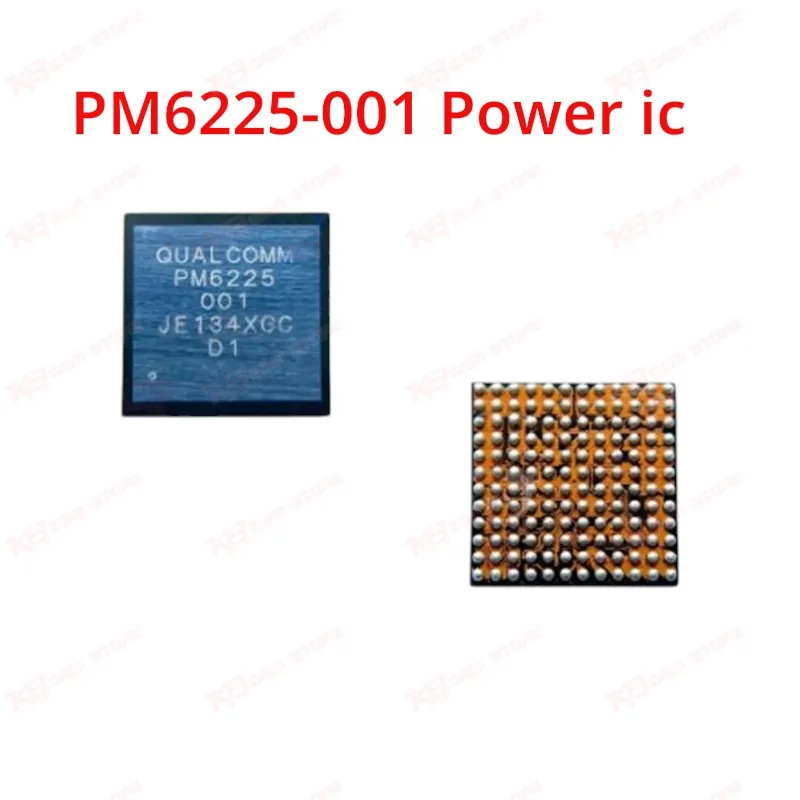
PM6225-001 Power ic
PM6225-001 Power ic
Regular price
Rs.300.00 PKR
Regular price
Sale price
Rs.300.00 PKR
Shipping calculated at checkout.
Quantity
Couldn't load pickup availability
The PM6225-001 is a power management IC (PMIC) used across a wide range of Redmi, Oppo, Vivo, Samsung, Motorola, and Huawei models. It regulates voltage distribution across the board, keeping charging, battery communication, and boot sequences stable. When a phone won't power on, gets stuck on logo, or won't charge properly, this IC is one of the first checkpoints on the power rail. Built in a BGA package for direct board-level replacement, it's a standard bench item for technicians handling dead-phone and no-power cases on this chipset family.
⚖️ Weight: 0.01 kg
SKU:MST-IC-196
- Safe & Secure Payment
- Fast Delivery
- WhatsApp Support


Description
FAQ
What is the product name?
The product name is PM6225-001 Power IC.
What is the brand of this product?
This is an aftermarket-compatible power IC, sold under the PM6225-001 model designation.
What is the model of this product?
The model is PM6225-001.
What is this product used for?
It's used for board-level power management repair, mainly to fix dead-phone, no-power, and charging faults.
Which devices are compatible with this product?
It supports Redmi Note 11, Redmi Note 12, Redmi 10C, Oppo A36, A76, Reno 7 4G, Reno 8 4G, Vivo Y32, Y35, Y36, Y27S, Samsung A23, A05, Motorola XT2233, Moto G32, Moto G Play 2024, and Huawei Nova 9SE.
Who should use this product?
This product is suitable for mobile repair technicians, repair shops, service centers, and professional users.
Does this PMIC require reballing before installation?
Yes, the PM6225-001 uses a BGA package, so it needs a matching stencil and a BGA rework station for proper reballing before board installation.
Can a faulty PM6225-001 cause a phone to hang on logo without any power fault symptoms?
Yes, some boards with a failing PM6225-001 show hang-on-logo behavior with normal current draw, which is why technicians check this IC before assuming a CPU or software fault.