


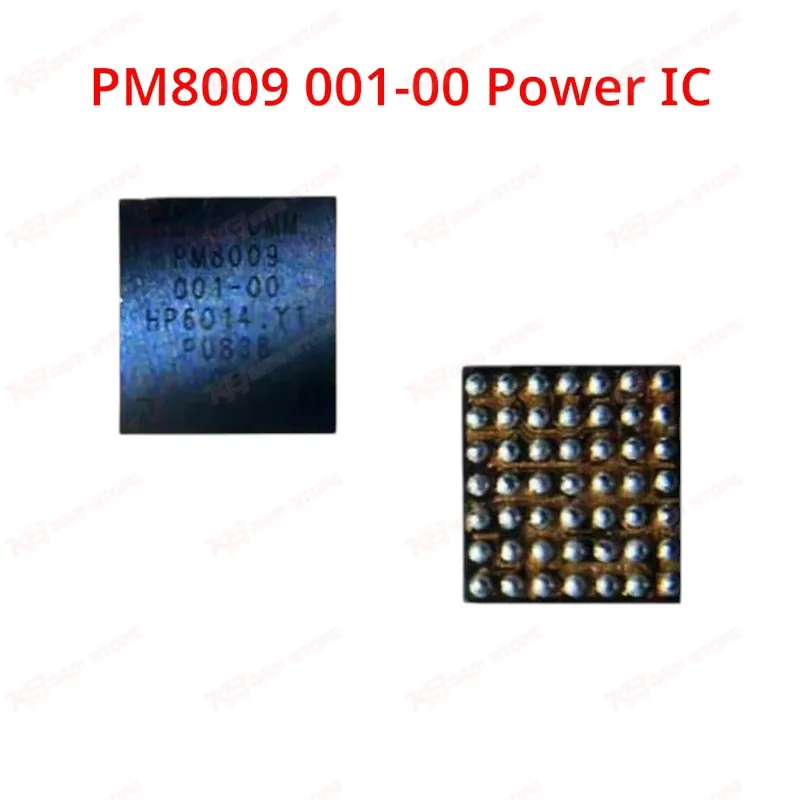
PM8009 001-00 Power IC
PM8009 001-00 Power IC
Regular price
Rs.300.00 PKR
Regular price
Sale price
Rs.300.00 PKR
Shipping calculated at checkout.
Quantity
Couldn't load pickup availability
The PM8009 001-00 is a Qualcomm companion power management IC built on the SPMI PMIC architecture. It works alongside the board's main PMIC to regulate specific voltage rails rather than running the whole power tree on its own. Technicians pull this chip out when a Snapdragon-based board shows a dead phone symptom, stays completely silent after a liquid or short-circuit fault, or powers up partially with certain sections staying dead. If your bench diagnostics point to a rail-specific power fault instead of a main PMIC failure, the PM8009 001-00 is the IC to check and replace.
⚖️ Weight: 0.01 kg
SKU:MST-IC-201
- Safe & Secure Payment
- Fast Delivery
- WhatsApp Support


Description
FAQ
What is the product name?
The product name is the PM8009 001-00 Power Management IC.
What is the brand of this product?
The brand of this product is Qualcomm.
What is the model of this product?
The model of this product is PM8009 001-00.
What is this product used for?
This product regulates specific voltage rails as a companion PMIC on Snapdragon-based smartphone boards.
Which devices are compatible with this product?
This product is compatible with Qualcomm Snapdragon boards using SPMI PMIC architecture, with the PM8009-1 revision specifically built for SM8250-platform boards.
Who should use this product?
This product is suitable for mobile repair technicians, repair shops, service centers, and professional users working on Snapdragon board-level power faults.
Does the PM8009 001-00 replace the main PMIC on a Snapdragon board?
No, it functions as a companion PMIC that handles a defined set of voltage rails, while a separate main PMIC manages the rest of the power tree.
Can replacing the PM8009 001-00 fix a dead phone with no power symptom?
It can resolve a dead phone fault when bench diagnostics trace the failure to the specific voltage rails this companion PMIC controls, rather than a main PMIC or battery circuit fault.