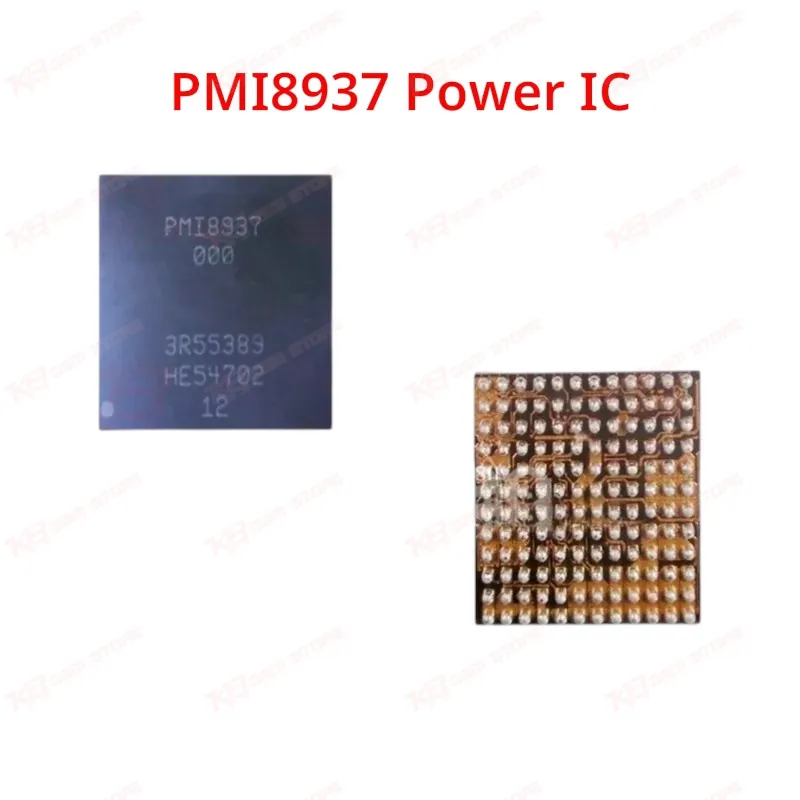
Product Title: PMI8937 Power Management IC – Qualcomm Power IC Chip for MSM8937 BoardsShort Description: The PMI8937 is a Qualcomm power management IC built for boards running the MSM8917, MSM8937, MSM8940, and APQ8937 chipset platform, covering Snapdragon 425, 430, and 435 devices. This chip regulates power rails, controls charging behavior, and feeds voltage to the processor, display, and RF sections. Technicians reach for this IC when a phone shows dead symptoms, no charging response, or a board that draws no current after a short. You get a genuine replacement part suited for reballing or direct chip swap on affected motherboards, letting you restore power delivery without replacing the entire board. Stock this part if you handle mid-range Xiaomi, Samsung, or other MSM8937-platform repairs regularly.Long Description: When a phone built on the MSM8937 or MSM8917 platform goes completely dead, the fault usually traces back to the power IC before it points anywhere else. The PMI8937 sits between the battery and the rest of the board, and it decides whether every other component gets the voltage it needs to wake up. If this chip fails, shorts internally, or loses a bond after liquid damage, the board stays silent no matter what charger or battery you connect.This IC manages multiple power rails at once. It handles charging logic from the USB input, regulates output voltage to the application processor, and supplies the smaller rails that feed the display driver and RF front end. On a working board, this coordination happens instantly and invisibly. On a faulty board, you see the classic pattern: zero current draw on the power supply, a phone that won't charge, or a device stuck at a fixed low current pull that never climbs. Any of these signs point straight at the PMI8937 as your first suspect, especially if diode mode readings on the main power rails come back shorted or completely open.Board-level technicians reach for this chip in a few recurring situations. A liquid-damaged board that shows corrosion near the PMI8937 footprint often needs a straight swap once you've confirmed the short sits on that IC rather than a nearby capacitor. A board that powers on briefly then dies, or one that never registers current draw at all, also points here after you've ruled out the battery connector and charging port. Because this chip carries the charging control logic, boards with a charging issue that survives a new charging IC swap sometimes still fail until you address the PMI8937 as well.Replacing this chip is reballing work, not a plug-and-play swap. You remove the faulty IC with hot air at a controlled temperature, clean the pads, reball the new chip on a suitable stencil, and reflow it back onto the board under a microscope. Preheating the board evenly matters here — uneven heat around a BGA this size risks lifting nearby components or warping the substrate. Technicians running an IC reballing station or a hot air rework setup already have the tools this job calls for; what changes is the pad count and footprint alignment specific to the PMI8937.Board diagnosis before ordering this part still matters. Confirm the short or open reading sits directly under the PMI8937 footprint using a thermal camera or current-limited power supply before you commit to a reball. Swapping this chip on a board where the actual fault lies in a nearby decoupling capacitor wastes both the part and your bench time. Once you've isolated the fault to this IC specifically, this replacement gets your board back to drawing normal current and powering up the way it should.Stock this part alongside your ISP pinout tools and eMMC programmers if you handle MSM8937-platform boards often, since power faults on this chipset generation show up regularly across Xiaomi Redmi and Samsung mid-range models built on it.