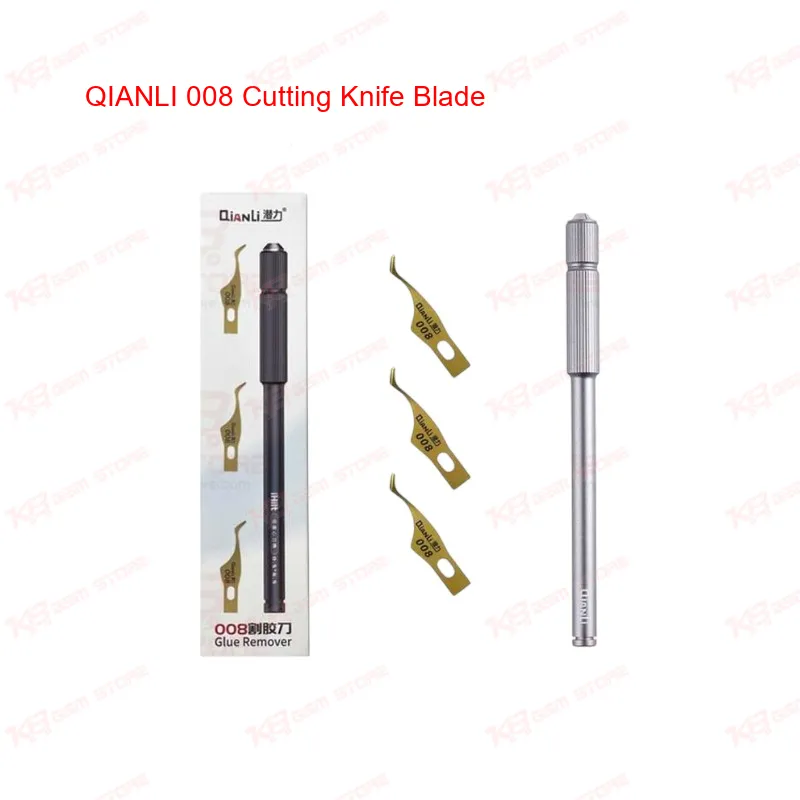
Removing underfill and black glue cleanly is one of the trickiest parts of board-level repair. Push too hard and you lift a pad or scratch the solder mask; use a dull blade and you end up smearing glue instead of lifting it. The QianLi 008 is built specifically to solve this problem on a repair bench where precision matters more than speed. At the core of the tool is a cryogenically treated, high-carbon steel blade. The cold treatment process realigns the steel's internal structure, making the edge harder and more resistant to dulling than a standard stamped blade. That matters on this job because underfill glue is abrasive on tool edges, and a blade that dulls quickly turns a clean scrape into a rough one. The crescent-shaped, ultra-thin profile is hand-ground for a fine, even edge, letting you slide it flat under a CPU or BGA chip without digging into the board surface. The handle is a double-head design in gold and grey, made from stainless steel and aluminium alloy, measuring roughly 13.3 cm in length with an 8.5 mm diameter. Both ends accept a blade, so you can load two working edges at once and switch without stopping to swap parts mid-repair. The grip uses a screw-texture surface pattern rather than a smooth or rubberized coating — this gives your hand friction under pressure, which matters when you are applying steady scraping force for several minutes at a time on stubborn glue. The set comes with three replacement blades, so a dulled or chipped edge does not put the tool out of action. Blades are held with a copper fixing mechanism designed for quick removal and reinstallation, and the flexible thin profile lets the blade bend slightly to follow board contours rather than fighting a rigid edge against an uneven surface. On the bench, this tool covers the underfill and glue removal stage that comes before component removal or reinstallation. Technicians use it to clear black glue around CPU pads before reballing, to break the seal on BGA chips before hot air removal, to clean board areas around Wi-Fi, baseband, and power ICs, and to scrape solder paste residue during general PCB cleanup. It is a common companion tool alongside hot air stations and reballing kits — the blade prepares the pad surface so solder paste and new balls seat cleanly. Because the blade is thin and the handle is compact, the QianLi 008 works well in tight motherboard layouts where a bulkier scraper cannot reach. It fits naturally into a workflow that already includes IC pry tools, tweezers, and flux, sitting at the underfill-and-glue-cleaning step of the repair sequence. For Pakistani repair shops handling high volumes of dead-after-flash boards, hang-on-logo units, and CPU/IC change jobs, having a dedicated, hardened glue removal blade reduces board damage from improvised tools like blunt tweezers or generic hobby knives. It is a low-cost addition to a repair kit that protects against the higher cost of a lifted pad or a scratched board trace.