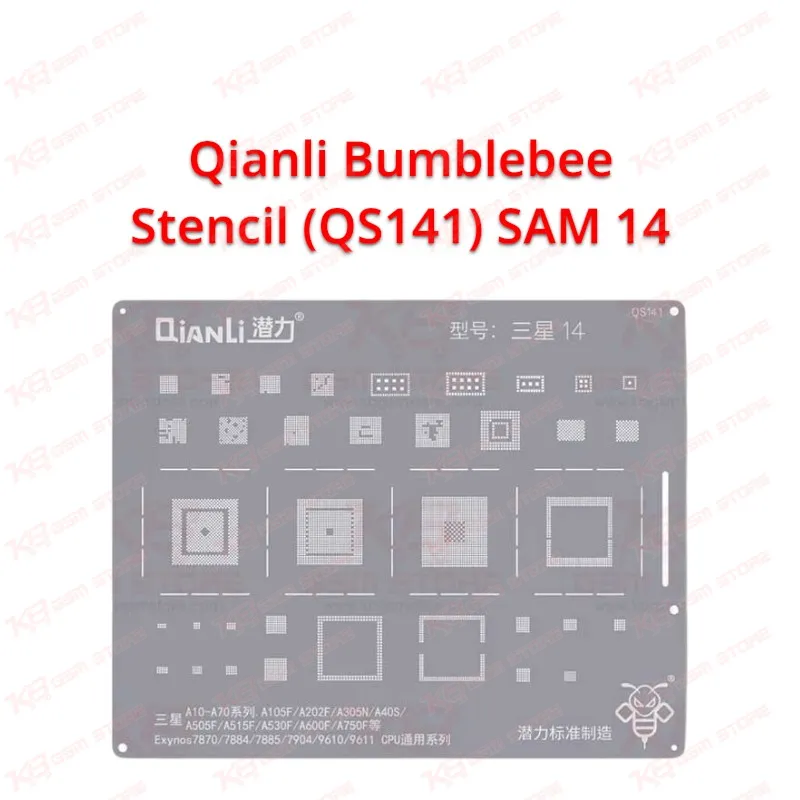
Qianli Bumblebee Stencil (QS141) SAM 14 is a reballing stencil from Qianli’s Bumblebee series, and it targets the Samsung Galaxy A10 to A70 range (A10, A20, A30, A40, A50, A51, A53, A60, A70). If your bench sees a lot of Samsung A-series boards, this is the plate you reach for when an IC change karna job ends with a lifted chip that needs fresh solder balls. The “SAM 14” tag in the name shows where it sits in the Qianli Samsung stencil line, which also includes SAM 8 and SAM 10, so you can match the right plate to the right board quickly. Inside your workflow, the stencil comes right after chip removal and pad cleaning, and right before you mount the chip back on the PCB. You lift the BGA chip with your hot air station, wick the old solder off the pads, clean the underside with flux and isopropyl alcohol, and then line the chip up with the QS141 openings. The Bumblebee series uses square holes with rounded corners, a layout that helps paste or balls sit evenly instead of smearing across neighbouring pads. That matters on Samsung A-series boards, where a dead phone, hang on logo, boot loop issue, or charging issue can trace back to a chip with weak or cracked ball joints. Reballing is not the first step for every fault. You still check the board with a multimeter, watch the current on your power supply, and rule out software first by trying a flash or software marna. Once you know the fault sits under the chip, the stencil gives you a repeatable way to restore the joints instead of guessing with loose balls and a steady hand. Using it takes a few simple habits. Fix the stencil onto the chip with heat-resistant tape or a reballing station so it cannot shift. Apply a thin layer of solder paste or drop in balls, then warm it with your hot air gun at a controlled temperature until the balls melt and settle into the holes. Let the stencil cool before you lift it, then peel it away slowly. A microscope helps you check every ball for height and spacing before you move on, and a PCB holder keeps the board steady while you reflow the chip. After reflow, power the board, check the current draw, and boot it before you close the phone. Clean the stencil with flux remover after every job, because leftover residue clogs the openings and ruins the next reball. Handle it by the edges, store it flat, and avoid bending it, since a warped plate gives uneven balls. Pakistani repair shops that handle volume work on Samsung A-series phones benefit most from keeping this stencil in the drawer. A10 to A70 phones come in often, from dead after flash cases to boards that lose network or display function after a drop. One stencil covers the whole listed range, so you do not need a separate plate for each model, which keeps your bench stock simple. New technicians also learn reballing faster with a dedicated stencil than with freehand paste, because the openings guide every ball into position. Pair it with a hot air station, a soldering station, a microscope, and a reballing kit from KB GSM Store, and you cover the full chip-off and chip-on workflow. If you later move toward heavier board-level work, a preheating rework station and a stronger microscope make the natural next upgrade. Before you order, confirm that your phone sits inside the listed A-series models, since this stencil covers the A10 to A70 range and not other Samsung lines. Qianli Bumblebee Stencil (QS141) SAM 14 gives your Samsung A-series repairs a precise reballing plate that you can use job after job.