


Brand:
QIANLI
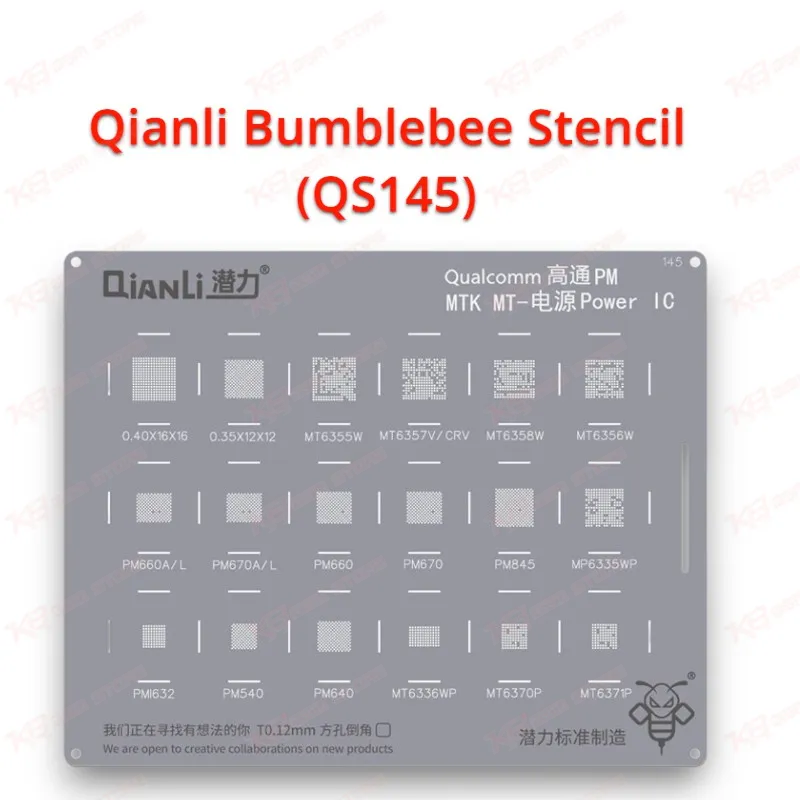
Qianli Bumblebee Stencil (QS145)
Qianli Bumblebee Stencil (QS145)
Regular price
Rs.1.00 PKR
Regular price
Sale price
Rs.1.00 PKR
Shipping calculated at checkout.
Quantity
Couldn't load pickup availability
Qianli Bumblebee Stencil (QS145) for Power IC Reballing The Qianli Bumblebee Stencil (QS145) gives you a dedicated reballing stencil for Qualcomm PM and MTK MT-Power ICs. When a dead phone shows no current draw, or a charging issue points to a weak power IC, you reball the IC on this stencil and refit it with clean, even solder balls. You skip the guesswork of freehand balling and keep every IC change karna job consistent, from the first board to the fiftieth. Match the stencil pattern to your IC footprint before you start, then order from KB GSM Store and get a fair price in Pakistan.
SKU:MST-SOLDERING-TOOLS-646
⚖️ Weight: 0.01 kg
- Safe & Secure Payment
- Fast Delivery
- WhatsApp Support


Description
FAQ
What is the product name?
The product name is Qianli Bumblebee Stencil (QS145).
What is the brand of this product?
The brand of this product is Qianli.
What is the model of this product?
The model of this product is QS145.
What is this product used for?
This product is used for reballing Qualcomm PM and MTK MT-Power ICs.
Which devices are compatible with this product?
This product is compatible with Qualcomm PM and MTK MT-Power ICs. Match the stencil pattern to your IC footprint before you reball.
Who should use this product?
This product is suitable for mobile repair technicians, repair shops, service centers, and professional users.
Can I use the QS145 stencil for CPU or eMMC reballing?
No. The QS145 targets Qualcomm PM and MTK MT-Power ICs. CPU reballing needs a CPU stencil, and eMMC work needs an eMMC stencil such as the Qianli QS73 for eMMC General DDR.
Which power ICs does the QS145 cover for dead phone repair?
The QS145 covers the Qualcomm PM and MTK MT-Power IC group. Check your IC footprint against the stencil pattern first, because Qianli numbers its Bumblebee stencils by IC group.