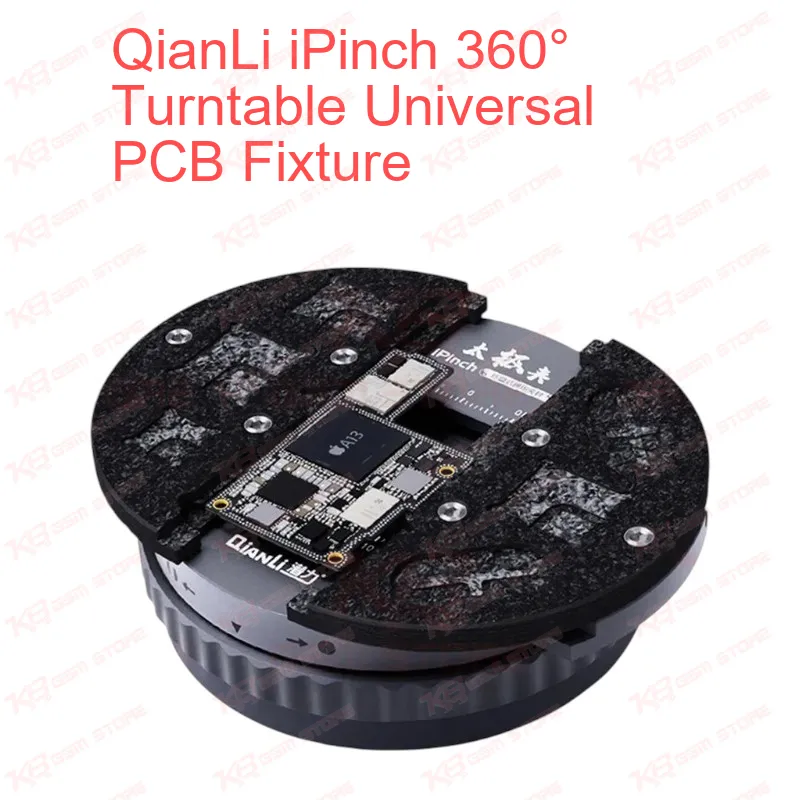
Micro soldering work on a mobile mainboard goes wrong fast when the board shifts mid-job. The QianLi iPinch solves that with a chuck drive clamp that grips mainboards and chips under 54mm wide and holds them dead still while you remove glue, lift an IC, or reball a CPU. You get full 360° rotation on the turntable, so instead of picking the board up and turning it by hand, you rotate the fixture itself and keep your soldering angle consistent. The turntable runs on silent needle roller bearings, so the motion stays smooth even after repeated use across a full day of repairs. This matters most during hot air work, where any small vibration or shift can crack a nearby component or misalign a chip you're trying to reflow. Pakistani technicians dealing with a dead phone after a failed IC change, or a board that needs a jumper lagana job on a tight pad, know how much a stable base changes the outcome. The iPinch base is made from real synthetic stone rather than plastic or standard resin. That matters because plastic bases warp or scorch under repeated hot air exposure, while this panel handles direct heat from soldering irons and hot air stations without deforming. You can scrape old glue off a board, remove tin, and run reflow work right on the surface without worrying about heat damage underneath your workpiece. Underneath the clamp sits a fixed chip storage slot, so when you pull an IC off a board mid-repair, you have somewhere to set it down without losing track of it on a cluttered bench. This small detail saves time on jobs where you're removing multiple components in sequence, such as NAND and CPU work on the same board. The fixture is built as a universal tool rather than a device-specific one. It works across roughly 99% of mobile phone motherboards on the market, which means one iPinch on your bench covers Samsung, Oppo, Vivo, Infinix, Tecno, and Apple boards alike, as long as the board or chip falls under the 54mm width limit. For a repair shop running multiple brands through the same workbench, that removes the need to switch fixtures between jobs. It pairs naturally with tools already common on a GSM bench — Qianli's own 007 and 008 soldering stations work directly with this holder, and it fits into any existing hot air, reballing, or ISP repair setup without extra adapters. If your workflow includes board cleaning after a liquid damage case, charging port board work, or CPU/eMMC reballing on a dead-after-flash board, the iPinch sits at the center of that process rather than as an accessory to it. For anyone running a service center where multiple technicians rotate through soldering stations, a fixture this stable cuts down on rework caused by boards slipping during a hang-on-logo repair or a failed reflow attempt. It's a small tool, but on a bench doing IC change karna work daily, it's one of the few fixtures that earns a permanent spot next to the hot air station.