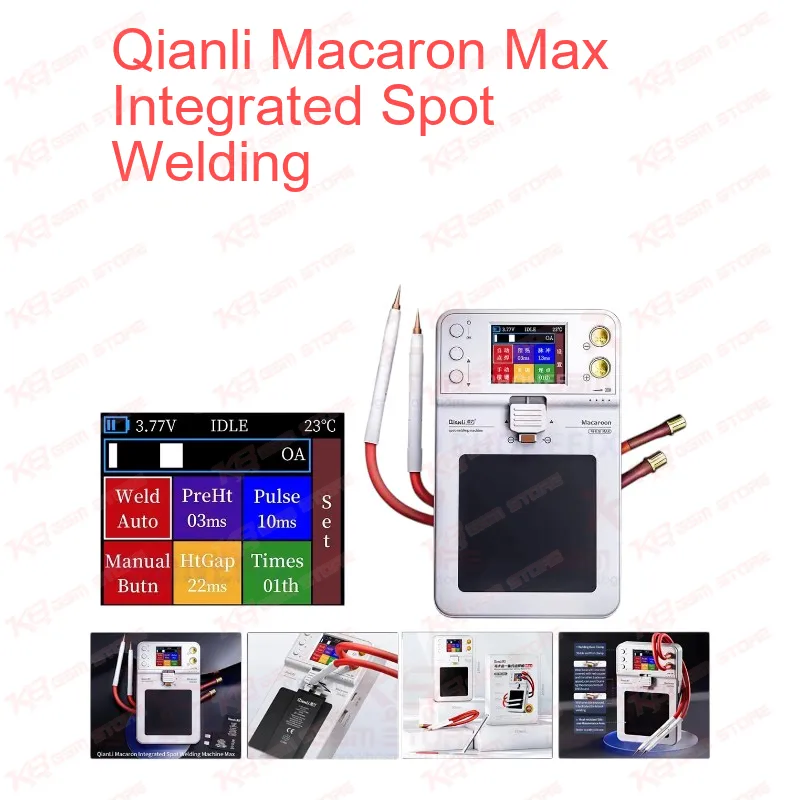
When you replace an iPhone or AirPods battery, the weak point is always the nickel tab connection to the BMS board. A shaky weld leads to a battery that reads charging issue on the diagnostic tool a week later, or worse, a dead phone that comes back to your bench with the same complaint. The Qianli Macaron Max solves this at the source by combining the clamp, the welding pen, and the control unit into one integrated body, so you stop juggling separate fixtures every time you sit down to do battery repair work.The BMS board welding clamp is the centerpiece of this design. Instead of holding the board steady with tape, tweezers, or a separate jig, you place the board directly into the integrated clamp and it locks in position on its own. This matters more than it sounds like on paper — a board that shifts mid-weld gives you an inconsistent bond, and an inconsistent bond on a lithium battery circuit is not something you want to guess about. With the clamp doing the holding, your hands stay free to manage the welding pen, and your weld point lands exactly where you intend it.The welding pen itself uses a red copper terminal, chosen for its conductivity over the cheaper alloy tips found on entry-level spot welders. Copper carries current more efficiently, which means the weld happens fast and clean instead of lingering and generating extra heat around the tab. A heat-insulated cord runs from the pen to the main unit, so the cable stays cool in your hand even during back-to-back welds on a busy repair day. If your workshop handles several battery jobs in a row — a common scenario for any GSM service center — this kind of cord protection keeps the tool comfortable to use for hours, not just for a demo weld.Double-pulse spot welding is what actually makes the bond reliable. A single pulse welder fires one burst of current and hopes for the best; the Macaron Max fires a multi-segment pulse sequence instead, which lets the current build gradually and settle the weld properly. You end up with a joint that holds under flex and vibration — important on a battery that sits inside a phone chassis that gets dropped, bent, or squeezed into a tight repair. Technicians who have dealt with a battery going into boot loop or shutting down randomly a few days after a weld job usually trace it back to a weak single-pulse connection. Double-pulse welding is built specifically to prevent that callback.On the front of the unit, a real-time display shows you exactly what the machine is doing at each stage: preheat level, pulse setting, HtGap (the gap tolerance for the welding head), and the weld count for the session. This is not a cosmetic add-on — it lets you dial in the right settings for the tab thickness you're working with instead of running the same generic setting on every board. A mechanical button next to the display handles all parameter adjustment, so you're not hunting through a touchscreen menu mid-repair. For technicians who switch between iPhone models with different battery tab specs throughout the day, this on-the-fly adjustment saves real time on the bench.The Macaron Max fits into the wider battery repair and BMS board workflow that any mobile repair shop runs through regularly. Once a phone comes in with a swollen battery, a battery health warning, or a straightforward charging issue, the fix usually means removing the old battery, prepping a new cell, and welding fresh nickel tabs onto the BMS board before reassembly. A weak or inconsistent weld at that stage is one of the most common reasons a "fixed" battery issue returns to the counter. Having a dedicated integrated welder on your bench — rather than relying on a soldering iron and hand-held tabs — cuts down on cold joints and gives you a repeatable result across every unit you handle.This tool is built around Apple's battery ecosystem specifically, covering iPhone battery BMS boards and Apple AirPods battery boards. If your shop takes on a steady volume of Apple device battery replacements, having a machine purpose-built for that BMS clamp shape and tab spacing beats adapting a general-purpose welder every time. It's a practical addition for any repair shop or service center that treats battery work as a core part of daily business rather than an occasional job.Setup is straightforward: plug in the unit, place the BMS board in the integrated clamp, set your preheat and pulse values using the mechanical button while watching the display, and weld. There's no external fixture to align, no separate power supply to configure, and no guesswork about whether the board is seated correctly before you fire the weld. That kind of consolidated workflow is exactly what a busy repair bench needs — fewer tools to manage means fewer points where something goes wrong mid-job.For a technician doing dead battery swaps, battery health resets, or full battery module rebuilds on iPhone and AirPods, the Macaron Max removes the weakest link in the process and replaces it with a controlled, visible, repeatable weld every time.