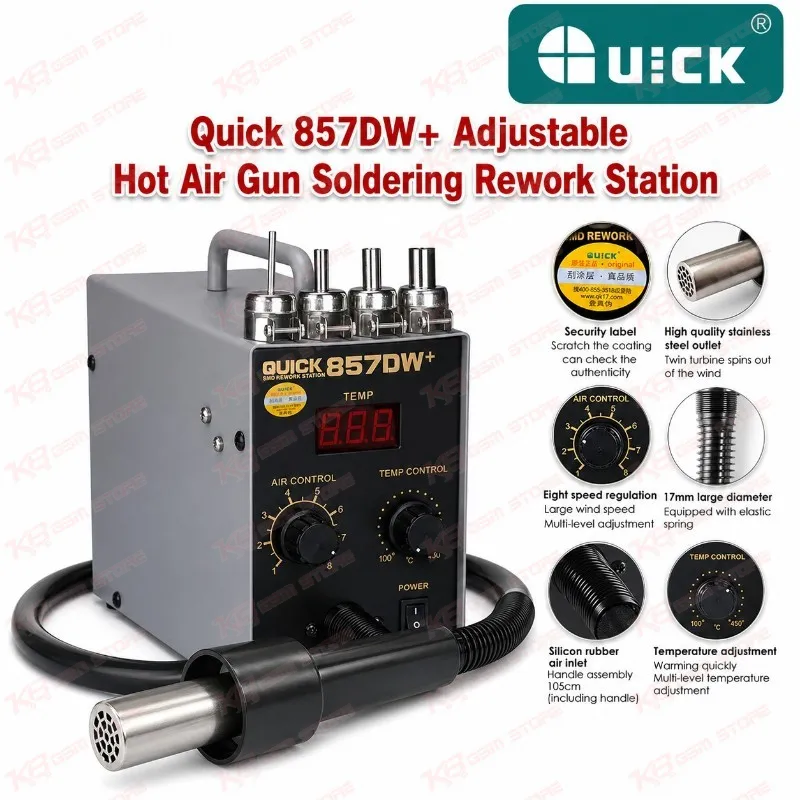
Every mobile repair shop hits a point where a basic heat gun stops being enough. Boards get denser, ICs get smaller, and one wrong burst of hot air ruins a component you can't easily replace. The QUICK 857DW+ exists for exactly that stage of a technician's career. It is a lead-free, digitally controlled hot air rework station built around a double-turbine DC motor blower, and it has become a standard bench tool across GSM repair markets because it solves the two biggest problems technicians face with cheaper stations: unstable temperature and harsh, inconsistent airflow. Most entry-level heat guns use a diaphragm pump. Air comes out in pulses, and that pulsing is what blows small SMD parts off a board mid-repair. The 857DW+ replaces that setup with a rotating double-vortex blower. Air spins out in a soft, continuous stream instead of a punchy blast, so you get even heat distribution across QFP, SOIC, PLCC, CHIP, and BGA packages without pushing components out of place. For anyone who has lost a tiny 01005 capacitor to a stray gust of air, this difference alone changes how confidently you approach a board. Temperature control is the second major upgrade. The 857DW+ runs a closed-loop sensor system with zero-voltage triggering, meaning the actual output temperature stays locked to your set value even when airflow speed changes. On cheaper stations, turning the airflow up or down often shifts the real temperature at the nozzle tip, which is how boards get scorched or components get under-heated and lift incorrectly. Here, the LCD panel shows your set point, and the station holds it steady from 100°C to 450°C — wide enough to cover everything from gentle plastic connector work to full lead-free BGA reflow. Speed matters when you're running a busy counter, and the 857DW+ delivers here too. It reaches set temperature in around 3 seconds, so you're not standing around waiting for the gun to warm up between jobs. The 580W heating element paired with the double-turbine airflow means you're not choosing between fast heating and safe, gentle handling — you get both. Airflow adjustment is linear and stepless, so fine-tuning between a light 30% flow for delicate SIM tray plastics and a full-power setting for stubborn solder is a smooth turn of the dial, not a jump between fixed steps. On a Pakistani repair bench, this station earns its place doing the jobs technicians handle every single day. IC change karna on a dead phone board, jumper lagana after tracing a broken line, reballing a charging IC or power IC, removing an EMI shield without lifting nearby components, reflowing a board after a "dead after flash" case, or gently warming a glued back panel or camera module without cracking it the 857DW+ handles all of it from one tool. The soft double-vortex airflow is particularly useful on modern phones where components sit closer together than ever; a harsher station risks disturbing a neighboring part while you work on the target IC. Safety and durability features round out the package. An intelligent induction system built into the handle puts the station into standby mode automatically when it's set down, so the heater isn't running full blast while you inspect a board or grab tweezers. Once you're done for the session, the automatic cooling function runs the blower briefly after shutdown to bring the heating core down safely, protecting both the internal element and your workbench from stray heat. Delay shutdown adds another layer of protection against premature power-off while the core is still hot. None of these are flashy marketing points they're the small engineering details that add years to a tool's working life on a busy bench. Build quality reflects its role as a workhorse rather than a showpiece. At 17 x 10.5 x 24 cm, the base unit sits compactly on a crowded repair table without eating up space you need for boards, jigs, and fixtures. The handle cable runs 110 cm, giving enough reach to work comfortably on a board clamped in a fixture without the base unit being dragged around. The handle itself stays cool during extended use thanks to the heat dissipation design carried over and improved from the earlier 857D series. For shops running mixed workloads — smartphone motherboard repair, tablet charging port rework, laptop board diagnostics, or general PCB assembly — the 857DW+ fits into the workflow between a basic soldering iron and a full BGA rework station with a preheater. It's the tool you reach for when a job needs controlled heat over an area rather than a soldering iron's point contact: connector reflow, shield removal, IC reballing, adhesive softening, heat-shrink work, and drying tasks after cleaning a water-damaged board. If your current heat gun is inconsistent, blows components around, or takes too long to stabilize between jobs, the QUICK 857DW+ addresses each of those pain points directly. It's built for technicians who need to move fast without sacrificing control over delicate work — which, on a modern smartphone board, is most of the work.