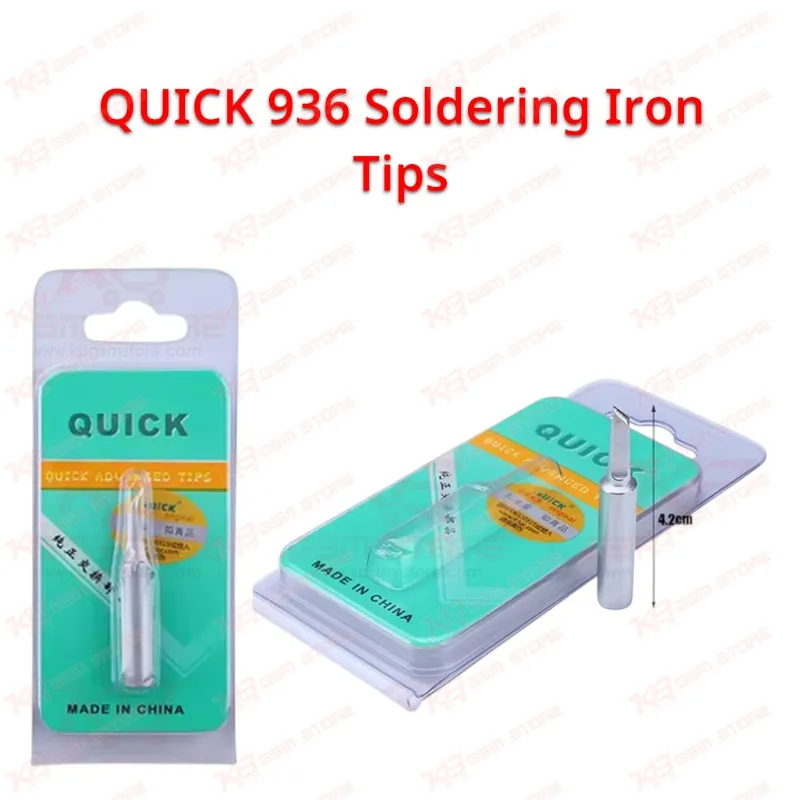
When your soldering iron tip stops tinning properly or starts showing a black oxide layer no matter how much flux you apply, the problem usually sits at the tip itself rather than the station. The QUICK 936 Soldering Iron Tip replaces that worn tip with a copper core body wrapped in multiple electroplated layers, a construction that pulls heat from the heating element to the working point faster than a plain copper tip and holds that heat steady through back-to-back solder joints on a busy repair bench. You avoid the temperature drop that happens when a technician works through IC removal, jumper wire attachment, or connector resoldering one after another, since the plated core keeps recovering heat quickly between joints. The 900M-T body style used in this series fits directly onto the QUICK 936 station handle and shares the same mounting profile as 937, 933, 907, 951, and 898D stations, so if your workshop runs a mixed fleet of soldering stations from different repair jobs, this tip covers more than one machine without forcing you to stock separate tip types for each. Outer diameter sits around 6mm with an inner diameter near 4mm, matched to fit snugly into the heating element sleeve without wobble, which matters when you are doing fine-pitch work near a PMIC or charging IC and cannot afford tip movement mid-joint. Temperature range runs from 200°C up to 480°C, giving you enough spread to handle lead-free solder at the higher end and standard leaded solder at lower, more controlled settings for delicate board areas. For a dead phone repair where the board shows a hardware fault around the charging IC, a tip with a fine point lets you isolate the affected pad without disturbing neighboring components, while a broader flat or chisel-style tip from the same 936 series handles ground shield removal or larger pad rework where more surface contact speeds up the job. The copper core resists the black oxide buildup that shortens tip life when a station idles at high temperature between jobs, and tinning the tip as soon as it heats up keeps the working surface protected during long shifts. Repair shop owners running multiple technicians on the same bench schedule get a tip that holds up through IC change work, board cleaning after a liquid damage case, and reballing prep where consistent heat transfer prevents pad lifting. This tip series works well within a wider PCB repair workflow that starts with visual inspection under a microscope, moves through diagnostics to isolate a hardware fault, and ends with soldering or rework depending on what the board needs. Whether you are dealing with a display problem traced to a damaged flex connector, a charging issue at the board level, or a network issue requiring RF shield rework, having a dependable tip on your 936 station reduces the rework cycles caused by cold joints or uneven heat transfer. The shape options available in this series, from fine bent tips for tight spaces to chisel and knife-shaped tips for broader pads, mean you pick the right geometry for the specific repair rather than forcing one tip shape to do every job on your bench.