


RDA6625 Power Amplifier IC
RDA6625 Power Amplifier IC
Regular price
Rs.150.00 PKR
Regular price
Sale price
Rs.150.00 PKR
Shipping calculated at checkout.
Quantity
Couldn't load pickup availability
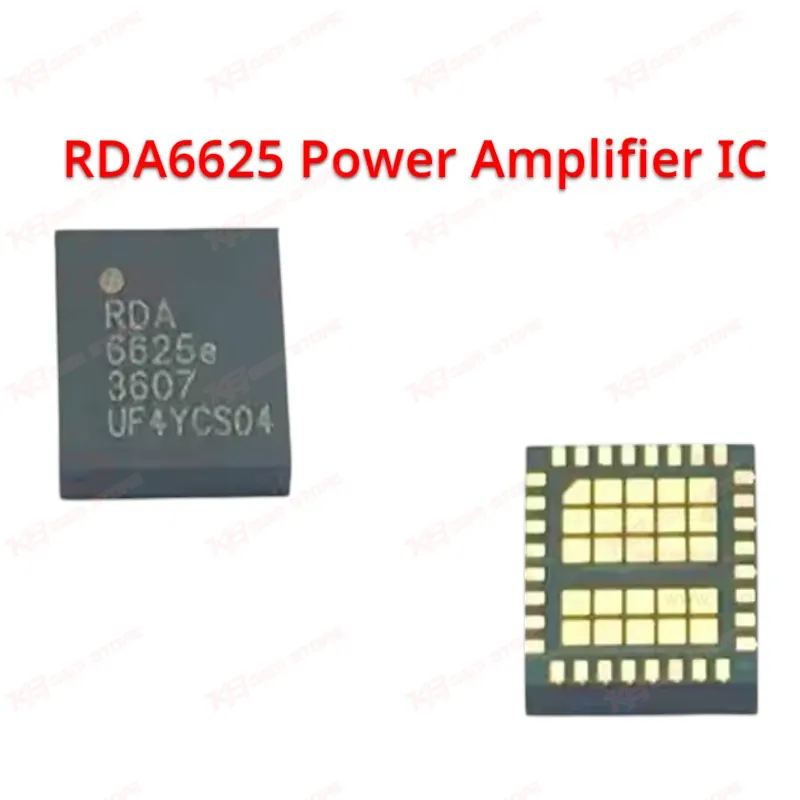
The RDA6625 is a quad-band power amplifier module built for GSM850, EGSM900, DCS1800, and PCS1900 phone boards. You get a compact 5mm × 5mm × 1.1mm LGA chip that combines power amplification and antenna switching in one package. GaAs HBT construction handles the RF amplification while a CMOS controller manages switching logic, giving you stable transmit power without extra external circuitry. This IC replaces burnt or dead PA chips causing no network, weak signal, or "network issue" complaints on affected boards. A reliable pick for your repair bench when signal-related faults trace back to the PA stage.
⚖️ Weight: 0.01 kg
SKU:MST-IC-356
- Safe & Secure Payment
- Fast Delivery
- WhatsApp Support


Description
FAQ
What is the product name?
The product name is RDA6625 Power Amplifier IC.
What is the brand of this product?
The brand of this product is RDA Microelectronics.
What is the model of this product?
The model of this product is RDA6625.
What is this product used for?
This product is used to replace faulty power amplifier modules causing no network, weak signal, or network issue faults on GSM/DCS/PCS phone boards.
Which devices are compatible with this product?
This IC is compatible with mobile phone boards built around the RDA6625 quad-band PA circuit; match it against your board schematic or existing chip marking before ordering.
Who should use this product?
This product is suitable for mobile repair technicians, repair shops, service centers, and professional users.
Does this IC support all four GSM bands together?
Yes, the RDA6625 covers GSM850, EGSM900, DCS1800, and PCS1900 in a single quad-band module.
Do I need extra matching components when soldering this IC?
No, the input and output are matched on-chip at 50Ω, so the module drops into the existing board footprint without added external matching circuitry.