


Brand:
RELIFE
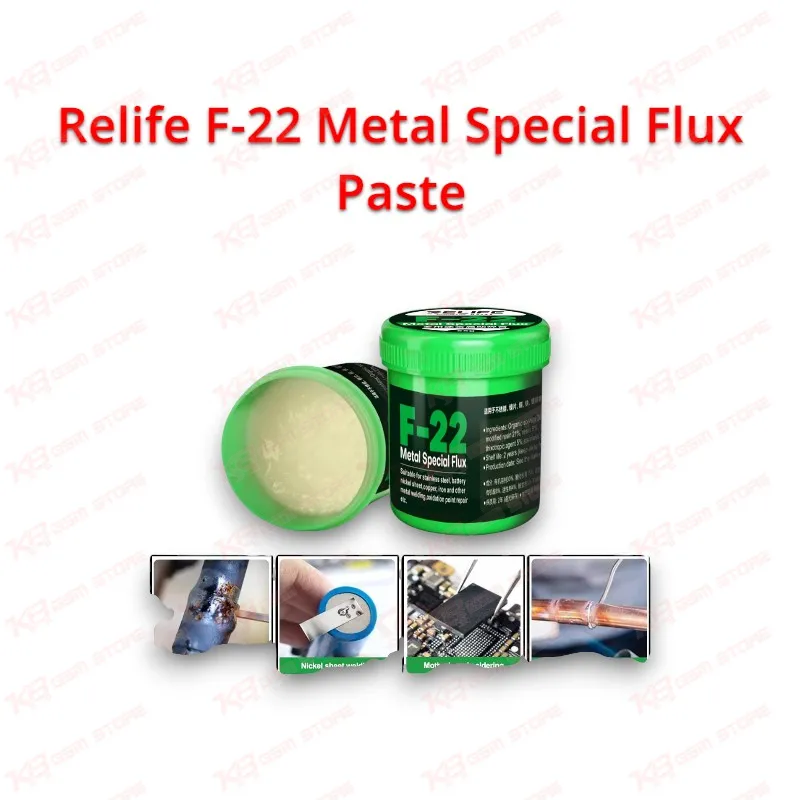
Relife F-22 Metal Special Flux Paste
Relife F-22 Metal Special Flux Paste
Regular price
Rs.1.00 PKR
Regular price
Sale price
Rs.1.00 PKR
Shipping calculated at checkout.
Quantity
Couldn't load pickup availability
Relife F-22 Metal Special Flux Paste is a halogen-free translucent paste built for tough metal soldering jobs on your repair bench. You get a 10CC syringe loaded with push-rod dispensing and swap-in tip sizes, so applying flux to stainless steel, copper, iron, nickel, or galvanized sheets stays precise and waste-free. The formula carries high insulation resistance and stays non-conductive, so you avoid short-circuit risk while removing oxide film and restoring solderability on corroded metal points. No harsh smell, no corrosive residue, just clean, repeatable soldering for daily workshop use.
SKU:MST-SOLDERING-ACCESSORIES-673
⚖️ Weight: 0.03 kg
- Safe & Secure Payment
- Fast Delivery
- WhatsApp Support


Description
FAQ
What is the product name?
The product name is Relife F-22 Metal Special Flux Paste.
What is the brand of this product?
The brand of this product is RELIFE.
What is the model of this product?
The model of this product is F-22.
What is this product used for?
This product is used for soldering and repairing oxidized metal surfaces such as stainless steel, copper, iron, and galvanized sheets during mobile and PCB repair work.
Which devices are compatible with this product?
This product is compatible with stainless steel, copper, iron, nickel, and galvanized metal surfaces rather than a specific phone model.
Who should use this product?
This product is suitable for mobile repair technicians, repair shops, service centers, and professional users.
Does Relife F-22 flux create a short-circuit risk on the motherboard?
No, it carries high insulation resistance and stays non-conductive, making it safe to use near live circuit points.
Can Relife F-22 be used for BGA reballing or only general metal soldering?
It is formulated for general metal soldering and oxidation repair on stainless steel, copper, iron, and galvanized surfaces, not as a dedicated BGA reballing flux.