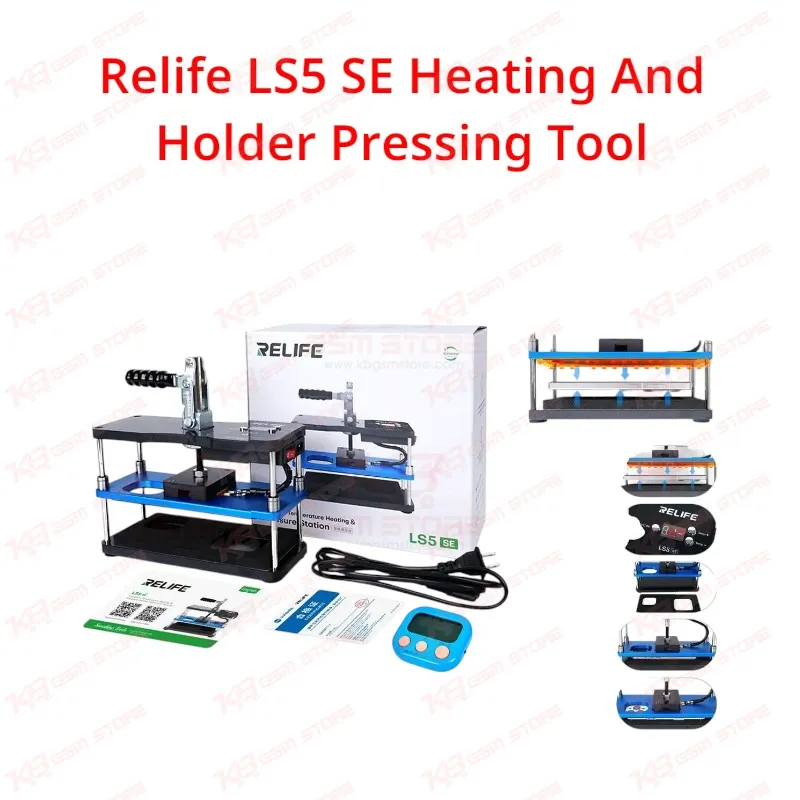
The Relife LS5 SE Heating And Holder Pressing Tool solves a problem every GSM technician in Pakistan runs into on a busy bench: screen lamination, frame reinforcement, and back cover heating each demand a slightly different pressure and heat setup, and swapping between separate tools slows down your workflow. This platform gives you one bidirectional dynamic holding pressure system that switches between front and back pressure modes without you changing rigs, so a screen bonding job in the morning and a frame reinforcement job in the afternoon both run through the same station. You place the phone or the board on the platform, choose your pressure direction, and let the digital temperature control take over from there, with adjustable heating up to 80°C and a fast-heating element that cuts down the waiting time between jobs. The camera avoidance design on the top and bottom plates means you don't have to worry about crushing a rear camera module when you're working on a back panel or full device hot press, which matters when you're running through several Android and iPhone models in a single shift and can't afford a cracked lens or a bent bracket. In real workshop terms, this tool sits at the intersection of your PCB repair bench and your cosmetic repair workflow: once you've finished a board-level fix, an IC change karna job, or a jumper lagana repair and the phone is back together, this is where you laminate the new screen, reinforce a frame that took stress during disassembly, or reheat a back cover to reseat the adhesive after an air tightness check. Technicians dealing with a phone that shows a display problem after a drop often need to both replace the panel and re-laminate it cleanly, and the LS5 SE gives you consistent pressure across the whole surface so you don't end up with air bubbles or uneven bonding that shows up later as a lifting edge. The bidirectional pressure system also covers stand hot pressing, so if you're reinforcing an accessory or a phone stand rather than the device itself, you don't need a second machine sitting on your workbench taking up space. Because the temperature control is digital and adjustable rather than fixed, you can run lower heat for adhesive-sensitive jobs and push toward the 80°C ceiling when you need faster softening on a stubborn back cover, giving you the flexibility a fixed-temperature hot plate doesn't offer. The compact 220 x 80 x 215mm footprint fits into a repair shop bench without eating the space you need for your soldering station, hot air station, or microscope setup, and the unit runs on standard AC 110/220V 50Hz input, so it works across the mains supply you already have in your Pakistani workshop without extra conversion gear. For a service center handling volume work, having lamination, frame reinforcement, and back cover heating on a single platform means fewer tools to maintain, fewer power points to manage, and a simpler training curve for junior technicians joining your team. The camera cutout design also means you're not restricted to a narrow band of supported phones: most current Android and iPhone models share a similar rear camera placement, so this platform stays useful as your customer base's device mix shifts over time rather than becoming obsolete the moment a new model line changes its housing. If your shop already runs ISP pinout tools, eMMC programmers, or UFS adapters for the software and chip-level side of repair, the LS5 SE covers the mechanical and cosmetic side of the same job, closing the loop from board fault to a phone that looks and feels properly reassembled when it goes back to the customer. Whether you're running a single-technician shop or a full service center with multiple repair stations, this platform gives you a repeatable, controllable process for the pressure-and-heat steps that too many workshops still handle with improvised clamps and a heat gun, which is exactly where inconsistent lamination and loose frames come from in the first place.