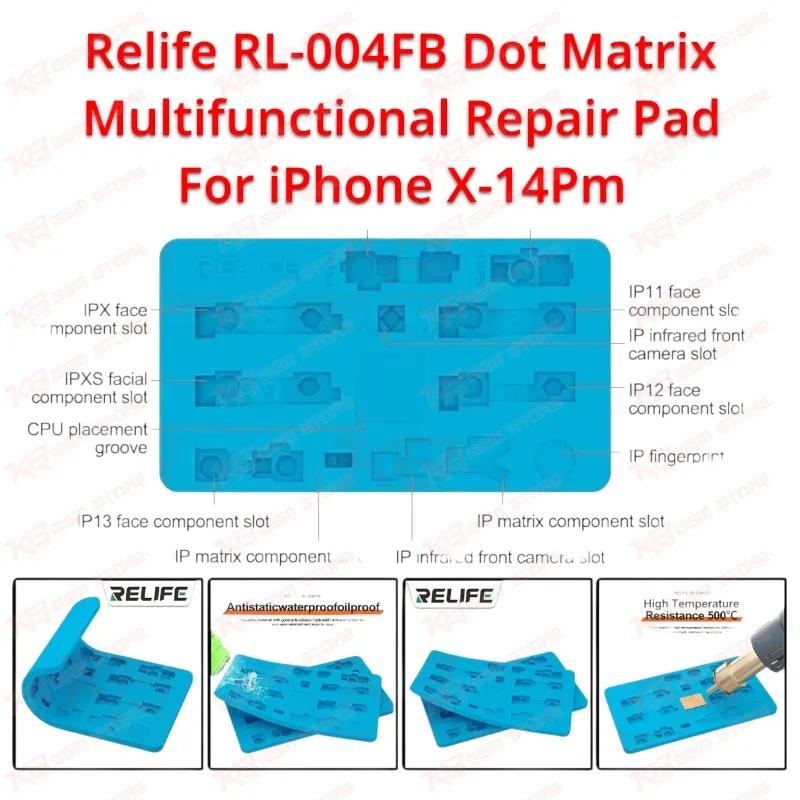
When you're doing board-level work on an iPhone X or later, you need a surface that does more than just sit under the phone — it needs to hold parts in place while you're running a hot air gun inches away from a $2 IC or a Face ID dot projector you cannot afford to lose. The Relife RL-004FB solves this with a dot matrix pattern of fixed slots molded directly into the silicone, letting you drop screws, brackets, camera modules, and small ICs into defined positions instead of watching them slide off a flat mat mid-repair. This matters most during Face ID repair, where you're juggling multiple tiny flex connectors and sensor components at once, and during BGA reballing, where a single dropped or misplaced chip means starting the job over. The pad is molded from a new-generation silicone compound rated to withstand 500°C without swelling, warping, or releasing fumes, so you can run your hot air rework station or soldering iron directly above or on the surface during CPU IC reflow and chip removal without worrying about melting your workbench mat mid-job — a real problem with cheaper mats that start to shrink or discolor after a few reflow cycles. Beyond heat resistance, the material is fully insulating, which protects you and your board when you're probing a live circuit or handling ESD-sensitive components, and it carries anti-collision, anti-skid, and anti-acid properties that keep boards from sliding during scraping, cleaning, or flux application. Flame-retardant and corrosion-resistant construction means the pad holds up against flux residue, alcohol cleaning, and repeated exposure to solder splash without breaking down the way rubber or standard silicone mats do over time. Physically, the pad is flexible enough to bend or roll for storage between jobs, then automatically resets flat when you lay it back on the bench — a small feature that matters a lot when your workstation doubles as storage space between repairs. Built specifically around the iPhone X through 14 Pro Max chassis and board layout, the RL-004FB fits directly into workflows for dead phone diagnosis, hang on logo troubleshooting, charging issue repair, and camera or Face ID replacement jobs that Pakistani repair shops handle daily. Whether you're doing IC change on a CPU, fixing a board after a bad flash, or separating a display for a screen replacement, having a dedicated positioning pad on your bench cuts down on lost parts and speeds up repeat repairs. For shops running high daily repair volume — service centers handling walk-in dead phone and boot loop cases back to back — this pad becomes a fixed part of the bench setup rather than a one-off accessory, since it holds up under continuous heat exposure without needing frequent replacement. It pairs naturally with your existing hot air station, soldering station, and BGA reballing kit, filling the gap between "somewhere to put the board" and "a surface engineered for board-level repair work." If you're already running iPhone motherboard repair as part of your service menu, this pad removes one of the small but constant frustrations of the job: components rolling off the bench or getting lost in flux residue during a delicate reflow.