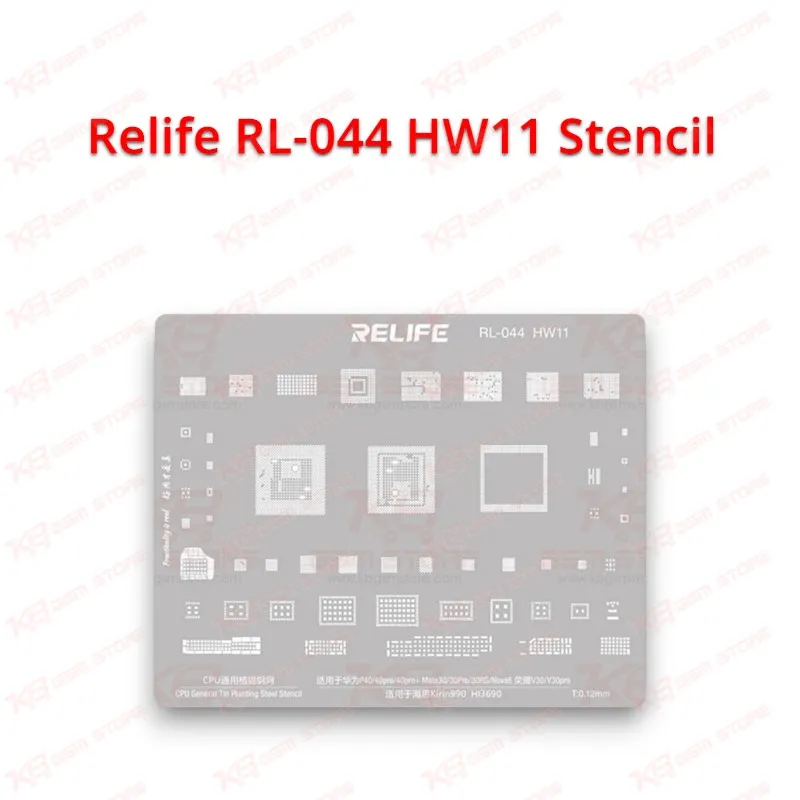
Chip-level repair on Huawei boards demands a stencil that holds its shape under heat and lines up exactly on the first try, and that's the gap the Relife RL-044 HW11 Stencil fills for technicians doing CPU reballing on the HW11 platform. You place the stencil directly over the cleaned CPU pads, apply solder paste through the laser-cut holes, and heat the board with your hot air station until the balls form — the tight tolerances on this template mean you don't end up chasing solder bridges or uneven balls afterward, which is the single biggest time-waster in reballing work. The steel sheet resists warping even after repeated heat cycles, so it holds its alignment across dozens of boards instead of degrading after a handful of uses like cheaper stamped alternatives. Rounded-square hole geometry lets solder paste separate cleanly from the mesh, so you get consistent ball height and diameter across the whole grid rather than a mix of oversized and undersized joints that cause boot loop issues or dead-after-flash symptoms down the line. For a workshop handling Huawei network issue complaints, charging issue diagnostics, or hang-on-logo boards traced back to a CPU-side hardware fault, having a stencil this precise cuts the guesswork out of the reballing stage and lets you move straight to functional testing once the board is reassembled. The Relife RL-044 HW11 Stencil sits at the CPU reballing stage of the wider PCB repair workflow, coming into play after diagnostics has isolated the fault to the processor and before the board goes back for functional retesting, and it pairs naturally with a hot air rework station, flux, and a magnetic reballing platform for holding the board steady during the process. Technicians who jumper lagana or do software marna on the logic board side still need clean hardware groundwork underneath, and a stencil that misaligns even slightly can undo hours of software-side troubleshooting by reintroducing a hardware fault at the CPU joint. Because the RL-044 designation covers several device-specific stencil variants across the Relife range, the HW11 marking on this particular template tells you it's cut for the Huawei CPU footprint rather than an Apple or MediaTek layout, so double-check the pad pitch against your board before running paste through it on a board you haven't reballed before. Build quality on this tier of Relife stencil holds up well across a busy service center's monthly workload, and keeping one dedicated to Huawei CPU work rather than swapping between device families reduces wear and keeps the hole geometry accurate for longer. Add this to your reballing station alongside your existing ISP pinout tools, eMMC programmers, and UFS adapters, and you've got the CPU-side of your Huawei repair workflow covered without relying on manual ball placement, which almost never matches stencil-level consistency. For any repair shop or service center billing itself on chip-level work rather than basic screen and battery swaps, a dedicated CPU stencil like the Relife RL-044 HW11 Stencil is what separates a professional reballing job from a rushed one that comes back with the same fault a week later.