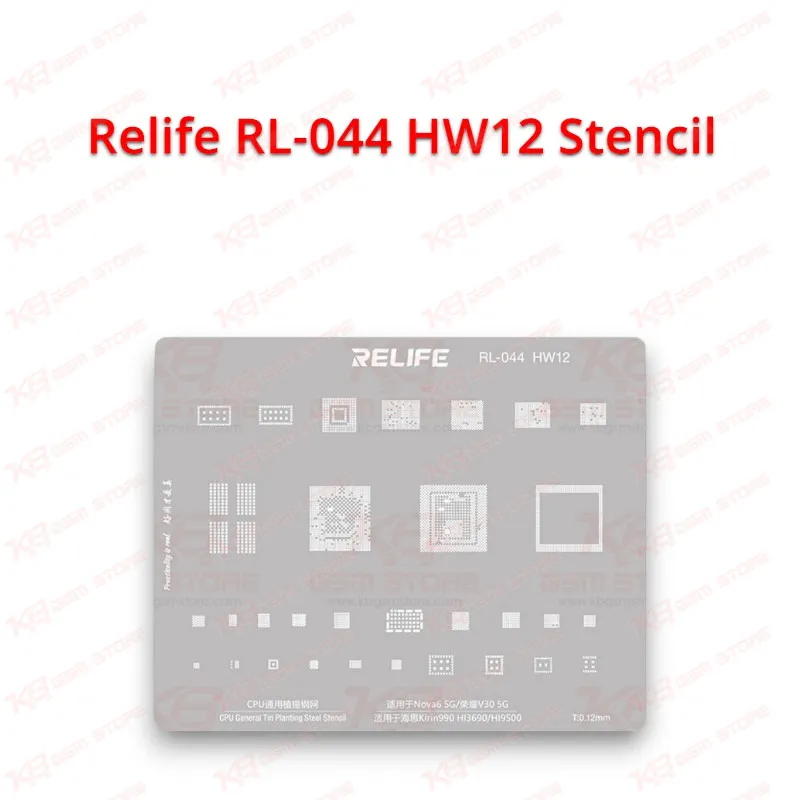
The Relife RL-044 HW12 Stencil is built for technicians who reball Huawei CPUs on a daily basis and need a template that holds its shape job after job, not a flimsy sheet that curls the first time it touches a hot air nozzle. This particular HW12 layout belongs to the RL-044 Huawei series, a set of sixteen individually numbered stencils (HW1 through HW16) that Relife engineered to cover the different HiSilicon Kirin CPU footprints found across Huawei mainboards, so you keep the exact pattern your board revision needs instead of forcing a universal sheet onto pads it was never cut for. The stencil itself is stamped from high-quality stainless steel using precision laser cutting, which gives you millimetric hole alignment on the first pass rather than the trial-and-error placement you get with cheaper punched stencils. Round-square hole geometry runs through the mesh, a design choice that lets molten solder release cleanly and stops paste from clogging inside the apertures during repeated reballing cycles, so your ball placement stays consistent even after dozens of boards. Relife also runs a half-etching process into the sheet around sensitive zones, cutting shallow grooves that let adjacent components sit into the stencil rather than press against sharp steel edges, which protects nearby ICs, capacitors, and connectors from accidental burn marks when you are working the reflow station close to other parts. Built-in cooling holes across the mesh let heat escape during the reballing pass instead of trapping it against the steel, which keeps the stencil flat and prevents the deformation that ruins hole alignment on lesser tools after just a few uses. On your repair bench, you place the HW12 sheet directly over the cleaned Huawei CPU pad, drop your solder balls or paste through the round-square apertures, run your hot air or reflow station over the mesh, and lift the stencil away to leave a uniform ball grid ready for chip mounting. That workflow matters most when a Huawei phone comes in dead after a failed flash, stuck on a boot loop, or showing a hardware fault that points to the CPU rather than software, situations where a technician needs to pull the chip, clean the pad, reball with the correct pattern, and remount without guessing at ball spacing. Because the HW12 stencil is purpose-cut for a specific Kirin CPU footprint inside the RL-044 series, you avoid the misaligned balls and cold joints that come from stretching a generic stencil across a pad it does not match, which directly cuts your rework rate on Huawei board-level jobs. The steel ships packed to resist bending in transit, so the sheet arrives flat and stays flat through storage on a busy workshop shelf, ready to pull out the moment a Huawei CPU reballing job lands on your desk. For a service center or repair shop handling Huawei alongside other brands, the Relife RL-044 HW12 Stencil slots into the same reballing station you already use for iPhone or Samsung stencils, keeping your CPU repair, PCB repair, and IC replacement workflow standardized across every brand you service instead of forcing separate equipment for each manufacturer.