


Brand:
RELIFE
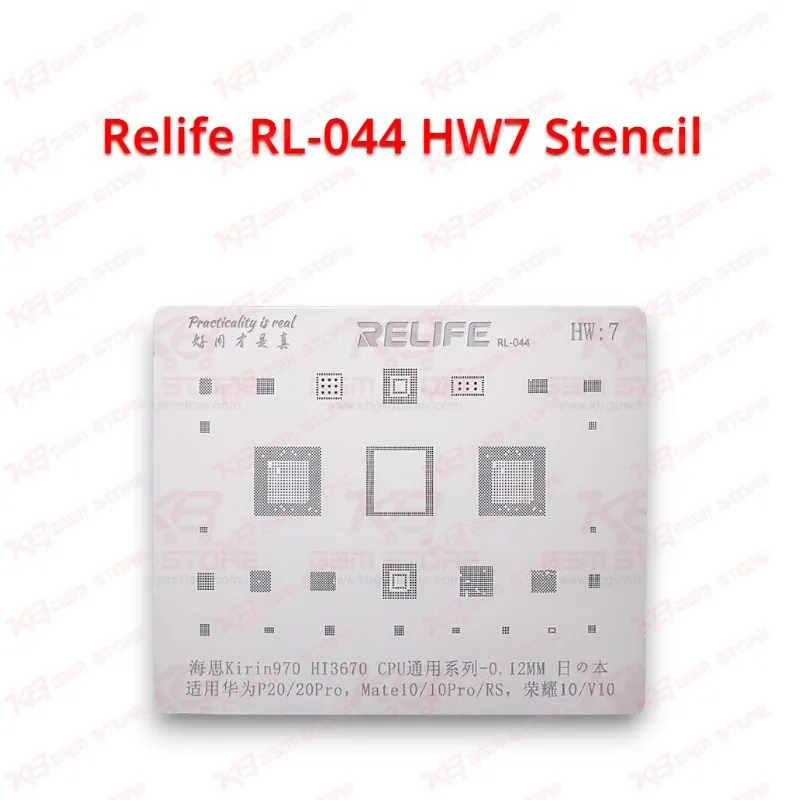
Relife RL-044 HW7 Stencil
Relife RL-044 HW7 Stencil
Regular price
Rs.499.00 PKR
Regular price
Sale price
Rs.499.00 PKR
Shipping calculated at checkout.
Quantity
Couldn't load pickup availability
The Relife RL-044 HW7 Stencil gives you a precision-matched reballing plate built specifically for the HiSilicon Kirin 970 HI3670 CPU package found on Huawei P20, P20 Pro, Mate 10, Mate 10 Pro, Mate 10 RS, Honor 10 and Honor V10 boards. Cut from ultra-thin 0.12mm stainless steel, it uses a round-square hole design that lets solder paste release cleanly and form uniform, evenly sized balls on every pad. You get a rigid, warp-resistant plate that holds its shape through repeated reflow cycles on your repair bench, so the CPU reball job comes out clean the first time instead of forcing you to redo a bridged or uneven pad layout.
SKU:MST-SOLDERING-TOOLS-565
⚖️ Weight: 0.01 kg
- Safe & Secure Payment
- Fast Delivery
- WhatsApp Support


Description
FAQ
What is the product name?
The product name is Relife RL-044 HW7 Stencil.
What is the brand of this product?
The brand of this product is Relife.
What is the model of this product?
The model of this product is RL-044 HW7.
What is this product used for?
This product is used for reballing the HiSilicon Kirin 970 HI3670 CPU during chip-level motherboard repair.
Which devices are compatible with this product?
This product is compatible with the Huawei P20, P20 Pro, Mate 10, Mate 10 Pro, Mate 10 RS, Honor 10, and Honor V10, all of which use the Kirin 970 HI3670 CPU.
Who should use this product?
This product is suitable for mobile repair technicians, repair shops, service centers, and professional users.
Does the RL-044 HW7 stencil match the exact hole layout of the Kirin 970 HI3670 CPU package?
Yes, the stencil is cut specifically to the HW7 pad layout for the Kirin 970 HI3670 package, so each hole aligns directly with the CPU's ball grid without needing manual adjustment.
What thickness does the RL-044 HW7 stencil use for solder ball planting?
The stencil is made from 0.12mm ultra-thin stainless steel, which balances flat pad contact with resistance to warping under repeated heat exposure.