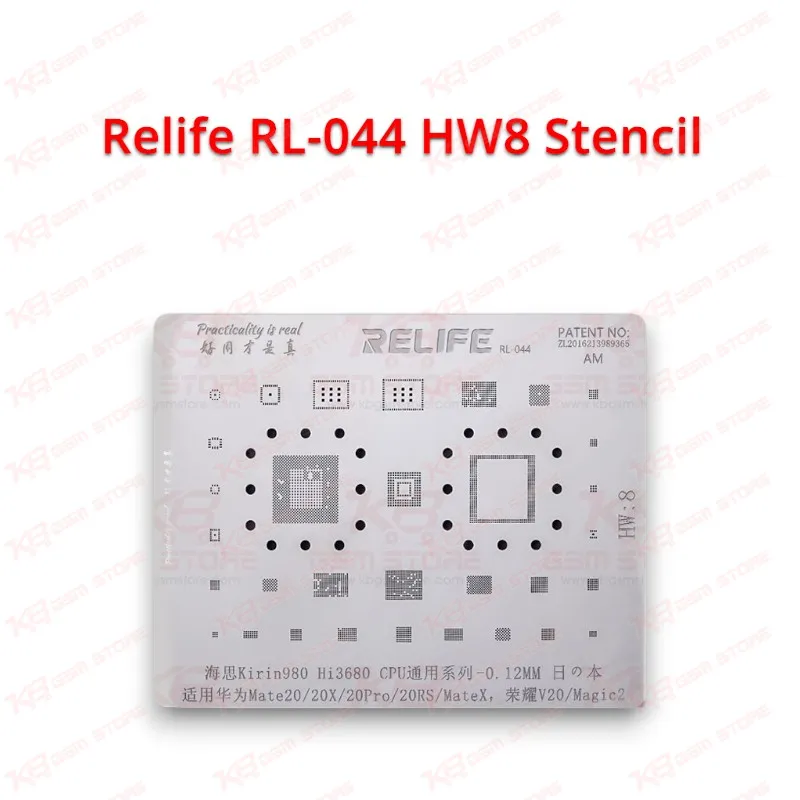
Huawei board-level repair puts real pressure on your stencil drawer, and the Relife RL-044 HW8 Stencil earns its spot there because it does one job — accurate reballing — without fighting you on alignment or heat resistance. You get a thin, laser-cut sheet of high-grade stainless steel, engineered to sit flat against the board and stay flat even after repeated passes under a hot air station, so you're not fighting warped corners or misaligned holes three jobs in. The mesh pattern is cut with tight tolerance, which means your solder balls drop cleanly through each opening instead of clumping, smearing, or leaving gaps that force you to redo a reball you already spent twenty minutes on. On a workshop bench in Pakistan, that translates directly into fewer callbacks: a phone that comes in dead after flash, boot loop, or a suspected hardware fault on the CPU often traces back to a bad reball job done with a cheap, deformed, or wrong-fit stencil, and swapping to a purpose-built template like this one is usually the fix that actually holds. The RL-044 line from Relife is built around exact-fit templates rather than one generic universal shape, and the HW8 variant is positioned for Huawei-side chipset rework within that series, so you're not stretching a Samsung or MediaTek stencil over a board it was never cut for and hoping the pitch lines up. That exact-fit approach matters more than it sounds — even a fraction of a millimeter of misalignment on a CPU stencil means solder bridging across adjacent pads, which shows up later as a phone that boots but drops signal, hangs on logo, or throws random hardware faults that are hard to trace back to the reball. Pair the Relife RL-044 HW8 Stencil with your existing reballing jig, a decent flux, and matched solder ball size, and the actual reballing step becomes fast and repeatable instead of a guessing game every time a Huawei board lands on your bench. It fits naturally into a standard PCB repair workflow: you isolate the fault through diagnostics, remove the suspect IC or CPU with your hot air station, clean the pad with braid or a cleaning kit, tin the pads, then bring in the stencil for the actual ball-drop and reflow stage before reinstalling the chip. Repair shop owners running multiple technicians benefit from keeping a labeled stencil set on hand rather than one universal template everyone shares and eventually damages — a dedicated RL-044 HW8 in the drawer means whoever picks up a Huawei board doesn't have to hunt for the right fit or improvise with a stencil that's close but not exact. Because it's a passive tool with no electronics or firmware involved, there's nothing to update or configure — you inspect it for bent edges or clogged mesh holes before each use, store it flat away from moisture to avoid corrosion, and replace it once the mesh openings start deforming from repeated heat cycles, which is normal wear on any stencil used daily in a busy service center.