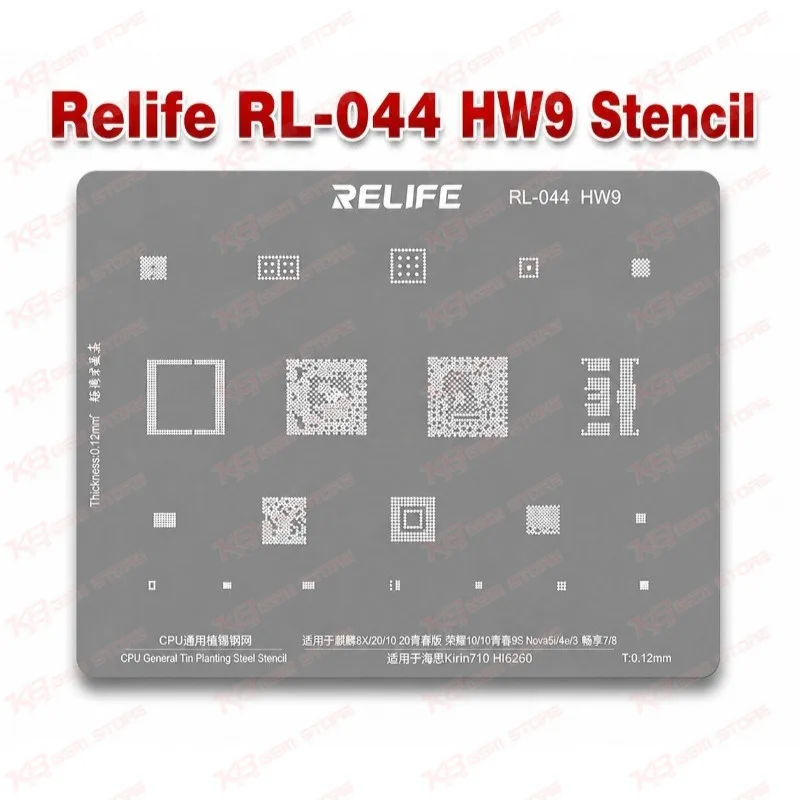
When you're sitting at the repair bench with a Huawei motherboard that needs IC reballing, the accuracy of your stencil decides whether the job goes smoothly or turns into a rework nightmare, and that's exactly where the Relife RL-044 HW9 Stencil earns its place in a technician's toolkit. This stencil is one specific layout from the Relife RL-044 Huawei series, a set that spans sixteen individual stencils numbered HW1 through HW16, each one laser-cut to match a different Huawei motherboard chip layout so you're not stuck trying to force a mismatched hole pattern onto pads that don't line up. The HW9 variant follows the same laser-cutting standard used across the RL-044 line, giving you round and square hole positioning that guides solder paste or solder balls exactly onto the CPU or IC footprint without smearing across neighboring pads, which matters a lot when you're working under a microscope on tightly packed board-level components. Built from high-quality steel, the stencil holds its flat shape even after repeated exposure to hot air station or reflow heat, so you're not replacing it every few jobs the way you would with a flimsy aluminum or low-grade metal template. That heat resistance is a practical detail for anyone running a busy workshop, since a stencil that warps mid-job forces you to stop, realign, and risk damaging the board or wasting solder balls. On the workflow side, you place the Relife RL-044 HW9 Stencil directly over the cleaned BGA pad after IC removal, apply your solder paste or drop solder balls through the openings, then lift the stencil away cleanly thanks to the precision-cut hole edges that don't trap residue or distort the print. This kind of clean release is what separates a proper reballing job from one where you end up chasing bridged joints or cold solder points after reflow, both of which are common causes of a dead phone coming back to your bench a second time. For technicians handling Huawei repair work regularly, board reballing isn't a one-off task, it's a routine part of fixing boot loop issues, charging faults tied to power IC damage, or network problems traced back to a faulty baseband chip, and having the correct stencil layout for the specific chip you're reballing saves you from improvising with a universal plate that only sort of fits. The RL-044 HW9 slots into that exact use case, giving you a dedicated, verified layout rather than a generic stencil you're forcing to work. In terms of workshop setup, this stencil pairs naturally with your existing reballing kit, hot air rework station, flux, and solder balls, and it fits into the same repair workflow you'd already use for eMMC or Wi-Fi IC reballing on other brands, just tuned for Huawei's board layout in this case. Reusability is another point worth mentioning for shop owners tracking tool cost per job, since a well-made steel stencil like this one is designed to survive dozens of reballing cycles rather than degrading after a handful of uses, which keeps your per-repair cost down over time. Whether you're running a dedicated Huawei repair line in your shop, training junior technicians on proper reballing technique, or simply need one reliable, correctly matched stencil for a recurring board issue, the Relife RL-044 HW9 Stencil gives you the precision and durability that Huawei board-level repair actually demands.