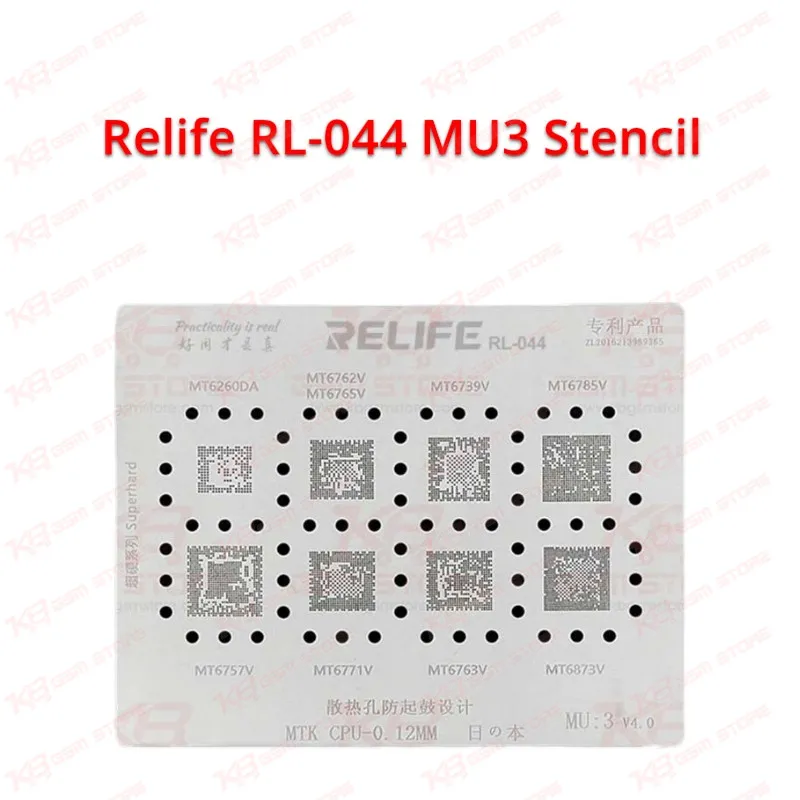
Every technician who has fought a stubborn reballing job knows the difference a well-cut stencil makes, and the Relife RL-044 MU3 Stencil exists to remove that guesswork from your bench routine. Instead of manually placing solder balls one by one and risking uneven height or shorted pads, you lay the stencil flat over the chip pad layout, brush solder paste or seat your balls through the laser-cut apertures, and lift it away to leave a clean, uniform grid ready for reflow. This matters most on boards where a single misaligned ball turns a fifteen-minute repair into a re-do, especially on dense mainboards where pad spacing leaves zero room for error. The RL-044 MU3 Stencil slots into the same Relife RL-044 family trusted across GSM repair shops in Pakistan for chip removal, IC reinstallation, and board-level rework, and it earns its place on the bench precisely because it standardizes something technicians used to eyeball. In a country where repair shops run high daily volume — flash tools running back to back, boxes chalana between jobs, dead phone after dead phone stacking up — a stencil that removes a variable from the reballing step pays for itself within the first few jobs. You are not fighting the tool while you work; you are using it to get a clean pass on the first try, which matters when a customer is standing at the counter waiting on their handset. The stencil is engineered from laser-cut steel, the same finishing standard used across the RL-044 line, giving you sharp, repeatable hole edges instead of the ragged punch-outs you get from cheaper stamped alternatives. That precision directly affects solder ball uniformity: consistent hole size means consistent ball height, and consistent ball height means fewer cold joints and fewer retries under the microscope. Workshops running ISP dead-phone recovery, eMMC data pulls, or UFS chip swaps use stencils exactly like this one as a supporting step before or after the programming stage — it is not the tool that reads the chip, but it is the tool that gets the chip back onto the board cleanly once the data work is done. For technicians training junior staff, a stencil-based reballing process is also easier to teach than freehand ball placement, because the physical template forces correct spacing regardless of hand steadiness. Pair the Relife RL-044 MU3 Stencil with a solder paste of matching profile and a hot air station set to the correct reflow temperature for your board type, and you get a repeatable, teachable reballing station rather than a guessing game. Keep the stencil clean between uses — dried flux residue in the apertures is the single biggest cause of uneven ball transfer — and store it flat to avoid warping, since even a slight bend throws off hole alignment on tightly spaced pad grids. Whether you run a solo repair bench or manage a service center handling volume work, this stencil earns a permanent spot in your reballing kit next to your existing ISP pinout tools, eMMC programmers, and UFS adapters.