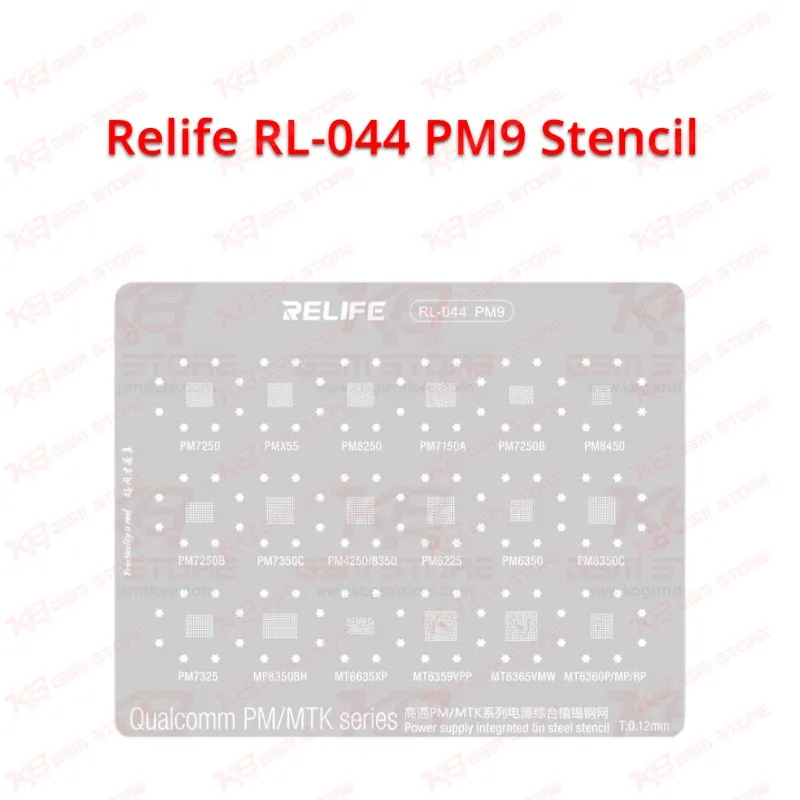
Working on a board with a faulty power management IC means your reballing accuracy decides whether the repair holds or the phone comes back with the same charging issue a week later, and the Relife RL-044 PM9 Stencil exists to remove that guesswork from your workbench. Built as part of the RL-044 modular stencil system that Relife produces for individual chip families rather than one generic universal mesh, this PM9 variant carries the rounded-square hole geometry used across the PM-series stencils, a design choice that lets solder balls form more evenly and lets the mesh lift away from the tinned pads without dragging or smearing fresh solder paste. Technicians who work Pakistani repair markets know how often a PM IC reflow goes wrong not because the chip itself failed, but because the reballing pattern underneath it was uneven, causing a dead after flash situation or an intermittent hardware fault that only shows up under load. A matched-pitch stencil like the RL-044 PM9 removes that variable by giving every ball on the footprint the same volume and spacing the original factory pattern used, so your reflow produces a joint that behaves the way the board expects electrically, not just visually. The stencil is manufactured from the same 0.12mm high-grade steel used across the RL-044 line, thin enough to flex around slightly uneven board surfaces during application yet resistant enough to hold its hole geometry through repeated heat cycles on the hot air station, which matters when you are running several boards through reballing in the same session and cannot afford a mesh that deforms by the third or fourth use. Because the PM9 stencil is scoped specifically to power management IC footprints rather than CPU or baseband packages, it belongs in the same drawer as your other PM-series and chipset-specific RL-044 stencils, letting you pull the correct mesh by IC type instead of hunting through a single oversized universal sheet and hoping the holes line up. That workflow logic is exactly why Relife split the RL-044 line into individual chip-family stencils in the first place, since a technician doing volume repair work needs speed and certainty more than a one-size-fits-all tool that requires trial alignment on every board. In practice, you place the stencil directly over the cleaned and fluxed PM IC pads, apply solder paste across the mesh with a squeegee pass, lift the stencil cleanly, and move straight to reflow, a sequence that takes a fraction of the time a manual ball-drop approach would need and produces a far more consistent result across repeated jobs. For a repair shop handling steady PM IC replacement work, whether the underlying issue is a dead phone, a charging port fault traced back to power regulation, or a board that hangs on logo because the power sequencing IC lost proper joints, having a dedicated PM9 stencil on hand means the reballing step stops being the bottleneck in your turnaround time. Pair it with your existing hot air station, flux, and solder paste, and the Relife RL-044 PM9 Stencil becomes a straightforward, repeatable part of the PCB repair and IC reballing process on your bench rather than a fiddly extra step that slows down every power-IC job.