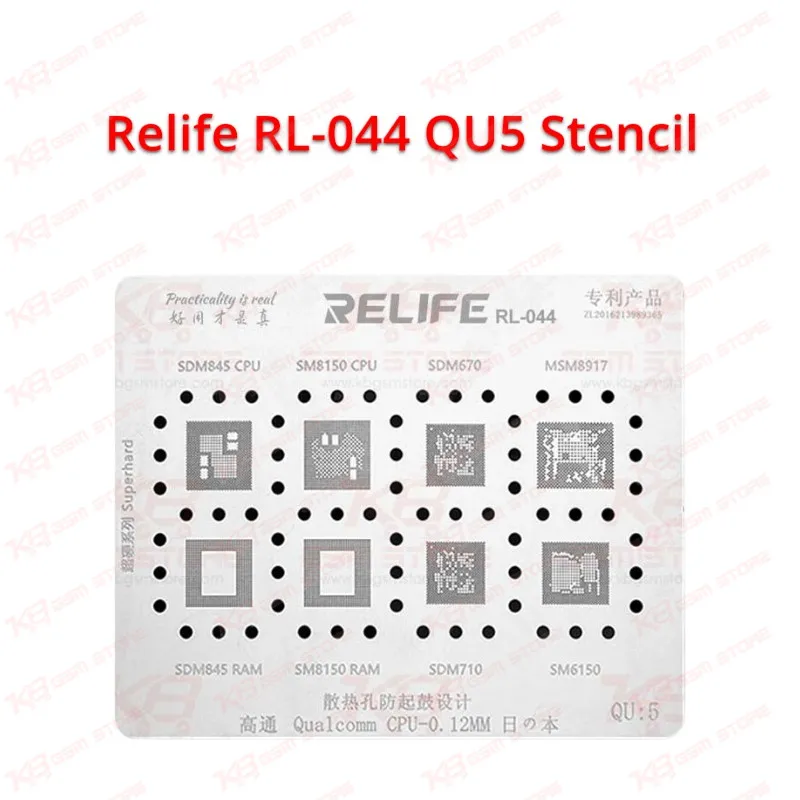
When your workshop deals with dead-after-flash boards, hardware fault diagnosis, or chip-level rework on a daily basis, the accuracy of your reballing stencil decides whether the repair holds or comes back a week later, and that's exactly where the Relife RL-044 QU5 earns its place on the bench, since its laser-cut apertures line up ball placement to within ±0.01mm across all 8 integrated layouts on a single 0.1mm-thick stainless steel sheet, letting you move between different BGA chip footprints without swapping stencils or re-verifying alignment each time. You place the stencil over the cleaned IC pad after fluxing, drop solder balls or apply paste through the polished apertures, and lift it away with an even, bridge-free ball pattern ready for hot air or reflow station work, which cuts the back-and-forth technicians usually face when a mismatched or worn stencil leaves shorted pads or missing balls after reflow. The polished, heat-treated surface finish matters more than it looks on a spec sheet — it keeps solder paste from sticking to the stencil itself, so you get a clean lift every time instead of dragging balls out of position, and the stainless steel construction holds its shape under repeated hot air exposure instead of warping the way cheaper laminate or thin brass stencils do after a handful of jobs. Because the layouts are universal rather than tied to one device family, you're not stuck buying a new stencil every time a different chipset or board generation lands on your bench; this makes it suited to general chip-level workshops that see a mix of hardware, from network issue boards needing IC change to charging port and power IC repairs where precise pad-level soldering is non-negotiable. At 10cm x 8cm, the Relife RL-044 QU5 sits comfortably on a crowded repair station without eating up bench space, and its 130mm x 120mm packaging keeps it protected and flat during storage, which matters for a tool where even a slight bend in the sheet throws off hole alignment. Reballing work sits at the core of PCB repair and CPU/IC rework workflows — after a board fails diagnostics for a dead phone, hang-on-logo fault, or charging issue traced back to a specific IC, the technician removes the suspect chip, cleans the pads, and uses a stencil like this one to rebuild the solder balls before reflowing the chip back onto the board or preparing it for testing on a separate rig. Skipping a proper stencil and hand-placing balls under a microscope is possible but slow and inconsistent, especially on fine-pitch chips, so a laser-cut, multi-layout stencil like the RL-044 QU5 becomes a workflow tool rather than an occasional accessory once your shop handles more than the occasional board. Pair it with a temperature-controlled hot air station, a PCB holder to keep the board steady during ball placement, and a decent flux to get the most consistent results, and it fits naturally alongside microscopes and reballing kits already on a technician's bench. For a repair shop juggling multiple device brands and chipset generations, having one stencil that covers 8 layouts reduces both tool clutter and the recurring cost of buying device-specific stencils for every new board that comes through the door.