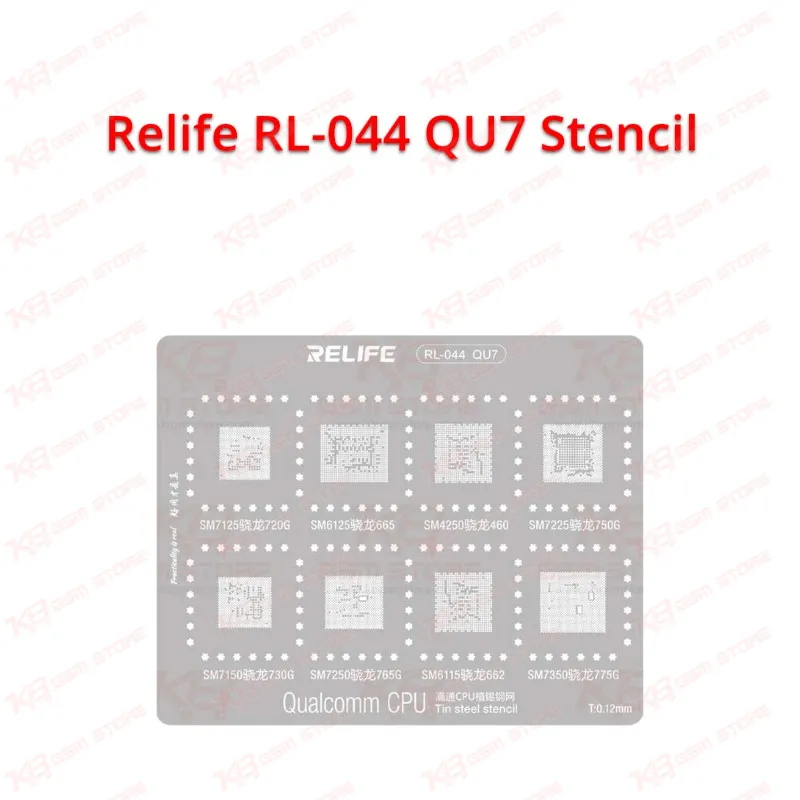
Working on a dead phone that traces back to a CPU-side fault means your reballing accuracy decides whether the board comes back to life or ends up scrapped, and that is exactly where the Relife RL-044 QU7 Stencil earns its place on your bench. This stencil belongs to Relife's QU series inside the RL-044 stencil family, a lineup built specifically for Qualcomm CPU BGA rework rather than generic multi-chipset use, so the hole pattern is cut to match the ball layout technicians encounter when handling Qualcomm-based motherboards during IC reballing. You get a 0.12mm thickness across the mesh, thin enough to let solder paste sit precisely over each pad without dragging into neighboring holes, which matters most when you are working under a microscope trying to avoid a solder bridge that turns into a short circuit issue later. The round-square hole design is not just a cosmetic choice — it changes how the paste releases from the stencil once you lift it off the chip, giving you rounder, more uniform solder balls instead of flattened or uneven deposits that cause boot loop or hang-on-logo symptoms after reassembly. Relife manufactures this mesh from high-quality steel that resists high temperatures and metal fatigue, so repeated exposure to reflow heat during rework sessions does not warp the stencil or throw off hole alignment over time, meaning your tenth reballing job stays as accurate as your first. Each stencil in this range gets checked against factory-level drawings during production, so the hole spacing lines up with the actual chip footprint rather than an approximated pattern, which directly reduces the chance of a missed solder joint after you reflow the paste. For a repair shop running through dozens of board-level jobs a week, that consistency translates into fewer callbacks from boards that fail again days after a reballing job because of a weak or missing ball connection. You place the RL-044 QU7 stencil over the IC footprint on the board, apply your solder paste across the mesh, lift it away cleanly, and move into your reflow step — a straightforward workflow, but one that only stays reliable if the stencil holes stay true to size and position, which is the core job this tool is built to do. Technicians handling CPU-side dead phone cases, no-power boards after a short, or hang-on-logo faults tied to a cracked or lifted solder ball under the chipset will find this stencil fits directly into that diagnostic-to-repair chain, sitting alongside your hot air station, preheater, and flux during the reballing stage of the job. Because it is a flat mesh rather than a device-specific frame, it works across your existing reballing platform or jig setup without needing extra adapters, and it stores flat in your tool tray without taking up bench space. If your workshop already stocks other stencils from the RL-044 range for different chipset families, adding the Relife RL-044 QU7 Stencil rounds out your Qualcomm-side coverage without disrupting your existing stencil organization system, keeping your CPU reballing tools together under one series for faster tool selection mid-repair.