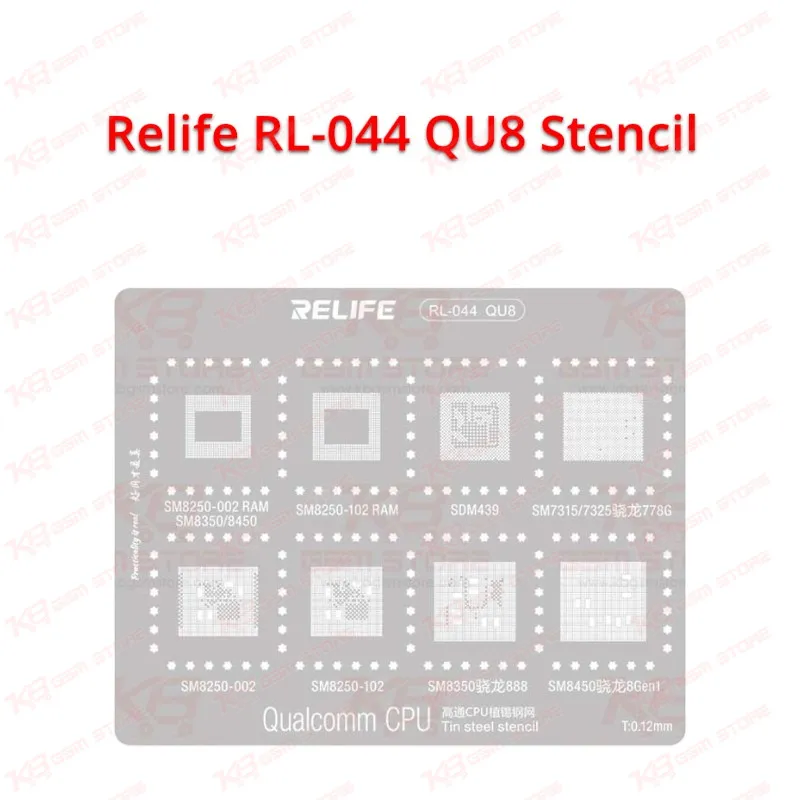
Chip-level repair on Qualcomm-powered Android boards almost always comes down to how clean your reballing job is, and the Relife RL-044 QU8 Stencil exists to solve exactly that problem on the CPU side of the motherboard. Built as a 0.12mm ultra-thin steel plate, it is designed around the QU8 pad pattern used on the SM8250-002 chipset, so when you are dealing with a dead phone that traces back to a CPU dry joint, cracked ball, or short after liquid damage, you get a stencil that matches the real factory footprint instead of guessing hole positions freehand. The round-square hole design is the detail that actually matters on the bench — it lets solder paste release cleanly during tin planting, which means your balls come out uniform in height and shape instead of uneven or bridged, and that directly affects whether the board boots clean after reflow or comes back with the same fault. Technicians working boot loop cases, hang-on-logo boards, or hardware fault diagnoses on Snapdragon-based Android units know that a warped or mismatched stencil is one of the most common reasons a reballing job fails on the first attempt, and this is where a properly matched plate earns its place in the toolkit. The steel used in the RL-044 series is chosen for high-temperature resistance, so it holds its shape through repeated hot air station cycles without bending or losing hole precision over time, which matters when you are running several boards through the same session rather than replacing your stencil after a handful of uses. Because the plate is calibrated against the actual chip pad drawing rather than a generic grid, alignment on the CPU footprint stays tight, reducing the chance of solder bridging between adjacent pads — a fault that often shows up later as a network issue, charging issue, or intermittent hardware fault that is hard to trace back. This Relife RL-044 QU8 Stencil fits directly into the CPU reballing stage of the wider PCB repair workflow: after you have confirmed a CPU-side fault through diagnostics, removed the faulty IC, and cleaned the pads on your PCB holder or fixture under the microscope, this stencil is what you place over the chip to reapply solder balls before reflow. It pairs naturally with your existing hot air rework station, flux, and solder paste, and slots into the same bench routine as your other reballing stencils for eMMC, UFS, or baseband chips, giving you a complete tin-planting setup across different chip families rather than a one-off tool. Its 0.12mm thickness is thin enough to sit flush against the chip surface, which keeps paste deposits consistent and avoids the excess tin that leads to shorts on tightly packed pads. For a repair shop handling volume work on Snapdragon-based devices, having a stencil that is chipset-matched rather than universal cuts rework time significantly, since you are not manually adjusting ball placement or re-tinning pads that came out uneven the first time. Whether you are running a service center bench, training technicians on board-level repair, or doing freelance GSM software and hardware work, this stencil gives you a repeatable, factory-accurate way to handle QU8 CPU reballing without relying on trial and error, and that consistency is what turns a risky board-level repair into a routine job on your workbench.