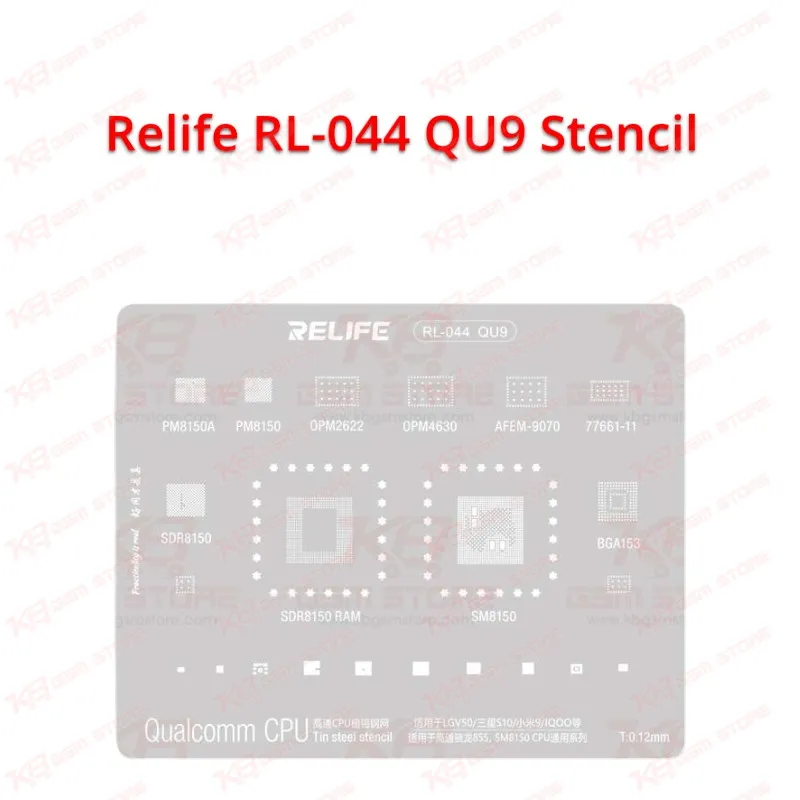
When you pull a Snapdragon-powered board onto your bench for a dead-after-flash repair or a stubborn boot loop issue, the Relife RL-044 QU9 Stencil becomes the difference between a clean chip-level fix and a wasted motherboard, because this 0.12mm ultra-thin steel plate lines up every solder ball on Qualcomm's newer CPU packages — SM8750, SM8650, SM8635, SM8550, SM8450 and SM7550 — with the round-square hole geometry that Relife engineers into the RL-044 series specifically to stop tin from catching inside the mesh while you're planting balls under a hot air station. You place the stencil directly over the CPU footprint after you strip the old solder and clean the pads, drop your solder paste or tin balls across the grid, run your hot air gun at a controlled temperature, and lift the plate away to leave a full, evenly spaced field of balls ready for reflow — the kind of result technicians in Karachi, Lahore, and Gujranwala repair markets expect when a customer walks in with a phone stuck on the logo or hanging after a botched software marna attempt somewhere else. Because the plate comes calibrated against real device drawings rather than generic hole spacing, you avoid the guesswork that turns a simple IC change into a re-do, and the ultra-thin cross-section flexes without cracking through repeated bending, so one RL-044 QU9 Stencil survives dozens of reballing jobs across your Qualcomm-based repair queue instead of warping after a handful of uses like cheaper mesh does. The steel itself holds up under the direct heat you apply during tin planting, resisting the metal fatigue that shows up as bent or torn holes on lower-grade stencils, which matters when your workshop runs back-to-back board repairs and can't afford downtime swapping tools mid-shift. This stencil slots into the same repair workflow you already run for CPU reballing, PCB cleaning, and board-level diagnostics — pair it with a quality PCB holder to keep the motherboard steady while you align the mesh, add a reballing kit with matched solder balls sized for the SM8xxx footprint, and keep a soldering station nearby for any jumper lagana work the board needs after reflow. Technicians handling network issue complaints, charging problems traced back to power-management ICs, or hang-on-logo symptoms after a failed flash often find the root cause sits at the CPU itself, and that's exactly where the Relife RL-044 QU9 Stencil earns its place on the bench: it turns a suspected hardware fault into a solvable chip-level repair rather than a board you write off. Because the hole layout matches the Qualcomm Snapdragon 8-series and 7-series packages listed above, you don't need to stock a separate stencil for every phone model that shares the same chipset family — one QU9 plate covers the CPU footprint across multiple devices built on those SoCs, which keeps your tool inventory lean if you're running a busy service center rather than a single-brand shop. The stencil ships as a standalone precision tool, so you still handle your own flux, solder paste, and reflow temperature settings, but the alignment work — the part that actually determines whether your reballing job succeeds or fails — is already solved by the factory-checked hole positions. If your workshop handles UFS, eMMC, or ISP-level repairs alongside CPU work, this stencil fits directly into that same bench setup without requiring separate calibration, letting you move a board from diagnostics straight to CPU reballing and back to functional testing in one continuous session. For any repair shop or mobile service center in Pakistan working on current-generation Snapdragon devices, the Relife RL-044 QU9 Stencil gives you the precision layer that turns a risky reballing attempt into a repeatable, professional-grade repair step.