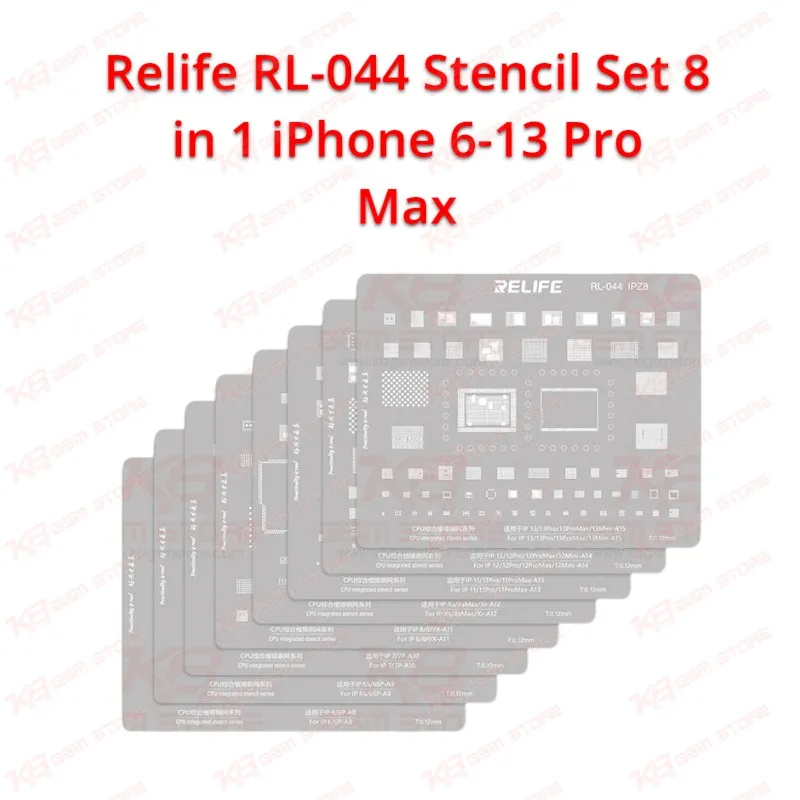
When a customer brings in a phone with a screen showing a "non-genuine display" or "no service" warning after an LCD swap, the fix almost always comes down to moving the original display IC or Face ID dot chip onto the new panel cleanly, and that is exactly where the Relife RL-044 Stencil Set 8 in 1 iPhone 6-13 Pro Max earns its place on your rework station; instead of relying on a single generic mesh that half-fits every model, you get eight separate stencil plates, each one matched to a specific iPhone generation from the 6 series up to the 13 Pro Max, so you place the correct plate over the correct chip footprint and avoid the misaligned solder balls that cause hang on logo, boot loop, or dead-after-flash symptoms following a rushed IC transplant. Every mesh in this set gets checked against the original factory hole pattern before it leaves production, which means the round and square hole positions line up with the real ball grid instead of an approximated one, giving you tighter tin planting and fewer missed joints on the first attempt rather than three or four reflow passes to catch stragglers. The steel used across the set resists high heat and metal fatigue, so when you're running your hot air station over the plate during reballing, the mesh keeps its shape instead of warping or sagging after a handful of jobs, and that durability matters on a busy repair bench where the same stencil might see use on ten or fifteen boards in a week. Handling is straightforward for anyone already comfortable with BGA work: you lift the damaged or donor IC, clean the pads on both the old and new logic board or screen flex, seat the matching RL-044 plate over the footprint, apply solder paste evenly through the mesh, and reflow with your hot air gun at a controlled temperature before lifting the stencil away to leave a clean, consistent ball grid ready for reattachment. Beyond IC reballing itself, the design also protects the flex cable during the transplant process, so you're not scorching nearby traces or connectors while you work on the chip pads, which cuts down on secondary damage that would otherwise turn a simple screen IC job into a full flex cable replacement. Technicians dealing with the common "pop-up window" or true-tone mismatch error after installing a copy or aftermarket screen will find this stencil set particularly useful, since transplanting the original display IC with an accurate mesh is the standard workshop method to clear that error without touching software. Because the set spans eight iPhone generations, it also reduces clutter on your tool tray; rather than stocking individual RL-044 variants for the 6, 7, 8, X, 11, 12, and 13 series separately, you keep one compact set that answers most iPhone display IC and Face ID dot jobs that come through a typical GSM repair shop or mobile service center. This stencil pairs naturally with a hot air rework station, a PCB holder to keep the board steady during reflow, a microscope for confirming ball placement on tighter pad spacing like the 13 Pro Max, and a decent flux to keep the paste flowing evenly through the mesh, so if your bench is still missing any of those, it's worth rounding out the setup alongside this kit. For a repair shop handling steady iPhone screen and Face ID complaints, the Relife RL-044 Stencil Set 8 in 1 iPhone 6-13 Pro Max reduces guesswork, cuts rework time, and gives junior technicians a repeatable, factory-accurate reference to reball against instead of eyeballing ball placement freehand.