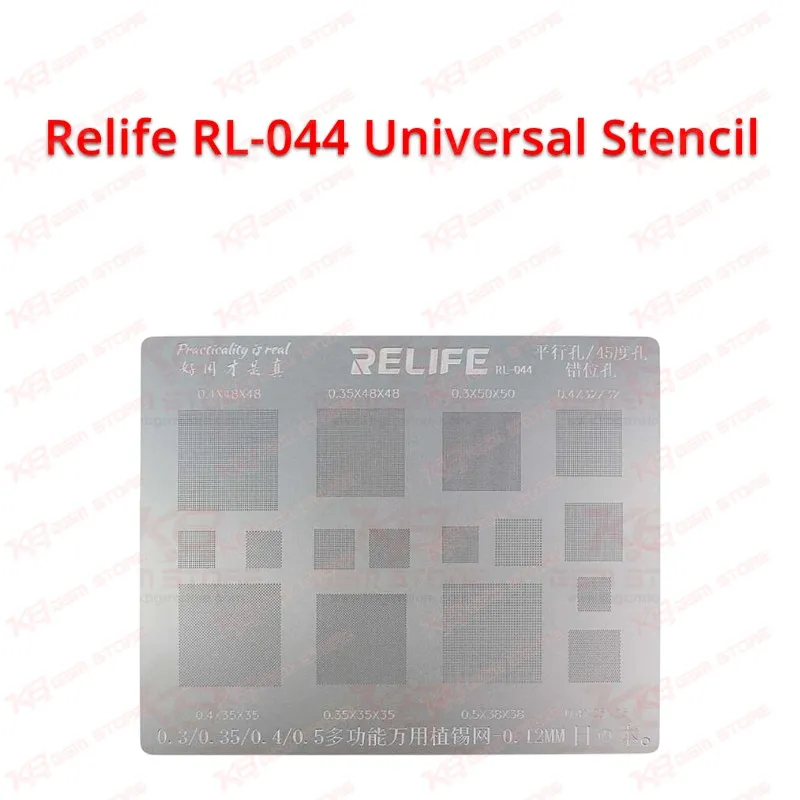
When a board comes in dead after a failed flash or stuck on hang-on-logo, the chip you pull off rarely goes back on with clean, even balls unless you reball it first, and that is exactly where the Relife RL-044 Universal Stencil does its job on a Pakistani repair bench. You get a single steel mesh that handles 0.3mm, 0.35mm, 0.4mm, and 0.5mm hole pitch in both parallel and 45-degree configurations, which means the same sheet lines up with Qualcomm Snapdragon power ICs, MediaTek Dimensity and Helio CPUs, HiSilicon Kirin chips, Samsung Exynos packages, and EMMC memory footprints without you keeping four or five separate stencils on hand. The steel itself is precision-cut to roughly 0.12mm thickness, thin enough to flex around a chip during alignment yet resistant to the metal fatigue that warps cheaper mesh after a few dozen reballing cycles on the hot air station. Round and square hole geometry keeps solder balls from spreading flat or pulling to one side, so when you drop paste through the RL-044 and run your rework station, each pad picks up a uniform, fully seated ball instead of the uneven tinning that causes a re-flash or a repeat visit. Technicians running an EMMC or UFS-focused workflow use this stencil right after IC removal, cleaning the pad with flux before seating the mesh, applying solder paste evenly across the openings, and lifting it clean to leave a matched grid of balls ready for reflow. The same sheet works just as well on a straightforward jumper lagana job where a CPU has lifted pads from a previous hardware fault, or on a board with a charging IC that needs pulling and reseating after a charging issue diagnosis. Because the RL-044 is a universal, multi-pitch layout rather than a single-model stencil, it fits naturally into an ISP and eMMC repair workflow where you are moving between different device brands through the same shift, cutting down the time you spend hunting for the right stencil size mid-repair. The compact footprint means it sits flat in a tool tray next to your hot air station, microscope, and multimeter without taking up bench space, and its light weight makes it easy to carry between a workshop and a service center visit. Pair it with a PCB holder to keep the board steady during alignment, and a quality flux or solder paste to get consistent results, since the stencil only controls ball placement while paste quality and reflow temperature still decide the final joint. Repair shops that handle a mix of Android and older iOS boards find the RL-044 useful as a general-purpose reballing stencil that reduces stock complexity, since one sheet replaces several device-specific templates for common chipset families. For a technician training on board-level repair, this stencil is also a practical way to learn correct ball formation on real chip footprints before moving to device-specific stencils for tighter pitch work. Used correctly, with clean pads, matched paste, and steady reflow control, the Relife RL-044 Universal Stencil turns chip reballing from a guessing game into a repeatable step in your dead phone and IC repair workflow, and it upgrades cleanly toward device-specific stencils from the same ISP pinout and eMMC programmer toolkit once your workshop needs tighter tolerances.