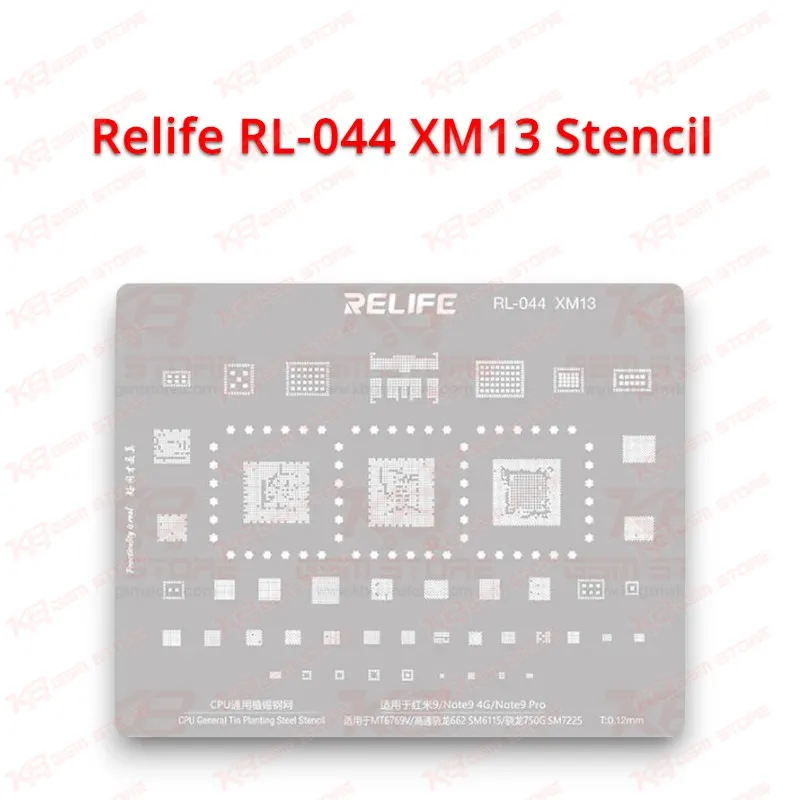
When your workshop pulls in a dead Redmi Note 9 Pro or a Redmi 9 stuck on hang-on-logo after a CPU short, the Relife RL-044 XM13 Stencil is the plate you reach for to put the board back together properly, because it's cut specifically for the MT6769V, Snapdragon 662 SM6115, and Snapdragon 750G SM7225 chipset family that sits on this generation of Redmi boards rather than being a generic universal grid you have to force onto pads that don't quite match. You lay the stencil over the cleaned BGA254 footprint, and the round-square hole pattern lines up directly with the chip's ball layout, so solder paste sits exactly where the reflow needs it instead of bridging across neighboring pads or leaving thin spots that cause a boot loop after reassembly. The 0.12mm stainless steel body is thin enough to keep tin planting flush and even, yet tough enough to survive dozens of heating cycles on your hot air station without the mesh bending out of shape or the holes stretching over time, which matters when you're running this same stencil across a stack of Redmi 9 and Note 9 Pro repairs in a single day. Technicians handling dead-after-flash boards, CPU reballing after a drop or liquid-damage short, or a network/baseband fault traced back to the SM6115 or SM7225 package will find the hole spacing matches the real chip drawing rather than an approximated grid, which is what actually decides whether your reball holds or fails after the phone goes back into daily use. Because the plate is model-specific to this chip generation, you skip the trial-and-error of forcing a mismatched stencil onto the pads, cutting rework time and reducing the chance of a cold joint that sends the same board back to your bench a second time. It fits naturally into a standard IC repair workflow: remove the faulty chip, clean the pad with flux and braid, position the Relife RL-044 XM13 Stencil, apply solder paste, reflow under your hot air gun, then test-boot the board before final reassembly. Pair it with a matching reballing fixture or preheater and a temperature-controlled hot air station for the most consistent results, and keep the stencil stored flat between jobs so the fine mesh doesn't deform. For any repair shop or service center handling Xiaomi and Redmi motherboard work at volume, this stencil earns a permanent spot in the CPU reballing kit sitting right next to your other MI-series and ISP pinout tools, since jobs on this chipset family come through the bench often enough to justify keeping the exact-match plate on hand rather than reaching for a universal one every time.