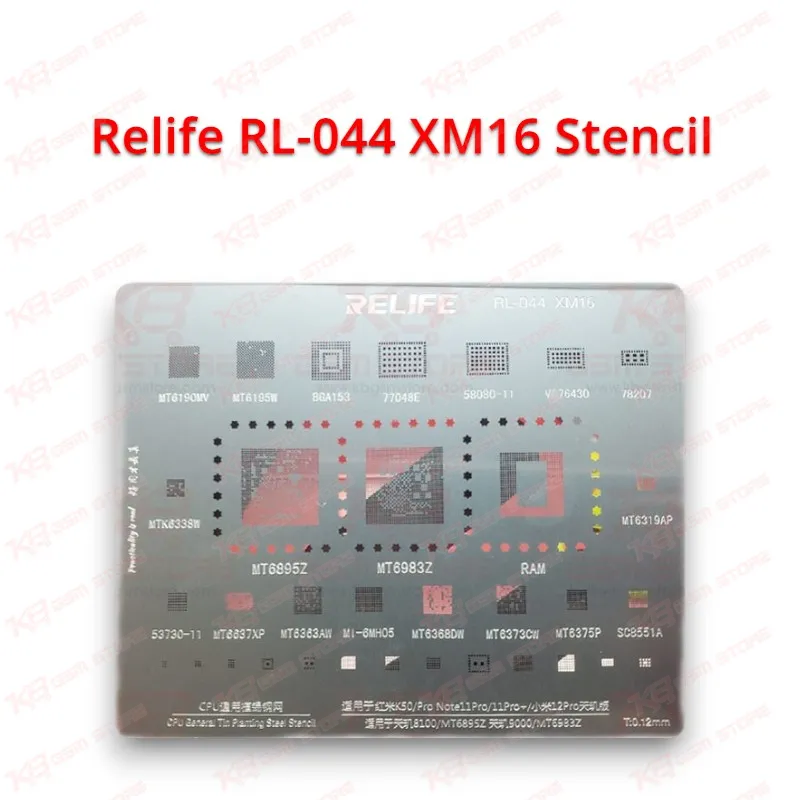
The Relife RL-044 XM16 Stencil is built for technicians who reball CPUs and ICs on mobile motherboards every day and need a template that lines up right the first time instead of forcing manual guesswork under the microscope. You lay the stencil flat over the chip footprint on the board, and the laser-cut holes guide your solder paste into place so every ball comes out round and consistent rather than smeared across neighboring pads. This matters most on dead-after-flash boards and CPU hang-on-logo cases, where a single bridged pad means redoing the whole reballing pass and burning more heat into a board that's already fragile. Because the hole pattern is cut rather than stamped, the edges stay sharp through repeated use, so paste release stays clean instead of dragging or leaving trailing solder. You get a tool that fits directly into your existing reballing workflow: clean the pads, seat the stencil, apply paste, lift, reflow, and inspect under the scope. Pair it with a magnetic fixture or clamp base and the stencil holds still while you work, which cuts the small alignment shifts that cause shorted balls or missed pads on a second attempt. Technicians running high volumes of board-level repair use tools in this RL-044 line because it lets them standardize the reballing step instead of relying on freehand paste application, and that consistency shows up directly in first-pass yield — fewer boards going back on the bench for a redo. It sits in the same repair sequence as your IC removal, pad cleaning, and reflow stations, and it's the piece that turns a rough reballing job into a repeatable one. For a repair shop juggling several boards a day, that repeatability is the actual value: less time per board, fewer wasted ICs, and less rework sent back from customers. If your bench already runs other stencils from the RL-044 family for different chip footprints, the Relife RL-044 XM16 Stencil slots into the same handling routine — same care in storage, same cleaning after use, same pairing with a stable fixture — so your team doesn't need a separate process just for this one tool. Keep it flat, keep it clean between uses, and it holds its precision across a long service life on the bench.