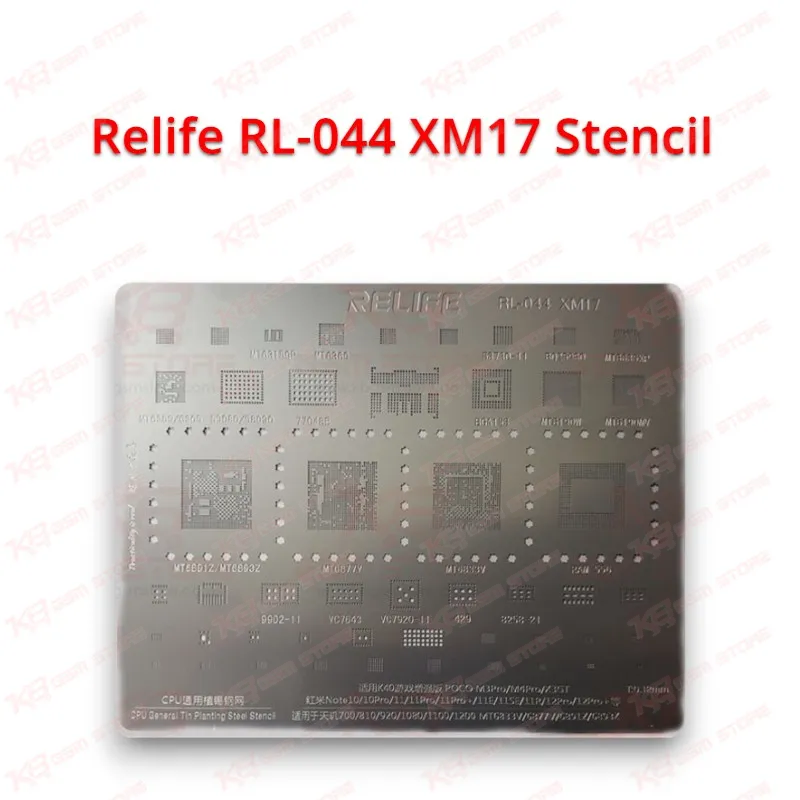
The Relife RL-044 XM17 Stencil is built for technicians who deal with CPU and IC-level repair every single day, where a shaky or misaligned stencil turns a five-minute reballing job into a wasted board, and this stencil solves that problem with laser-precision hole positioning that matches the exact pad layout of the chips it covers, so you place it, apply your paste, and lift it off without smearing solder across neighboring pads or leaving gaps that cause dry joints later. Made from high-quality steel, the stencil resists warping under repeated exposure to hot air stations and preheaters, which matters on a busy repair bench where a single stencil gets used across dozens of boards a week without losing its flat, true shape. The square mesh hole design is what actually separates a good stencil from a cheap one you throw away after ten uses, because it lets solder paste release evenly instead of clogging inside the mesh, giving you uniform ball height across every pad and a cleaner reflow when the board goes back under hot air. For a technician working ISP recovery, CPU reballing, or board-level chip swaps, that consistency directly affects whether the phone powers back on after the repair or comes back to your bench with the same fault. The stencil covers a wide range of iPhone motherboard generations, which means you are not buying a separate tool for every model year that comes through your shop, and it fits naturally into workflows where you move from diagnosis to IC removal to reballing to reinstallation without switching tools mid-job. Pakistani repair shops handling dead phone cases, hang on logo boards, and hardware fault diagnostics use this stencil specifically because CPU-related faults are some of the hardest issues to fix without the right alignment tool, and a stencil that shifts even half a millimeter during paste application can turn a repairable board into a scrapped one. The build quality also holds up against the kind of daily handling a repair counter puts it through, getting picked up, wiped down, and reused constantly without the holes deforming or the edges curling, which is where lower-grade stencils usually fail first. Whether you run a solo repair bench or manage a full-service center, this stencil slots into your existing soldering and rework station setup, working alongside your hot air gun, flux, and low-temperature solder paste as part of a standard reballing sequence rather than requiring any special setup of its own. For technicians who bill by turnaround time, the reduction in failed reballing attempts and rework cycles pays for the stencil within the first few jobs, and for training institutes teaching PCB repair fundamentals, it gives students a reliable reference point for what correct pad alignment actually looks like under a microscope. The Relife RL-044 XM17 Stencil earns its place in a professional toolkit not because of a long spec sheet, but because of what it prevents on the bench: bridged pads, uneven balls, and boards that come back a second time for the same CPU fault.