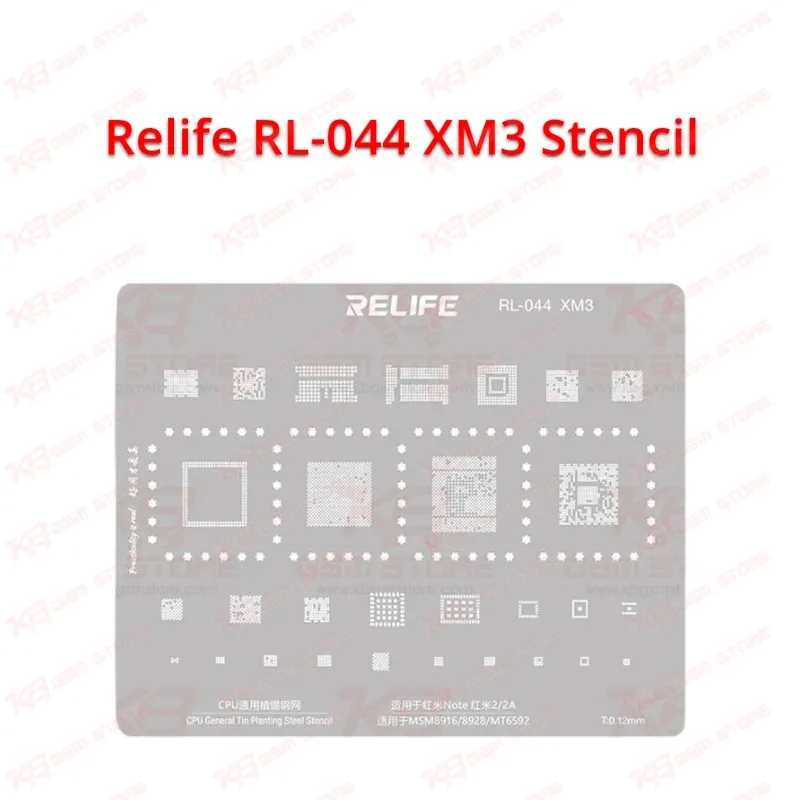
When a Redmi Note, Redmi 2, or Redmi 2A comes into your workshop dead after a drop, a failed flash, or a hardware fault traced back to the CPU, you need a stencil that matches the exact ball layout of the MSM8916, MSM8928, or MT6592 chip — not a generic universal mesh that forces you to eyeball the pad grid. The Relife RL-044 XM3 Stencil is built specifically for this job, and it takes its place inside the wider RL-044 Xiaomi/Redmi stencil series that covers everything from the older MIX2 boards up to newer Snapdragon 8-series motherboards, so you keep one consistent, reliable stencil family across your Xiaomi and Redmi repair queue. You get a 0.12mm stainless steel plate that stays flexible enough to sit flush against the board without warping under heat, which matters when you're running a hot air station over the CPU pad multiple times during a stubborn reballing job. The rounded square hole design isn't just a cosmetic choice — it lets solder paste release cleanly from each cavity so your tin balls form round and uniform instead of flattening or bridging, which directly affects whether the chip boots after reflow. Relife measures each stencil against the real board and the original factory drawing before it ships, so every aperture on the Relife RL-044 XM3 Stencil lines up with the actual ball pattern on MSM8916, MSM8928, and MT6592 packages rather than an approximated grid, and that precision is what separates a clean one-pass reball from a board you end up reworking three times. In your actual workflow, you'll reach for this stencil after you've already diagnosed a CPU-side dead phone issue — no display, no charging response, hang on logo, or intermittent boot loop that survives a software flash attempt — and you've pulled the chip off the board for inspection or reballing. Clean the CPU pads and the board footprint with flux and isopropyl alcohol, seat the Relife RL-044 XM3 Stencil directly over the exposed pads, apply solder paste across the mesh, and use your hot air station at a controlled temperature to melt the paste through each aperture into fresh, evenly sized balls. Lift the stencil away once the paste sets, inspect the ball height under your microscope, and you're ready to reflow the chip back onto the board or move it to a donor board for testing. Because the stencil is reusable, it holds up across dozens of jumper and IC change jobs without losing its shape, which keeps your per-repair tooling cost low compared to buying single-use reballing kits. Stock the Relife RL-044 XM3 Stencil alongside your ISP pinout tools, UFS adapters, and other stencils from the RL-044 range so your bench is ready the moment a Redmi Note, Redmi 2, or Redmi 2A comes in with a CPU-side fault, and pair it with a proper hot air rework station and PCB holder for the cleanest results. For shops running high repair volume on older Xiaomi and Redmi devices, having the exact-fit stencil on hand rather than switching to a universal plate mid-repair saves real time on every board that reaches your bench.