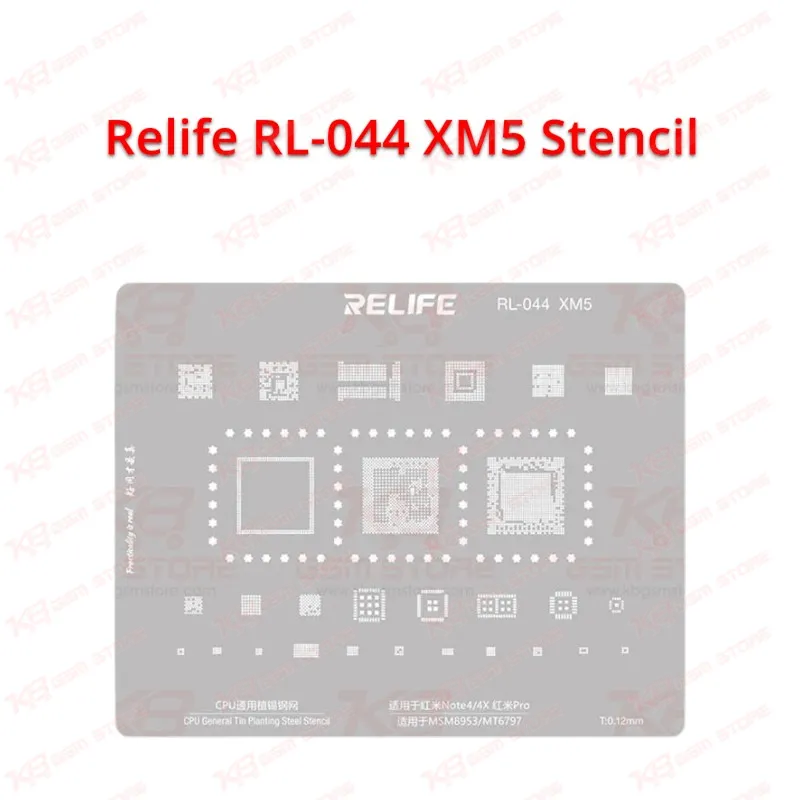
A cracked CPU ball joint on a Xiaomi or Redmi board rarely shows itself cleanly: the phone arrives dead, stuck in a boot loop, or hanging on the logo after a drop, and your multimeter shows healthy power rails while the processor still refuses to respond. Once you trace the fault to the CPU and lift the chip, the next step decides whether the repair lasts, and that step belongs to the Relife RL-044 XM5 Stencil. This single plate comes from Relife's RL-044 Xiaomi series, a numbered range of CPU reballing stencils where each plate carries the ball layout for a specific Xiaomi or Redmi processor footprint. Relife calibrates each plate in the series against the original board drawings and checks it on real devices, so the hole grid lines up with every pad on the chip instead of approximating the pattern. The plate measures 0.12mm thick, the standard depth for mobile CPU tin planting, which lets your solder paste fill each opening evenly and reflow into balls of consistent height across the full array. Level ball height matters more than most technicians admit, because a single short ball in a corner leaves one pad floating, and that floating pad turns into an intermittent boot loop issue two weeks after the customer walks out. Relife cuts the openings in a rounded-square profile instead of a plain circle. The squared corners hold more paste during application, and the rounded edges let the formed balls release cleanly when you lift the stencil, so fewer balls stick inside the holes and you spend less time picking stragglers out with tweezers under the microscope. The plate uses heat-resistant special steel chosen for resistance to metal fatigue, which keeps it flat through repeated hot air cycles; a stencil that bows even slightly after a few jobs throws off alignment on every chip that follows, and a flat plate protects your reballing accuracy over months of daily bench use. In practice, the workflow runs like this: remove the CPU with your hot air station, clean the chip and board pads with flux and wick from your soldering station until the surface sits flat and bright, align the chip under the XM5 plate or lock it in a reballing fixture, spread paste across the openings with a scraper, heat until the paste flows into balls, let it cool, then lift the plate and inspect every row. The chip then goes back onto the board, held steady in a PCB holder, for final reflow, and you verify current draw on your DC power supply before moving to software-side checks with your test box, eMMC programmers, UFS adapters, or ISP pinout tools if the storage side also needs attention. Because the XM5 covers one footprint, the most important step comes before you buy: read the processor marking on the board and match it to the XM5 plate label, since Xiaomi and Redmi models across different generations use different ball layouts and one plate cannot serve them all. Shops that handle a steady flow of Xiaomi CPU work often keep the full XM1-XM15 set on the shelf, but a single Relife RL-044 XM5 Stencil makes sense when you only need to replace a worn or damaged plate from your existing set, or when one specific model keeps landing on your bench. It also costs far less than a complete reballing kit, which suits smaller workshops building their toolkit one job at a time. Pair it with good solder paste, quality flux, and a microscope with enough working distance for clear ball inspection, and you get a reballing result that holds under heat and survives the daily thermal stress a phone goes through in a Pakistani summer. For technicians in Karachi, Lahore, and Islamabad who handle dead phone and hardware fault repairs on Xiaomi boards every week, this plate keeps the CPU stage of the repair precise, repeatable, and fast, so the board goes back to the customer working instead of returning with the same fault.