Skip to product information
1 of 4
Brand: RELIFE

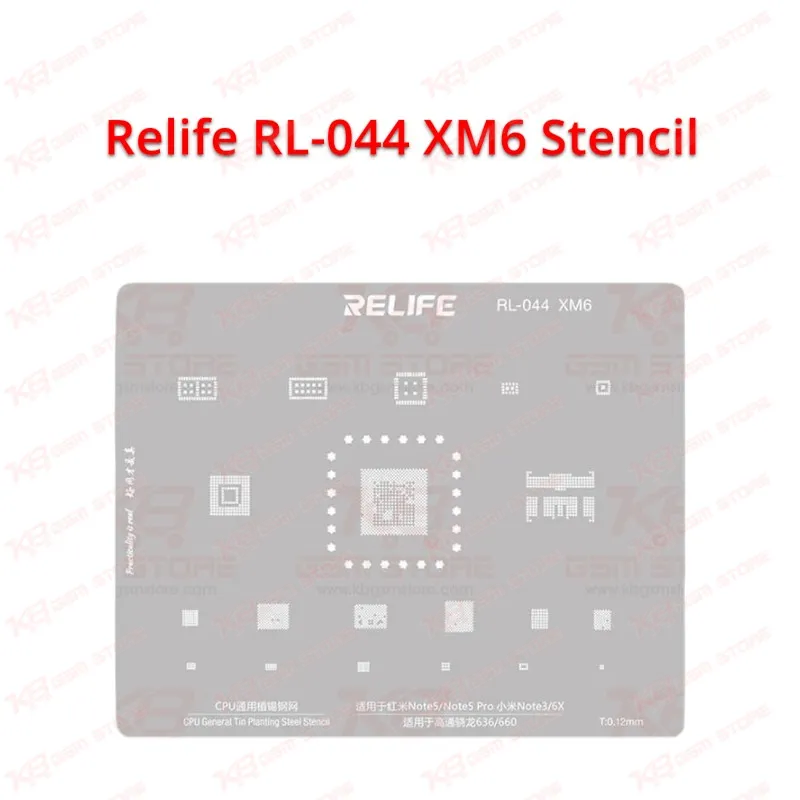
Relife RL-044 XM6 Stencil

Relife RL-044 XM6 Stencil

Regular price Rs.599.00 PKR
Regular price Sale price Rs.599.00 PKR
Sale Sold out
Shipping calculated at checkout.
Quantity

The Relife RL-044 XM6 Stencil is a 0.12mm stainless steel BGA reballing stencil built for the Qualcomm Snapdragon 636 and Snapdragon 660 CPU footprint found in the Xiaomi Redmi Note 5, Redmi Note 5 Pro, Mi Note 3 and Mi 6X. Precise rounded-square apertures give clean paste release and uniform solder balls, while the heat-resistant steel stays flat through repeated hot air cycles. Use it to rebuild CPU joints on dead phones, boot loop issue units and handsets that hang on logo because of a CPU-side hardware fault. A dependable plate for Pakistani repair shops, service centers and board-level technicians who handle Xiaomi CPU reballing on a regular basis.

SKU:MST-SOLDERING-TOOLS-551

⚖️ Weight: 0.01 kg

  • Safe & Secure Payment
  • Fast Delivery
  • WhatsApp Support
View full details

Description

CPU faults on the Redmi Note 5 and Redmi Note 5 Pro rarely announce themselves clearly: the phone lands on your bench as a dead phone, a unit stuck in a boot loop issue, or a handset that hangs on logo after a drop or moisture exposure, and the diagnosis eventually points to cracked or starved solder joints under the Snapdragon processor. The Relife RL-044 XM6 Stencil gives you the exact ball map for Qualcomm Snapdragon 636 and Snapdragon 660 CPUs, so you rebuild those joints through a controlled, repeatable reballing process instead of guessing with a universal plate. Relife numbers each plate in its RL-044 Xiaomi series by chipset footprint, and XM6 targets the Snapdragon 636/660 family used in the Redmi Note 5, Redmi Note 5 Pro, Mi Note 3 and Mi 6X. That chipset-first approach matters because the ball pitch and pad layout of a mobile SoC leave no room for approximation; one misaligned aperture leaves a joint short or bridges two neighbours, and the board goes straight back to a no-boot condition. The stencil uses 0.12mm stainless steel, a thickness that deposits enough solder paste for full, round balls on a fine-pitch BGA without flooding adjacent pads. Rounded-square apertures let the paste release cleanly when you lift the plate, so balls form evenly and do not stick inside the holes, a common frustration with cheaper etched meshes. The steel holds its flatness under repeated heat, so the plate stays usable across many jobs rather than warping after the first few reworks. In a typical workflow, you remove the CPU with your hot air station, clean old solder from the chip and board with a soldering station and desoldering wick, then align the Relife RL-044 XM6 Stencil over the cleaned processor, fill the apertures with solder paste, and apply controlled hot air until the balls form. After you lift the stencil, inspect the ball grid under a microscope before you refit the chip; a missing or undersized ball costs you a minute at this stage, while the same fault after reinstallation costs you another full removal cycle and extra thermal stress on the PCB. A stable PCB holder keeps the board flat during removal and refitting, which protects nearby components and stops the board from bending under heat. Once the CPU sits back in place, a multimeter check on the main supply rails and a current reading on your DC power supply tell you whether the processor now draws a normal boot current. If the phone powers up but still fails at the software level, your next step moves to test boxes, ISP pinout tools, eMMC programmers or UFS adapters for flashing and storage-side faults, because a successful reball restores the hardware connection but does not repair corrupted firmware. For repair shops in Lahore, Karachi, Islamabad and smaller city markets across Pakistan, Redmi Note 5 series handsets still reach repair counters in steady numbers, and CPU reballing remains one of the few board-level jobs that turn a written-off device into a paid repair. A dedicated XM6 plate speeds up alignment compared with a crowded multi-chip universal stencil, cuts rework, and gives consistent results when several technicians share one bench. Pair it with your reballing kits and the rest of the Relife RL-044 Xiaomi series so your workshop covers other Xiaomi and Redmi CPU generations without waiting on stock. Keep this plate strictly for the Snapdragon 636 and 660 footprint; other Xiaomi chipsets need their own RL-044 XM plate, and forcing a mismatched stencil onto a different CPU only produces bridged or missing joints. For technicians who handle hardware fault diagnosis every day, this plate turns a delicate chip-level job into a predictable procedure: clean pads, accurate alignment, even paste, uniform balls, and a CPU that seats flat on the first attempt.

Key Features

  • Chipset-specific ball map for the Qualcomm Snapdragon 636 and Snapdragon 660 CPU footprint
  • 0.12mm stencil thickness deposits the right paste volume for fine-pitch mobile BGA packages
  • Stainless steel construction keeps the plate flat and stable through repeated hot air cycles
  • Rounded-square aperture design releases paste cleanly and prevents balls from sticking in the holes
  • Precise hole alignment reduces bridged or missing joints on the rebuilt ball grid
  • Part of the numbered Relife RL-044 Xiaomi series, so you can build a complete Xiaomi CPU plate set
  • Single-chip plate layout makes alignment faster than crowded universal stencils
  • Reusable across many reballing jobs for workshops that handle Xiaomi board repairs regularly

Specifications

Brand Entity Relife
Product Entity Relife RL-044 XM6 Stencil, BGA reballing stencil
Technology Entity BGA reballing, tin planting, 0.12mm stainless steel stencil, Qualcomm Snapdragon 636 / 660 (SDM636 / SDM660)
Compatible Device Entities Xiaomi Redmi Note 5, Redmi Note 5 Pro, Xiaomi Mi Note 3, Xiaomi Mi 6X
Repair Process Entity CPU reballing, BGA rework, CPU removal and refitting, board-level repair
Industry Entity Mobile phone repair, PCB repair, micro-soldering

Compatible Devices

  • Xiaomi Redmi Note 5
  • Xiaomi Redmi Note 5 Pro
  • Xiaomi Mi Note 3
  • Xiaomi Mi 6X
  • Chipset scope: Qualcomm Snapdragon 636 / Snapdragon 660 CPU footprint

Common Repair Uses

  • CPU reballing after removal from Snapdragon 636 / 660 boards
  • Repairing dead phone and no-power faults caused by cracked CPU solder joints
  • Fixing boot loop issue and hang on logo faults traced to CPU-side hardware
  • Refitting a CPU after drop damage or liquid-damage board cleaning
  • Transferring a CPU from a donor board to a customer board
  • Reworking a CPU after a previous failed or poor-quality reball

FAQ

What is the product name?
The product name is Relife RL-044 XM6 Stencil.
What is the brand of this product?
The brand of this product is Relife.
What is the model of this product?
The model of this product is RL-044 XM6.
What is this product used for?
This product is used for BGA reballing of Qualcomm Snapdragon 636 and Snapdragon 660 CPUs during board-level mobile phone repair.
Which devices are compatible with this product?
This product is compatible with the Xiaomi Redmi Note 5, Redmi Note 5 Pro, Mi Note 3 and Mi 6X, covering the Snapdragon 636 / 660 CPU footprint.
Who should use this product?
This product is suitable for mobile repair technicians, repair shops, service centers, and professional users.
Which CPU chipsets does the Relife RL-044 XM6 Stencil support?
It supports the Qualcomm Snapdragon 636 and Snapdragon 660 CPU footprint. Other Xiaomi chipsets need a different plate from the RL-044 Xiaomi series.
Does the XM6 stencil fit the Redmi Note 5A?
No. The Redmi Note 5A uses a Snapdragon 425 or 435 chip, which has a different ball layout, so it needs a separate RL-044 plate.
Why does a 0.12mm stencil thickness matter for CPU reballing?
A 0.12mm plate deposits enough solder paste to form full, round balls on a fine-pitch mobile CPU without excess paste bridging neighbouring pads.

Ask any Query