


Brand:
RELIFE
Relife RL-044 XM7 Stenci
Relife RL-044 XM7 Stenci
Regular price
Rs.599.00 PKR
Regular price
Sale price
Rs.599.00 PKR
Shipping calculated at checkout.
Quantity
Couldn't load pickup availability
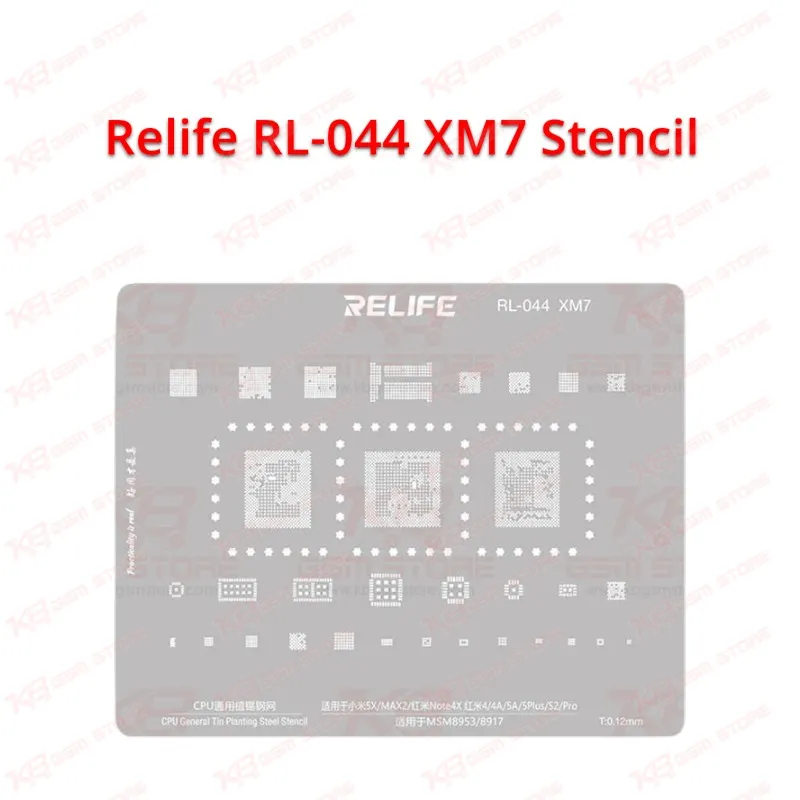
The Relife RL-044 XM7 Stencil is a 0.12mm BGA reballing stencil for Qualcomm MSM8953 (Snapdragon 625) and MSM8917 (Snapdragon 425) CPUs found on popular Xiaomi and Redmi motherboards. Its round-square apertures release solder paste cleanly and form full, even balls, so your CPU sits level on the pads after reflow. Relife measures each pattern against a real board and checks it against factory drawings, which keeps every pad covered. Use it for CPU reballing on the Redmi Note 4X, Redmi 4A, 5A, 5 Plus, S2, Xiaomi 5X, and Mi Max 2 when a dead phone, boot loop, or hang on logo fault traces back to cracked CPU solder joints.
SKU:MST-SOLDERING-TOOLS-552
⚖️ Weight: 0.01 kg
- Safe & Secure Payment
- Fast Delivery
- WhatsApp Support


Description
FAQ
What is the product name?
The product name is Relife RL-044 XM7 Stencil.
What is the brand of this product?
The brand of this product is Relife.
What is the model of this product?
The model of this product is RL-044 XM7.
What is this product used for?
This product is used for reballing Qualcomm MSM8953 and MSM8917 CPU chips during Xiaomi and Redmi motherboard repair.
Which devices are compatible with this product?
This product is compatible with Xiaomi 5X, Mi Max 2, Redmi Note 4X, Redmi 4, Redmi 4A, Redmi 5A, Redmi 5 Plus, and Redmi S2.
Who should use this product?
This product is suitable for mobile repair technicians, repair shops, service centers, and professional users.
Which Qualcomm CPUs does the Relife RL-044 XM7 Stencil support?
It supports the Qualcomm MSM8953 (Snapdragon 625) and MSM8917 (Snapdragon 425) CPU footprints.
What stencil thickness does the RL-044 XM7 use, and why does it matter?
The RL-044 XM7 uses a 0.12mm plate, which deposits a controlled amount of solder paste per pad and helps the reballed CPU sit level during reflow.