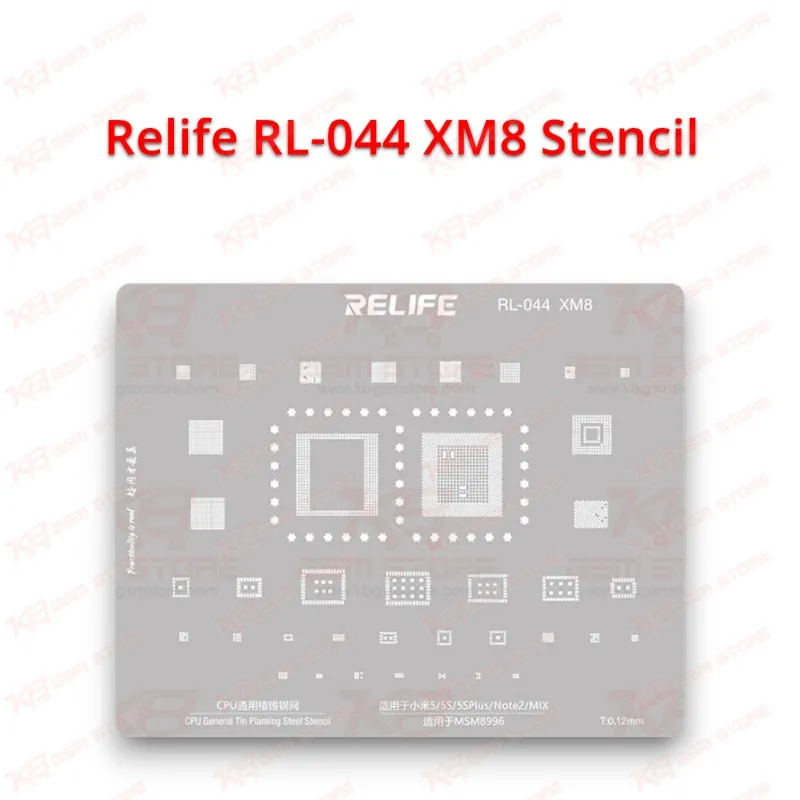
When a board comes in with a chip that has failed after a drop, a bad flash, or corrosion damage, your reballing accuracy decides whether the repair holds or comes back a week later, and this is exactly where the Relife RL-044 XM8 Stencil does its job on your bench. Built from high-quality laser-cut steel, the stencil is engineered to match the XM8 chip footprint precisely, so the solder paste or solder balls sit exactly where the pads need them rather than drifting during reflow. Technicians handling dead-after-flash boards, boot loop issues, or hardware faults traced back to a failing chip know that a stencil with even slightly misaligned holes turns a fifteen-minute reballing job into an hour of rework, and that is the problem the Relife RL-044 XM8 Stencil is built to remove from your workflow. The laser-cut hole geometry helps solder paste release cleanly instead of smearing across the plate, which keeps ball size uniform across the entire grid and lowers the chance of shorts or missing joints once the chip goes back onto the board. Because it is made from stainless steel rather than a soft alloy, the stencil resists warping when you place it directly over a heated board during hot air rework, so you are not fighting a bent template halfway through a session. This matters on a busy repair bench where the same stencil gets used dozens of times a week across different boards, and any loss of flatness shows up immediately as inconsistent ball height. In a typical workflow, the stencil sits between your board preheater and your hot air or infrared rework station: after removing the faulty chip and cleaning the pads on the board or on a donor chip, you position the Relife RL-044 XM8 Stencil directly over the exposed pad layout, apply solder paste or place solder balls through the holes, then reflow under controlled heat before lifting the stencil away. Getting this step right is often the difference between a chip that boots clean on the first try and one that comes back with a charging issue or hang-on-logo fault after a few days of use. The stencil is a passive tool with no electronics inside it, so there is nothing to configure or calibrate beyond making sure it is seated flush against the board or jig before you begin heating. Repair shops that run high volumes of chip-level work usually keep several stencils on hand for different chip footprints, and the Relife RL-044 XM8 Stencil covers the XM8 pattern specifically, so it pairs naturally with other reballing templates you already use for different chipsets rather than replacing them. Pairing it with a dedicated BGA reballing station or magnetic platform gives you tighter control over stencil alignment, though experienced technicians can also use it directly on a preheater with careful positioning. For a service center or training institute building out a proper board-repair station, this stencil fits alongside ISP pinout tools, eMMC programmers, hot air stations, and microscopes as one more precision instrument in a complete PCB repair setup, and its narrow, specific purpose is exactly why it earns a spot in a technician's kit rather than being treated as a generic accessory.