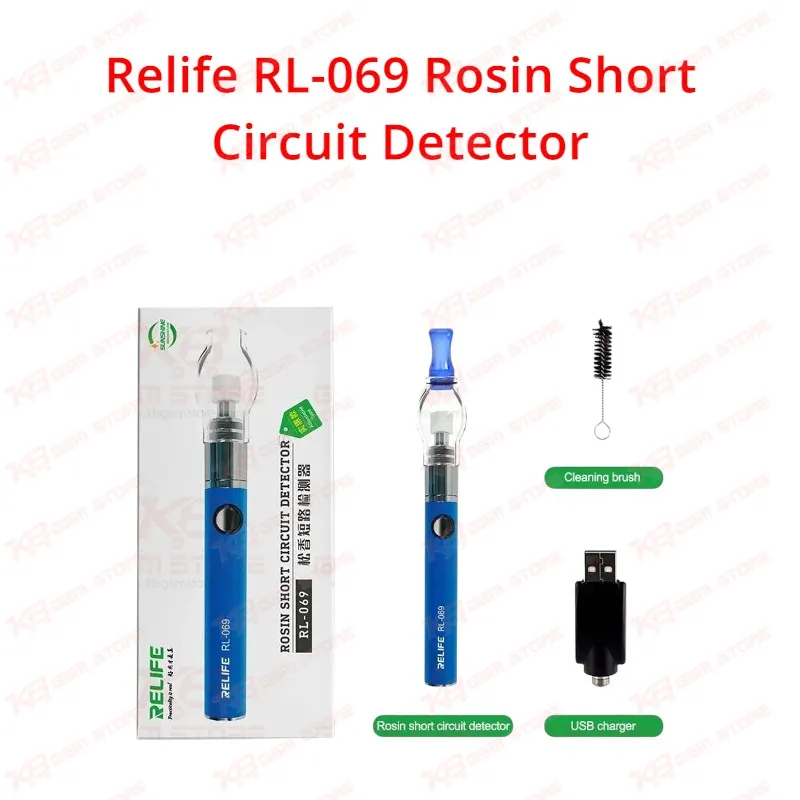
When a board comes in dead after flash, hanging on logo, or drawing current it shouldn't on a rail, the first job on your bench is finding exactly where the short sits before you touch a single component, and this is where the Relife RL-069 Rosin Short Circuit Detector earns its place next to your soldering station. Instead of repeatedly heating rosin on an iron tip and watching for smoke by eye, you load a small amount of rosin into the base of the RL-069, press the button, and the built-in atomizer turns it into a dense, uniform vapor in around two seconds. You aim the glass cover outlet at the suspected short point on the PCB, hold it steady, and read where the smoke thins out fastest, that's your short. Pakistani technicians dealing with dead phone cases, hardware fault boards, or a charging issue that traces back to a shorted rail will recognize this as a faster, cleaner replacement for the old rosin-on-a-soldering-iron trick that wastes flux and takes several attempts to get a clear read. The RL-069 runs on a rechargeable battery charged over USB, so you're not tied to a cable or fumbling with disposable cells mid-repair, and the power button uses a simple five-press sequence to switch the unit on and off, which keeps accidental triggering low when it's sitting on a crowded bench. Build quality centers on a thickened glass cover over the atomization chamber, chosen specifically so the wall resists cracking under repeated heat cycles while still giving you a clear, unobstructed view of the smoke pattern as it forms, and the enlarged atomization contact area means less rosin gets wasted per detection cycle compared to older pen-style tools. At roughly 85g and sized to fit in one hand, the RL-069 moves easily around tightly packed components, adjacent copper tracks, and cluster-packed chipsets where a bulkier tool or a soldering iron simply can't get positioned without risking damage to nearby parts, and because the detection method itself doesn't apply heat directly to the board's traces or pads, it won't damage the motherboard during the search, which matters when you're troubleshooting a board that's already fragile from a prior repair attempt. This makes the RL-069 a natural fit earlier in your diagnostic process, before you commit to IC change karna or jumper lagana on a suspect component, because you want to confirm the exact short location first rather than guessing and reworking the wrong spot. It sits well alongside your existing PCB repair workflow, pairing naturally with a hot air station for the rework that follows once the short is located, a multimeter for continuity checks that confirm what the smoke pattern shows, a microscope for close inspection of the pad or track once you've narrowed the fault down, and a PCB holder to keep the board steady while you work the atomizer around it. For repair shops handling a steady flow of no-power and dead-after-flash boards, having a dedicated short-circuit detector on the bench cuts down the guesswork that otherwise eats into turnaround time, and it reduces the number of boards that get reworked in the wrong spot because the technician couldn't pin down the fault fast enough with a soldering iron alone. The tool suits mobile repair technicians, laptop and computer motherboard repair engineers, GSM service centers, and training institutes teaching board-level diagnostics, since the operation itself, load rosin, press to atomize, watch the smoke, is simple enough to demonstrate and repeat consistently across skill levels. Whether you're chasing a hardware fault on a phone board or a short that's causing a laptop to draw excess current at the power rail, the Relife RL-069 Rosin Short Circuit Detector gives you a quicker, cleaner path to the fault point than repeated soldering iron passes, and it keeps your rosin consumption down while you're at it.