Skip to product information
1 of 4

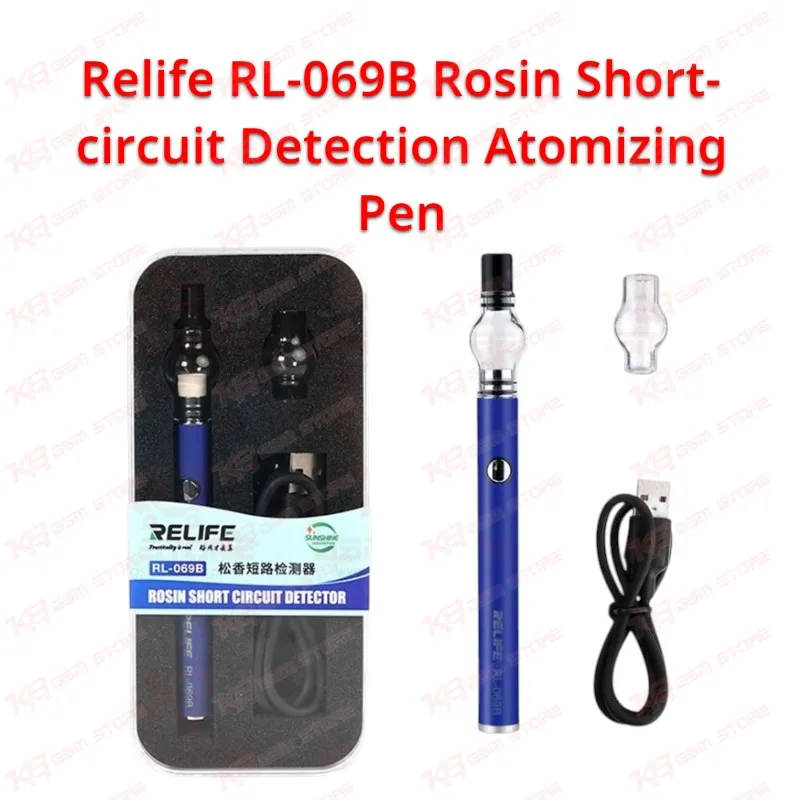
Relife RL-069B Rosin Short-circuit Detection Atomizing Pen

Relife RL-069B Rosin Short-circuit Detection Atomizing Pen

Regular price Rs.800.00 PKR
Regular price Sale price Rs.800.00 PKR
Sale Sold out
Shipping calculated at checkout.
Quantity

The Relife RL-069B Rosin Short-Circuit Detector Pen helps you trace short-circuit fault points on mobile phone and PC motherboards without repeatedly heating a soldering iron. It runs on external 5V USB-C power in a plug-and-play design, so you skip battery charging delays and get consistent atomization every time you power it on. The ceramic atomizing core produces dense, uniform rosin smoke within seconds, and the thickened glass cover lets you watch smoke flow directly over suspect components to pinpoint the exact short. It's a practical addition to any repair bench dealing with dead phone and hardware fault diagnostics.

SKU:MST-SOLDERING-ACCESSORIES-430

⚖️ Weight: 0.2 kg

  • Safe & Secure Payment
  • Fast Delivery
  • WhatsApp Support
View full details

Description

Locating a hidden short on a phone motherboard usually means heating a soldering iron, dabbing rosin near a suspect component, and watching where the smoke curls fastest — a slow process that wastes rosin and risks overheating nearby ICs. The Relife RL-069B Rosin Short-Circuit Detector Pen replaces that workflow with a dedicated atomizing tool built specifically for board-level fault tracing. You load a small piece of rosin into the pen's tip, connect it to a 5V power source through the included USB-C cable, and within seconds the ceramic atomizing core turns the rosin into a dense, visible vapor. Because the pen runs on external power rather than an internal battery, it stays at consistent output every session — no partial charge, no fading performance as a battery ages, and no waiting around for it to top up before a repair job. You simply plug it in, load rosin, and start tracing. The thickened glass cover sits over the atomizing chamber and channels smoke through a narrow outlet, so you aim that outlet directly over the board area you suspect is shorted — around a PMIC, a coupling capacitor, or a suspicious resistor — and hold for roughly ten seconds per pass. The vapor draws toward the hottest point on the board, and that pull shows you exactly where current is leaking, saving you from probing blindly with a multimeter across dozens of components. The copper-nickel plated heating element inside heats quickly and holds up under repeated daily use, which matters on a busy repair bench handling multiple dead phone and boot loop cases in a single shift. Technicians dealing with a phone that's dead after flash, showing a charging issue, or hanging on logo after a drop often trace the fault back to a shorted line on the board, and this pen turns that guesswork into a visible, repeatable test. Because there's no built-in battery to manage, the RL-069B avoids one of the more common failure points on rosin atomizer pens — a battery that no longer holds charge after months of daily heating cycles. You keep it connected to a USB power bank, a PC port, or a wall adapter while working, and it performs the same way on day one as it does after a year of bench use. The glass cover is built to resist cracking from routine handling, keeping the smoke path clear and the atomization visible pass after pass, so you're not replacing the cover every few weeks. This tool fits naturally into a board-level repair workflow alongside your multimeter, hot air station, and microscope: you use the multimeter to confirm a short exists, the RL-069B to localize which component is causing it, and your hot air station or soldering iron to remove and replace the faulty part once identified. It's equally useful across phone motherboard repair, laptop board diagnostics, and general PCB rework where a component-level short needs isolating fast. For a repair shop processing several boards a day, cutting even a few minutes off short-circuit tracing per job adds up, and doing it without burning through a soldering iron tip or wasting rosin on manual application keeps consumable costs down too. The RL-069B ships with a USB-C data cable in the box, so it's ready to connect and use as soon as it arrives at your bench.

Key Features

  • Fast atomization with no long preheating wait before use
  • Ceramic atomizing core for dense, uniform rosin vapor
  • Runs on external 5V USB-C power — no built-in battery to degrade over time
  • Plug-and-play operation, ready to use as soon as it's connected
  • Thickened glass cover for clear, visible smoke tracing
  • Copper-nickel plated heating element for fast, consistent heating
  • Reduces rosin waste compared to manual soldering iron application
  • Includes USB-C data cable in the package

Specifications

Brand Entity Relife
Product Entity RL-069B Rosin Atomization Short-Circuit Detector Pen
Technology Entity Ceramic atomizing core, rosin vapor short detection
Compatible Device Entities Mobile phone motherboards, PC/laptop motherboards, general PCBs
Repair Process Entity Short-circuit fault tracing, board-level diagnostics
Industry Entity Mobile phone repair, PCB rework and diagnostics

Compatible Devices


Universal — not device-specific. Works across mobile phone motherboards, PC and laptop motherboards, and general PCBs wherever a component-level short circuit needs to be located.

Common Repair Uses


Short-circuit fault tracing on mobile phone and PC motherboards, dead phone diagnostics, dead-after-flash fault isolation, PMIC and capacitor short localization, and general board-level diagnostic work ahead of component removal and replacement.

FAQ

What is the product name?
The product name is Relife RL-069B Rosin Short-Circuit Detector Pen.
What is the brand of this product?
The brand of this product is Relife.
What is the model of this product?
The model is RL-069B.
What is this product used for?
It's used to trace and locate short-circuit fault points on mobile phone and PC motherboards using visible rosin vapor.
Which devices are compatible with this product?
It works on any mobile phone or computer motherboard where a short-circuit needs to be traced — it isn't limited to specific device models.
Who should use this product?
This product is suitable for mobile repair technicians, repair shops, service centers, and professional PCB repair users.
Does the RL-069B have a built-in battery?
No, the RL-069B runs on external 5V USB-C power and must stay plugged in during use, unlike the RL-069A which has a built-in rechargeable battery.
How long does each atomization pass take when tracing a short?
Each heating pass typically takes around ten seconds, aimed directly at the suspect board area to show where the vapor is drawn toward the short.