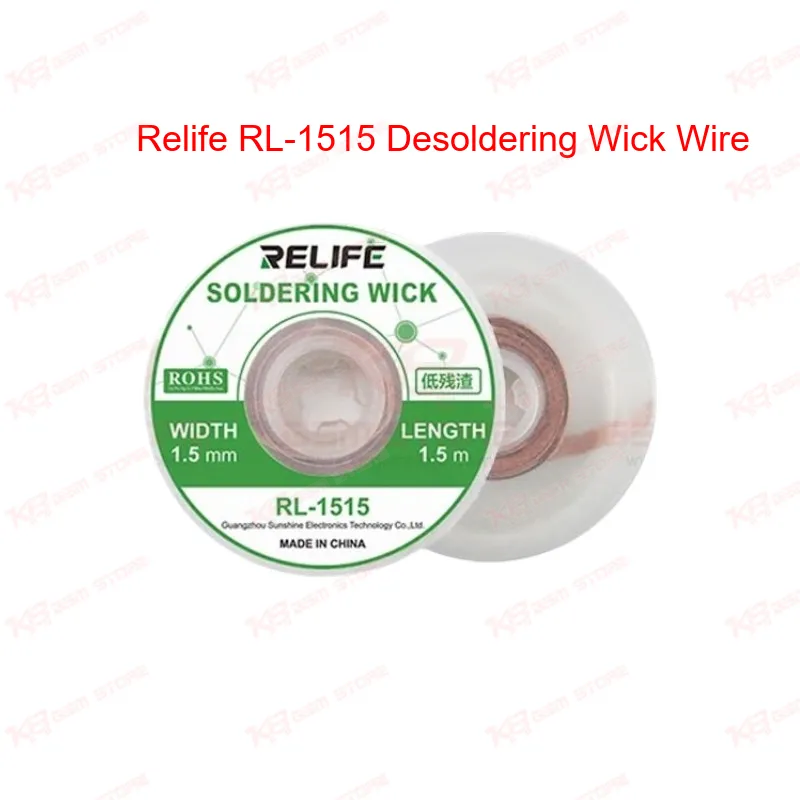
Excess solder on a phone motherboard is one of the most common reasons a repair goes wrong. Leftover tin on pads can cause bridging, short circuits, or a bad connection after reflow, and cleaning it up properly is often the difference between a board that boots and one that stays dead. The RELIFE RL-1515 Desoldering Wick Wire exists for exactly this job. It is a 1.5mm wide, 1.5-meter long solder braid designed to lift molten solder off pins, pads, and connectors quickly and cleanly, giving technicians a controlled way to prepare a board for the next step in the repair process. The wick is made from pure oxygen-free copper wire, which matters more than it sounds. Oxygen-free copper resists oxidation better than standard copper, so the braid stays effective and doesn't degrade in storage the way lower-grade wicks can. The strands are woven tightly enough to create strong capillary action, which pulls molten solder up into the braid the moment heat is applied, rather than just pushing it around the board. This means less time spent reheating the same joint and less thermal stress on nearby components, which is critical when working near sensitive ICs, PMICs, or camera modules that don't tolerate repeated heat cycles well. A key feature of this wick is its no-clean flux coating. Many older or lower-quality solder wicks leave a sticky, corrosive flux residue behind that has to be scrubbed off with isopropyl alcohol before the board can be reflowed or tested. The RL-1515's low-residue design cuts that step out of the workflow. After use, the pad is left clean enough to move directly into IC placement, reballing, or continuity testing, saving time on high-volume repair days. The 1.5mm width is a deliberate choice, not just a default size. It's narrow enough to work precisely around single pins, small SMD components, and BGA pads without accidentally soaking up solder from neighboring points, but wide enough to remove tin efficiently from IC pads and connector legs. This makes it a good middle ground for technicians who don't want to carry multiple wick widths for every job. For dead phone diagnosis where a suspect PMIC or CPU IC needs to come off for testing, or for board cleaning before a full reball, this width handles the majority of real repair scenarios on a typical bench. Beyond IC removal, this wick is a staple for general PCB repair work. It's used to clean thermal bonding pads before installing a new IC, to remove old or damaged solder from a charging port or connector before replacement, and to tidy up joints after a failed repair attempt from another technician. Because it doesn't require aggressive scrubbing afterward, it also speeds up jumper wire work, where a clean, flat pad makes a much more reliable connection than one covered in leftover flux and solder blobs. For a repair shop running through dozens of boards a week, a wick like the RL-1515 is a low-cost, high-frequency consumable that directly affects repair quality. A clean pad reduces the chance of a comeback repair from a short circuit or a bad reflow, which matters as much for shop reputation as it does for the individual job. Paired with a decent soldering iron or hot air station, it forms part of the basic toolkit every board-level technician keeps within reach.