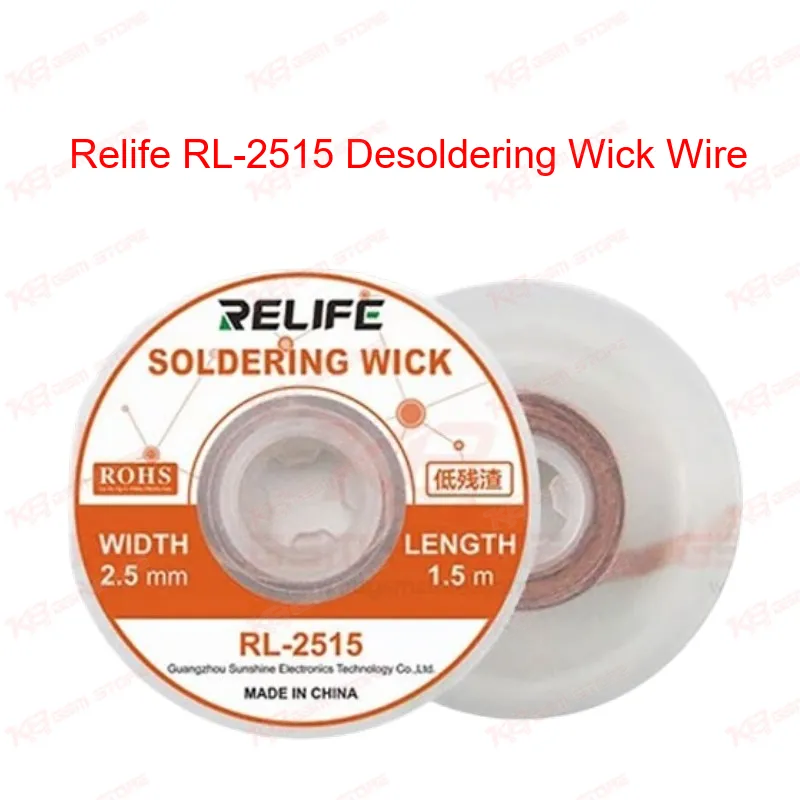
Every mobile repair bench in Pakistan needs a reliable solder wick, and the Relife RL-2515 is built exactly for that job. When you're doing an IC change karna job or cleaning a board after removing a damaged chip, leftover solder on the pads causes short circuits, cold joints, and boot loop issues later. This wick soaks up that extra solder in seconds, leaving clean, flat pads ready for the next component. The RL-2515 uses finely braided oxygen-free copper wire, coated with rosin flux. This flux coating activates under your soldering iron's heat and pulls molten solder straight into the braid through capillary action. You place the wick over the joint, press your iron tip on top, and watch the solder disappear into the copper strands. No scraping, no digging with a blade, no risk of lifting a pad off the board. At 2.5mm width and 1.5 meters in length, this wick sits in the sweet spot for most mobile repair tasks. It's wide enough to clear solder bridges on IC pads and connector pins, yet narrow enough to work in tight spaces around small SMD components. Whether you're clearing solder off a charging port, cleaning a network IC footprint, or prepping a CPU pad before reballing, this width handles it without wasting material. Low residue is the real selling point here. Cheaper wicks leave a sticky flux film that you then have to scrub off with isopropyl alcohol or flux remover before continuing your repair. The RL-2515's formula leaves minimal residue, so your board stays cleaner through the whole repair process. This matters most when you're working on a dead phone with a hang on logo issue, where every extra minute of cleanup adds up during diagnosis. In the PCB repair workflow, this wick fits right between disassembly and rework. After you spot a burnt IC or a shorted component under your microscope, you use hot air to lift it off, then reach for the RL-2515 to clear the remaining solder from the pads. Only after the pad is clean can you accurately test continuity with a multimeter or place a new IC without misalignment. Skipping this step is one of the most common reasons technicians end up with a dead after flash board that never boots properly. The wick also plays a role in eMMC and UFS chip replacement. Before reballing a new eMMC IC onto a board, the old pad must be completely solder-free and flat. Any leftover bump under the new chip causes bad connections, which shows up later as random hangs or storage errors. Pulling this wick across the pad a few times before reballing solves that problem at the source Because it's compatible with any standard soldering iron tip and works alongside hot air rework stations, this wick doesn't lock you into one brand of equipment. You can pair it with your existing soldering station, hot air gun, or reballing kit without any adjustment. It's one of those accessories every repair shop keeps in bulk, because it gets used on nearly every board that comes in for hardware fault repair, whether the job is a simple charging issue or a full CPU reball. For technicians running a busy service center, having a stock of RL-2515 wicks on hand keeps your workflow moving. You're not stopping mid-repair because you ran out of usable braid, and you're not settling for a lower-quality wick that leaves your boards dirty. This is a practical, no-frills tool that does one job extremely well: pulling solder off a board cleanly, every single time.