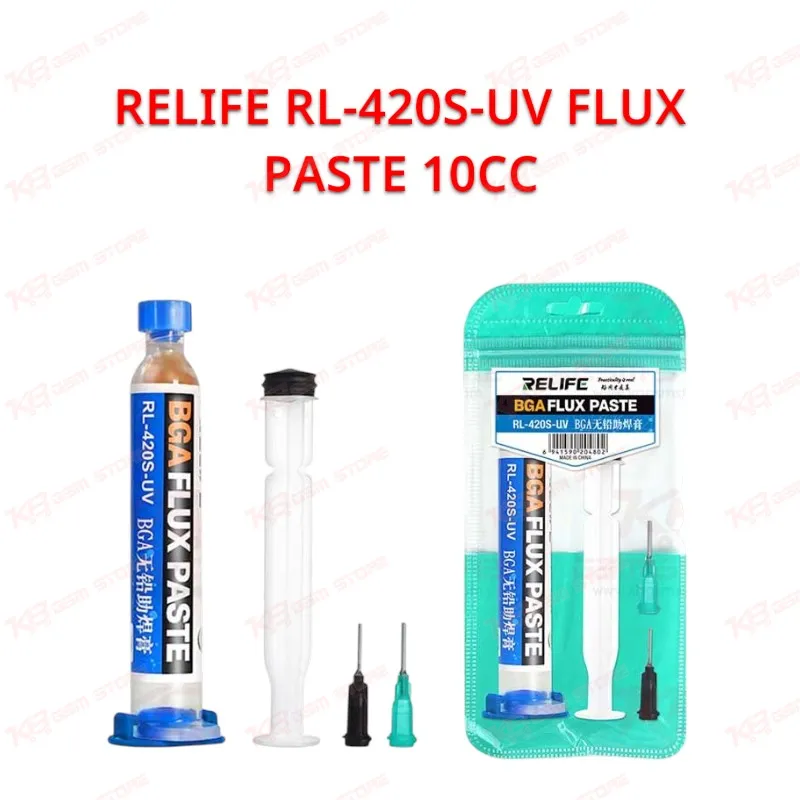
RELIFE RL-420S-UV flux paste solves one of the most common headaches on a mobile repair bench: unreliable tin flow during BGA and CPU rework that leads to cold joints, bridging, and repeat visits. This 10cc syringe paste uses active flux ingredients that improve tin fluidity the moment you touch the iron or hot air nozzle to the pad, so solder balls seat evenly across the IC footprint instead of pooling unevenly at the edges. You get a yellow, medium-viscosity paste that clings to the pad during positioning but flows freely once heat is applied, which matters a lot when you are reballing a CPU IC or reworking a tightly packed PMIC on a modern mainboard. The lead-free and halogen-free composition keeps the formula safer to work with over long shifts, since you are not breathing in the harsher fumes that older rosin-based fluxes produce, and the low smoke emission during reflow means you can work faster under a microscope without constant fume interruption. RELIFE built the paste around a no-clean chemistry, so once the joint cools you are not obligated to scrub the board with isopropyl alcohol before moving to the next repair; the residue left behind is minimal and does not compromise the board's insulation resistance, which protects against short circuits on densely populated PCBs. The syringe format itself is a practical upgrade over tub-style flux. You get a needle tip and a push rod that lets you dispense a controlled amount directly onto a BGA chip, a PGA socket, or a CPU pad without dipping a brush and risking cross-contamination between jobs. Because the sealing plug reuses cleanly after each session, the paste inside stays fresh instead of drying out at the tip, which is a common complaint with cheaper flux pens that clog after a few uses. On a typical repair bench, this flux earns its place across several workflows. When a phone comes in dead after flash or stuck on hang on logo, and diagnosis points to a CPU or PMIC fault, you apply RL-420S-UV before reflowing or removing the IC so the solder balls release cleanly from the pad without lifting copper. During reballing work, whether you are reblowing a Qualcomm baseband IC or a MediaTek power IC, the flux keeps the new solder balls wetting evenly to the substrate, which reduces the chance of a dry joint that causes an intermittent charging issue or network issue after reassembly. For general board-level repair, jumper lagana on a damaged trace, resoldering a loose connector, or reworking a display IC after a display problem diagnosis, a small dab of this paste improves tin adhesion and cuts down on bridging between fine-pitch pins. Repair shops handling high daily volume benefit from the syringe's precision because it avoids the paste wastage that comes with tub-dip application, and the 10cc capacity is sized to last through weeks of steady bench use without needing frequent restocking. The paste also performs reliably across mixed brand workshops, since flux chemistry is not device-specific; whether the board on your bench comes from an iPhone, a Samsung, an Oppo, or a Vivo unit, the same fluidity and low-residue properties apply, provided the pad size and soldering temperature are appropriate for the IC in question. For training institutes and technical labs teaching board-level repair, this flux is a practical teaching tool because trainees see a visible difference in solder flow and joint quality compared to using no flux at all, which builds a clearer understanding of proper reflow technique from the first lesson.